

A 13-week cash flow is a rolling, weekly, direct-method forecast that tracks actual cash receipts and disbursements over approximately three months. It exists to answer one question: will you have enough cash on hand each week, and if not, when does the shortfall hit? Done right, it pinpoints your minimum-cash week and your real runway. The rest of this guide covers how to build it, run it weekly, and automate the parts that eat the most time.
TL;DR:
- A 13-week cash flow forecast uses actual cash receipts and disbursements to project weekly liquidity over three months, not accruals.
- Building the model requires defining scope, anchoring to actual bank balances, and focusing on 8 to 12 key cash flow lines for accuracy and ease of maintenance.
- Weekly routine updates involve replacing forecasts with actuals, reviewing variances, and adjusting for near-term cash requirements or shortfalls.
- Automation should target core manual tasks like bank feeds, accounts payable, and payroll to reduce errors and weekly update time.
- Proper ownership of data inputs and a disciplined weekly review process ensure the forecast remains accurate and useful for timely decision-making.
Table of Contents
- What Is a 13-Week Cash Flow Forecast?
- Why the 13-Week Cash Flow Matters for CFOs
- How Do You Build a 13-Week Cash Flow Model?
- Modeling AR, AP, Payroll, and Debt Service Correctly
- What's the Right Weekly Cadence for Cash Flow Review?
- Where Should You Automate the 13-Week Cash Flow Process?
- Who's Behind This Guide
- An Advisor's View on Making the Weekly Habit Stick
- Get Hands-On Help Building Your 13-Week Model
- Sources
What Is a 13-Week Cash Flow Forecast?
A 13-week cash flow forecast (often shortened to TWCF) projects cash in and cash out on a weekly basis for the next quarter, using the direct method. That means you forecast the actual timing of receipts and payments, not accrual-based revenue and expense recognition. You're not asking "what did we earn this week?" You're asking "what hit the bank, and what left it?"
The direct-method structure is what makes the model useful in a crisis: it shows real dollars moving, not adjusted earnings. A rolling 13-week forecast, built as a quarter-long window, works differently from a static budget:
- Every week, you drop the completed week and add a new Week 13, so the horizon never shrinks.
- You replace forecasted numbers with actuals as each week closes, which forces continuous accuracy checks.
- Thirteen weeks strikes a balance most finance teams find workable: long enough to plan financing or vendor negotiations, short enough that the numbers stay grounded in real, known transactions rather than guesswork.
A 12-month forecast tells you the strategic direction. A 13-week forecast tells you whether you'll make payroll in week 6.
Why the 13-Week Cash Flow Matters for CFOs
The model earns its place on a CFO's desk because it drives specific, time-sensitive decisions. Distressed companies use it to negotiate with lenders and vendors before cash runs out. Private equity sponsors require it as standard reporting for portfolio companies. Lenders build covenant monitoring around it. And plenty of healthy, non-distressed businesses run it simply because weekly visibility beats monthly hindsight.
The practical benefits show up fast:
- Shortfalls surface weeks earlier than they would in a monthly cash report.
- Lender and investor conversations get easier when you can show, week by week, exactly when a gap opens and how a draw would close it.
- Discretionary payment decisions (which vendor gets paid this week, which can wait) become disciplined instead of reactive.
Statistic Callout: In restructuring and DIP financing situations, a credible TWCF that reconciles to actual bank balances can materially affect financing outcomes. Lenders read the model as a proxy for how well management understands its own liquidity position.
The 13-week model isn't the only horizon you need. Daily cash tracking takes over when a crisis is acute enough that a week is too slow to react. A 12-month rolling forecast handles capital planning and strategic decisions the 13-week window is too short to capture. Use all three together rather than forcing one model to do every job.
How Do You Build a 13-Week Cash Flow Model?
Building a usable model is less about spreadsheet mechanics and more about discipline: who owns each number, where it comes from, and how often it gets checked against reality.
-
Define scope first. Decide which entities and bank accounts are in scope, pick a consistent week-ending day (Friday is common), and assign an owner and a submission deadline for every input. Ambiguity here is where most forecasts break down before they even start.
-
Anchor Week 0 to a reconciled bank balance. Never start from a projected number. Pull the actual, reconciled balance from your bank feed, and commit to one single source of truth per line item, whether that's the AR subledger, the payroll system, or the AP ledger.
-
Build the receipts side. Start with AR aging and real customer payment behavior, not invoice terms on paper. Map material customers at the invoice level so you know exactly which dollars land in which week. Smaller or less predictable customers can be modeled off historical collection patterns instead of tracked individually.
-
Build the payments side. Payroll calendars are fixed and predictable, so lock those in first. Layer in AP obligations from the ledger, any committed payments (leases, insurance, recurring vendor contracts), tax due dates, and scheduled debt service.
-
Add financing rows separately. If you have a revolver or asset-based lending facility, show borrowing base availability and draw activity as its own line, distinct from operating cash flow. This is what lets you show both an unfunded position and a post-financing position side by side, which matters enormously in lender conversations.
-
Keep it to 8 to 12 meaningful rows. Practitioner guidance is consistent on this point: more granularity doesn't mean more accuracy, it means more maintenance and more places for errors to hide. Flag one-off items separately so they don't distort your recurring-line trends.
-
Run the weekly routine. Every week, replace the completed week's forecast with actuals, run a variance review, re-forecast the remaining weeks, and add a new Week 13 to the end of the model. This is what makes it "rolling" rather than a one-time exercise.
Pro Tip: Build a change log alongside the model itself. Every time you adjust a collection assumption or push out a payment date, write down why. Six weeks later, when a number looks off, that log tells you whether you're looking at a real trend or a one-time assumption change you already forgot about.
Modeling AR, AP, Payroll, and Debt Service Correctly
Each roll-forward has its own logic, and treating them all the same way is a common source of bad forecasts.
Accounts receivable should be driven by actual customer payment behavior, not contractual terms. Map your largest customers at the invoice level so specific dollars land in specific weeks. For the long tail of smaller accounts, shift to segment-average conversion rates in the outer weeks rather than tracking every invoice, since precision that far out is mostly noise anyway.
Inventory and accounts payable work best when you convert open purchase orders into expected invoice dates using your own historical PO-to-invoice lag, then apply a realistic days-payable-outstanding assumption to time the cash outflow.
Payroll is the easiest row to get right and the worst one to get wrong. Schedules and amounts are fixed, so treat confirmed hires or terminations as immediate updates rather than waiting for the next cycle.
Debt service and revolving facilities need explicit borrowing base and availability modeling, not a lump estimate. A model that separates committed, invoiced receipts from pipeline revenue avoids the classic mistake of treating a hopeful sales forecast the same as cash that's already contractually due.
- AR: invoice-level for large accounts, segment averages for the rest.
- AP: PO-to-invoice lag plus a DPO assumption.
- Payroll: fixed, updated immediately on headcount changes.
- Debt: availability and draws shown as their own line.
What's the Right Weekly Cadence for Cash Flow Review?
The forecast only pays off if the weekly meeting produces decisions, not just a report nobody acts on.
-
Set a fixed weekly timeline. Someone pulls reconciled bank actuals early in the week. AR and AP owners submit their inputs by an agreed deadline. The updated model goes out before the review meeting, not during it.
-
Classify every variance by type. Timing variances mean the cash arrived or left in a different week than expected. Amount variances mean the dollar figure itself was wrong. Assumption variances mean the underlying logic (a collection rate, a payment term) needs to change. Each type gets a different fix, so don't lump them together.
-
Measure accuracy by week band, not as one number. Weeks 1 and 2 should be nearly exact since they rely on known items. Weeks 3 through 6 should be actionable. Weeks 7 through 13 are directional at best. Track your own trend in each band rather than chasing an industry benchmark that doesn't reflect your business.
-
Set clear decision triggers. A projected minimum-cash week below your threshold should automatically trigger a financing conversation or a deferral of discretionary spend, not a wait-and-see approach.
Pro Tip: Timebox the variance review to the five largest misses each week. If you try to explain every $200 swing, the meeting turns into an audit instead of a decision forum, and the team stops showing up prepared.
A common failure mode worth naming directly: carrying forward last week's projected balance instead of the actual reconciled balance. That one habit, more than any modeling error, is what causes a forecast to quietly drift away from reality over a few months.
Where Should You Automate the 13-Week Cash Flow Process?
Automation should target the parts of the process that eat the most hours and introduce the most manual error, not every line item at once.
- Connect AR, payroll, and bank feeds each to a single source system instead of re-typing numbers into a spreadsheet.
- Prioritize AP automation and bank balance refresh first. These two areas produce the largest weekly time savings because AP data entry and reconciliation are typically the slowest manual steps.
- Keep scenario copies of the model and maintain a change log so a "what if we lose this customer" version never accidentally overwrites the base case.
- Watch for graduation signals: multiple entities in scope, the same manual assembly work every week, or one person who's the only one who knows how the spreadsheet actually works.
That last point is the real risk in most finance teams. A model that only one analyst can rebuild is a liquidity risk on top of the cash risk it's supposed to track.
Who's Behind This Guide
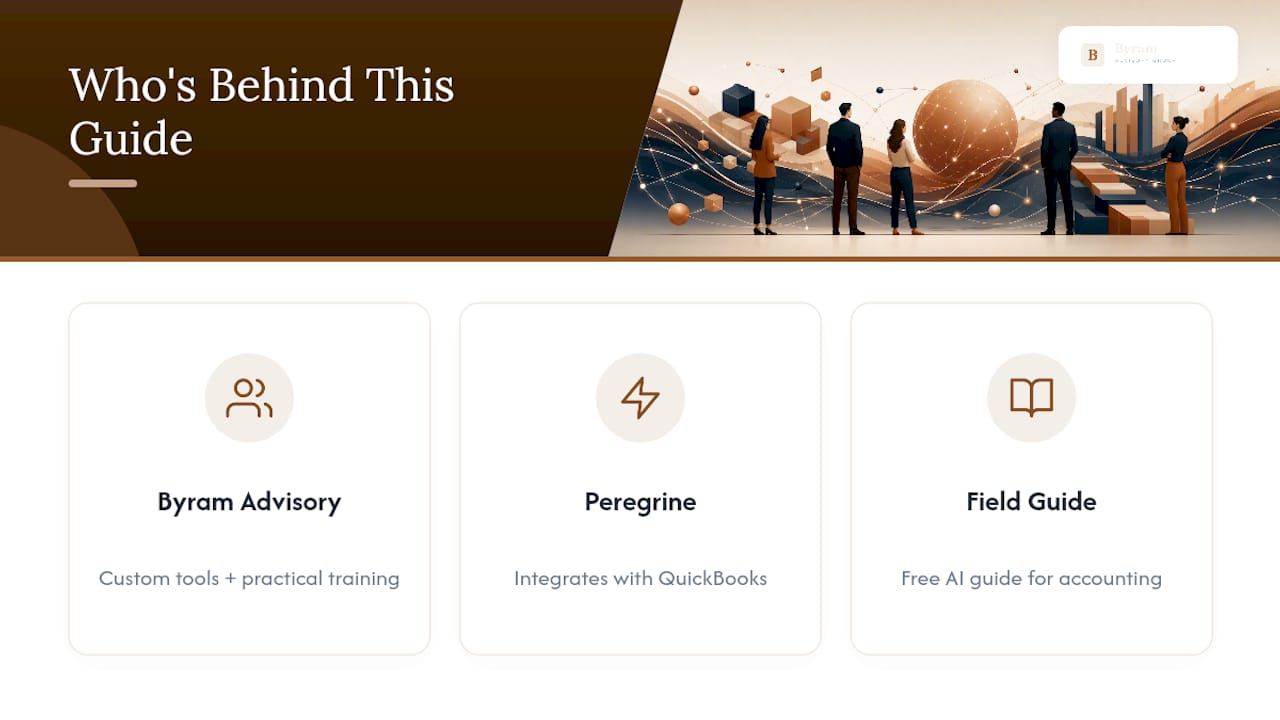
This guide is written based on work helping fractional CFOs and accounting teams build and run cash flow processes that hold up under real scrutiny. Byram Advisory Group specializes in automating financial processes for fractional CFOs and accounting teams, pairing custom-built tools with practical training rather than generic templates.
The firm's platform, Peregrine, integrates directly with QuickBooks to automate the repetitive tasks that make weekly cash updates slow, catching data integrity issues before they reach a client review. For teams building this muscle on their own, Byram-advisory also publishes The Field Guide to AI for Accounting Firms, a free resource covering implementation basics.
An Advisor's View on Making the Weekly Habit Stick
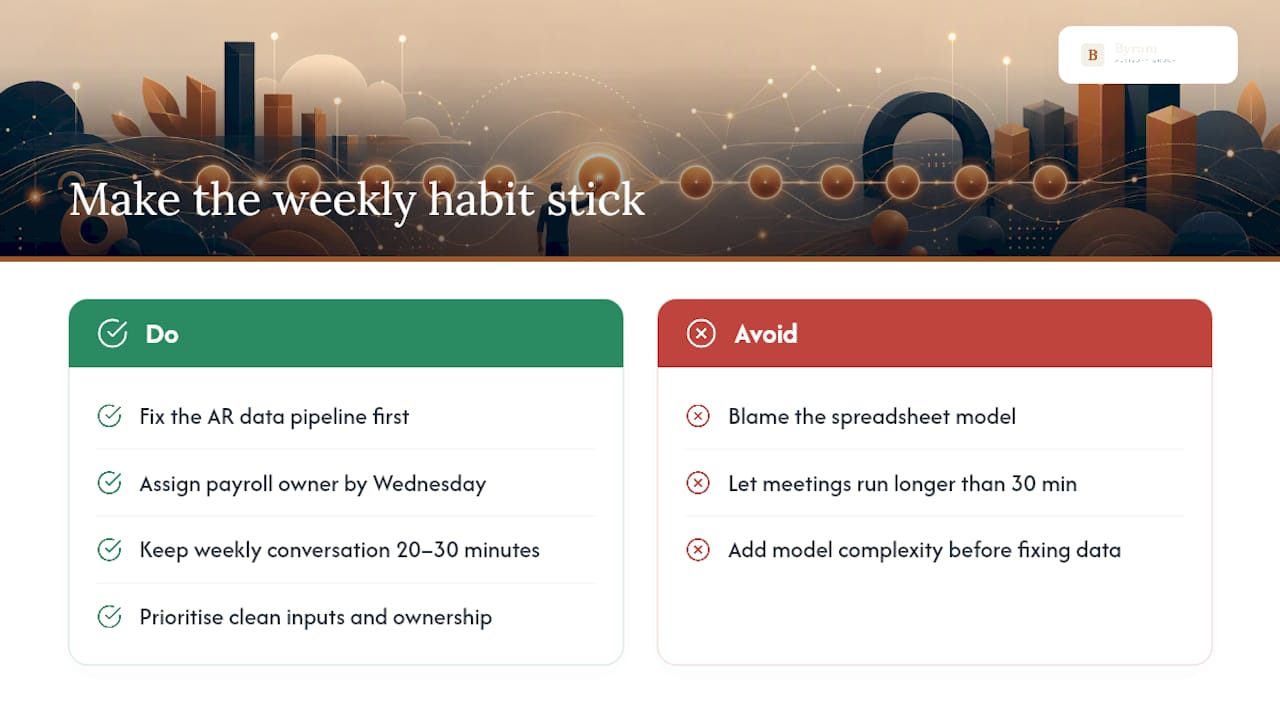
The forecast rarely fails because of the model. It fails because AR data is three weeks stale or nobody owns the payroll input by Wednesday. Fix the data pipeline before you fix the spreadsheet.
Keep the weekly cash conversation to 20 or 30 minutes. Any longer and teams start skipping it. The goal is a repeatable habit built on clean inputs and clear ownership, not a more elaborate model.
— Owen
Get Hands-On Help Building Your 13-Week Model
If you've read this far and you're picturing the hours it'll take to wire up AR aging, payroll timing, and AP into a weekly-ready model, specialized consulting or automation solutions can close that gap. Byram Advisory Group builds custom automation for fractional CFOs and accounting teams so the weekly cash update stops being a manual scramble and starts being a five-minute check against numbers you already trust.
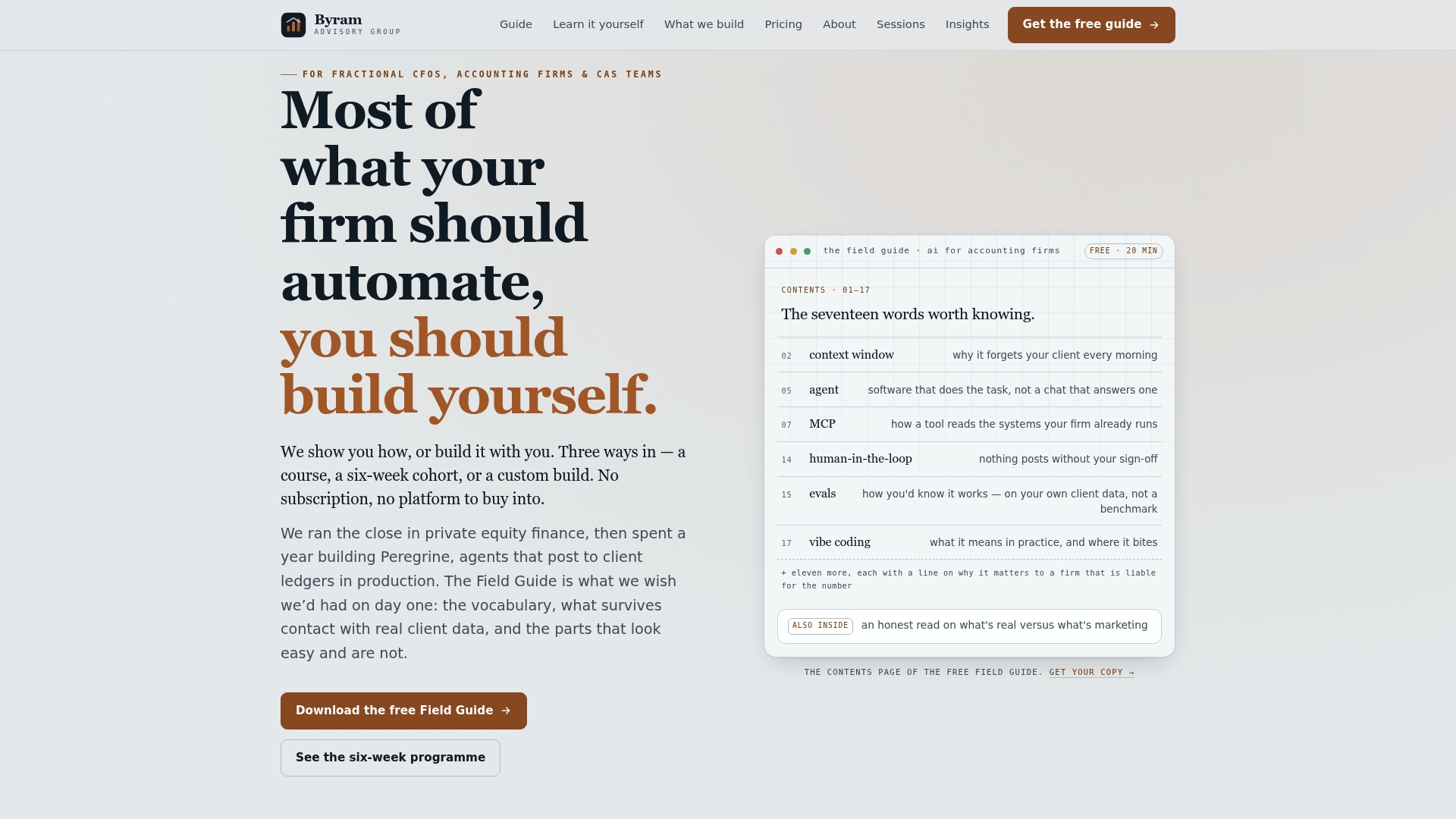
Start with The Field Guide to AI for Accounting Firms, a free PDF that walks through implementation basics before you commit to anything. If you'd rather learn the build process hands-on, the DIY AI Implementation Course walks a finance team through setting up automated workflows step by step. When manual assembly and key-person risk are slowing down weekly close, some platforms offer QuickBooks integrations to handle this automation.
Sources
- 13-Week Cash Flow Model (TWCF) | Template Example
- What is the 13-week cash flow forecast?
- How Do You Implement A 13-Week Cash Flow Forecast?
- 13-Week Cash Flow Forecasting: A CFO's Practical Guide