

AI agents for finance are software systems that combine reasoning models, data connectors, and stored context to complete multi-step financial work, then hand a finished draft to a human for approval. The best ones don't post journal entries or wire money on their own. They reconcile accounts, flag anomalies, draft research memos, and assemble close packages, then wait for sign-off.
Three outcomes justify the investment: hours of manual work recovered every week, reconciliation that runs continuously instead of once a month, and research or monitoring that updates in real time instead of on a quarterly cycle. Mentions of AI agents on corporate earnings calls quadrupled quarter-over-quarter in Q4 2024, a sign that finance leaders stopped treating this as a lab experiment.
That same research found finance teams gravitate toward controlled, workflow-style automation over fully autonomous agents that act without checkpoints. Keep that instinct. Every recommendation below assumes a human stays in the approval loop.
- Recover analyst and controller hours currently spent on manual reconciliation and data pulls
- Run reconciliation and anomaly checks continuously rather than at month-end
- Speed up research and monitoring workflows that used to take days
Table of Contents
- What Are AI Agents for Finance, Really?
- What Capabilities Should a Production-Ready Agent Have?
- Where AI Agents for Finance Deliver the Most Value
- How Do Agent Architectures and Workflows Actually Work?
- What Governance and Controls Do You Need Before Going Live?
- A Pilot-to-Scale Playbook Firms Actually Use
- How Do You Start a Finance Agent Pilot This Quarter?
- What This Article Gets Right That Most Vendor Pitches Don't
- Byram-advisory Builds the Agentic Workflow, Not Just Another Dashboard
- Sources
What Are AI Agents for Finance, Really?
Strip away the marketing and an AI agent for finance is five parts working together: a model, a set of tools, connectors, memory, and an orchestrator. Understanding each piece matters because vendors often bundle them and call the bundle "the agent," which makes it hard to evaluate what you're actually buying.
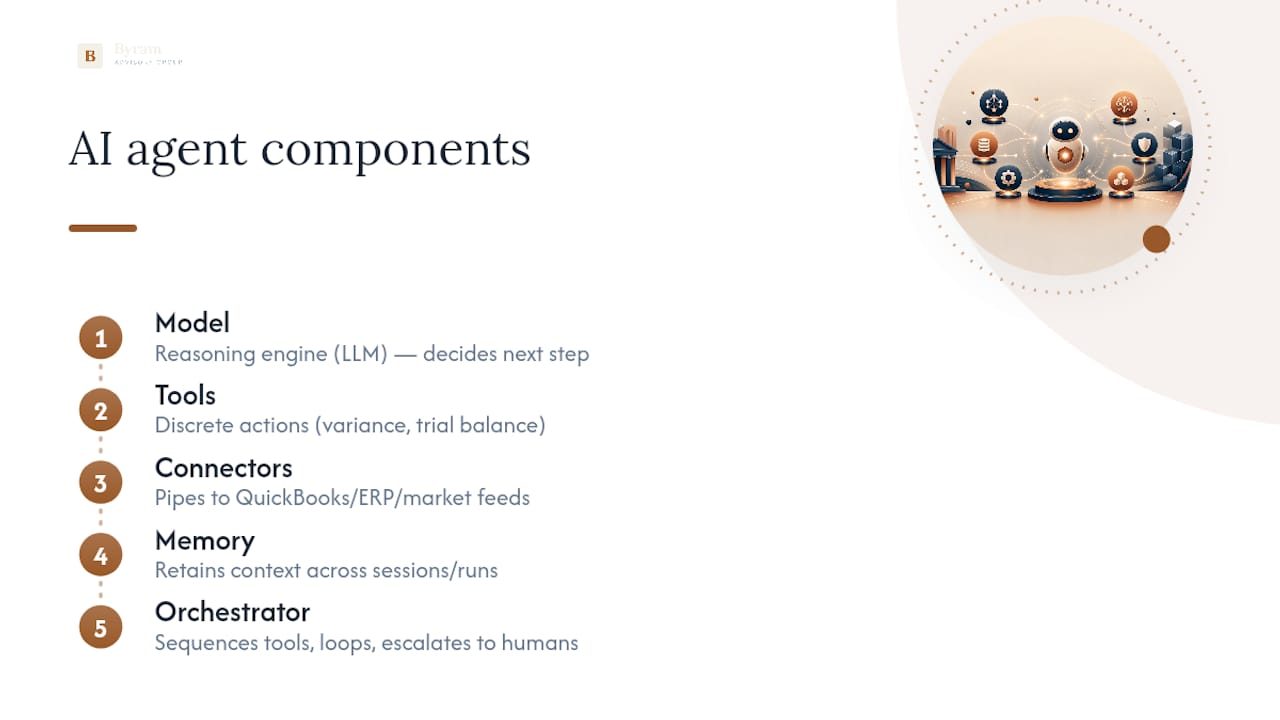
The model is the reasoning engine, usually a large language model that decides what step comes next based on the task and the data in front of it. Tools are discrete actions the model can call, like "run a variance calculation" or "pull the trial balance." Connectors are the pipes that link the agent to your actual systems, QuickBooks, your ERP, a market data feed, so it can read and, in limited cases, write data. Memory lets the agent retain context across a session or across runs, so it doesn't ask you the same clarifying question every time it processes a vendor invoice. The orchestrator sequences all of it, deciding which tool to call, when to loop back, and when to stop and ask a human.
Map that to real finance tasks and it gets concrete fast. A reconciliation agent uses a connector to pull bank and ledger data, a tool to compute variances, memory to remember which discrepancies were already flagged and dismissed last cycle, and an orchestrator to decide whether a variance needs escalation. A research agent uses connectors to market data and filings, a summarization tool, and memory to track which companies it already reviewed this week.
Anthropic's published library of ready-to-run finance agent templates illustrates this pattern well. Rather than building an open-ended agent and hoping it behaves, the templates package a specific skill, a scoped connector, and a defined output format, things like KYC file assembly or month-end close prep, into something closer to a cookbook than a blank canvas.
Pro Tip: Before you evaluate any agent platform, ask the vendor to draw you the five-part diagram: model, tools, connectors, memory, orchestrator. If they can't, you're looking at a chatbot wearing an agent costume.
What Capabilities Should a Production-Ready Agent Have?
Plenty of demos look impressive and fall apart the first time real transaction data hits them. Here's what separates a pilot toy from something you can run in production.
- Connector-backed data access with scoped credentials. The agent should read from QuickBooks, your ERP, or your data warehouse through a credential that grants only the access it needs, not an admin login copied from an IT spreadsheet.
- Multi-step reasoning with a visible plan. Agents built on ReAct-style patterns generate an explicit chain of steps, pull data, check a condition, decide the next action, rather than producing an answer in one opaque leap. That visible plan is what lets a controller sanity-check the agent's logic before trusting its output, a pattern documented in academic work on agentic reasoning.
- Evidence lineage and audit trails. Every number the agent produces should trace back to the source record it pulled, the calculation it ran, and the timestamp it ran at. Without this, you've automated a black box, which is worse than the manual process it replaced.
- Deterministic checks and escalation gates. Not every decision needs a model's judgment. Hard-coded rules ("flag anything over $10,000 variance") should trigger automatic escalation to a human, no reasoning required.
- Template-driven deliverables. Journal entry drafts, close packages, and pitch materials should come out in a format your team already reviews, not a novel structure the agent invented.
Finance adoption research backs the emphasis on structure over improvisation: firms consistently favor workflow-style automations with built-in human oversight over agents that act autonomously. Predictability, in this domain, beats cleverness.
Where AI Agents for Finance Deliver the Most Value
Not every finance workflow is a good candidate for agent automation. The ones that pay off fastest share a common trait: repeatable structure with a clear, checkable output.
Continuous reconciliation and close prep. Instead of a controller reconciling accounts once at month-end, an agent runs the comparison daily, flags variances above a defined threshold, and drafts explanations pulled from transaction memos. Firms using this pattern typically measure success in reviewer hours recovered and how many discrepancies get caught before they compound over multiple periods, rather than waiting for a year-end surprise.

Research and market monitoring. An earnings-review agent reads a transcript the morning it's released, cross-references it against the company's prior guidance, and drafts a two-paragraph summary flagging anything that contradicts previous statements. A market-tracking variant does the same for a watchlist of securities, surfacing unusual volume or price moves before a human would think to check.
KYC and credit screening. Assembling a know-your-customer file traditionally means pulling documents from six different systems and cross-checking them by hand. An agent with the right connectors assembles the file automatically and flags missing documentation or inconsistent identity data for a human reviewer, rather than approving anything itself.
Fraud and risk detection. Agents excel at enrichment work here: pulling transaction context, cross-referencing a flagged payment against historical patterns, and packaging the signal so a risk analyst can triage in seconds instead of minutes. The agent narrows the haystack; the human still makes the call.
Forecasting and scenario generation. Rather than one static forecast, an agent can run a dozen scenario variants overnight, adjusting assumptions like churn rate or input costs, and present the range to a finance leader the next morning. This doesn't replace judgment about which scenario matters. It replaces the manual labor of building each one.
Report drafting and pitchbook assembly. Agents connected to Excel and PowerPoint templates can populate slides with updated figures, pull chart data from the latest model, and draft narrative sections based on the numbers, cutting the mechanical assembly time that analysts usually spend the night before a pitch.
Pro Tip: Start with the workflow that has the clearest "right answer." Reconciliation and KYC assembly have checkable outputs. Forecasting narrative doesn't, at least not immediately, so save it for your second or third pilot once your team trusts the tooling.
How Do Agent Architectures and Workflows Actually Work?
The architecture you choose determines how much engineering effort you burn before an agent does anything useful, and how much risk you're accepting once it does.
Model Context Protocol (MCP) has emerged as a standardized way for agents to talk to external tools and data sources without custom integration code for every connector. Instead of writing bespoke plumbing between your agent and QuickBooks, then separate plumbing for your market data feed, MCP defines a common interface both can speak. That standardization is what lets multiple agent frameworks reuse the same enterprise connectors instead of every team rebuilding integration work from scratch.
Orchestrator-worker designs split a task into a manager agent that plans and several specialized worker agents that execute narrow steps. A close-prep orchestrator might dispatch one worker to pull bank data, another to compute variances, and a third to draft explanatory notes, then assemble the results itself. Multi-agent setups extend this further, with agents that can hand off to each other based on what they find, useful for something like fraud triage where an initial screening agent escalates to a specialist agent only when it detects a real signal.
The choice between a tightly structured workflow and a more autonomous multi-agent setup comes down to risk tolerance. Structured workflows are predictable and easier to audit, which is why they dominate in finance. Fully autonomous agents that decide their own next steps without a defined path are harder to test and harder to explain to an auditor, even when they perform well in a demo.
Cost and latency deserve a mention too. Long-running agent sessions that loop repeatedly through a reasoning cycle consume tokens with every pass, and a poorly bounded agent can rack up compute costs quietly if nobody sets a hard limit on iterations.
- MCP standardizes connector access, cutting integration time across teams
- Orchestrator-worker patterns split complex tasks into auditable steps
- Structured workflows beat open-ended autonomy for anything touching real money
- Set iteration caps to control cost on long-running agent sessions
Pro Tip: Ask any vendor how many reasoning loops their agent allows before it gives up and escalates. "Unlimited" is not a feature, it's an unbounded cost line waiting to surprise your finance team.
What Governance and Controls Do You Need Before Going Live?
Rolling out an agent without governance is how a promising pilot turns into an incident report. Work through this checklist before anything touches production data.
- Scope every credential to the minimum access required. An agent that reconciles accounts payable doesn't need write access to payroll. Least-privilege connectors and proper credential vaulting limit the blast radius if something goes wrong.
- Log evidence lineage for every action the agent takes. You need to reconstruct, months later, exactly which record the agent pulled and what calculation it ran to reach a number in a report.
- Set human-in-the-loop thresholds explicitly. Decide in advance which dollar amounts, transaction types, or anomaly scores require a human sign-off before anything moves forward. Practitioner guidance consistently points to human oversight as the factor that preserves auditability while still capturing the time savings.
- Build a validation test suite and run it continuously. Freeze a set of known-good transactions and re-run the agent against them regularly to catch model drift or a connector that silently broke.
- Estimate inference cost against realistic usage volume. A daily reconciliation agent processing a few hundred transactions costs very differently than one scanning a full ERP nightly. Model that before you scale.
Pro Tip: Treat your validation test suite the way you'd treat internal controls testing: scheduled, documented, and reviewed by someone who wasn't the one who built the agent.
A Pilot-to-Scale Playbook Firms Actually Use
Byram-advisory built its Peregrine platform around exactly this governance model: wire it into your existing QuickBooks setup, define mapping policies for how accounts and categories translate, and let the agent prepare drafts while your team retains approval authority over anything that touches the ledger.
A realistic pilot design looks like this: pick one entity, freeze the last four quarters of transaction data as a testing baseline, and measure reviewer time saved plus discrepancies caught over a 30-day run. At 30 days, you know whether the agent's variance flags are trustworthy. At 60, you're expanding to a second workflow. At 90, you're deciding whether to scale across the full client roster.
Byram-advisory's Field Guide and structured training programs exist specifically to help firms codify these mapping policies and onboard staff without reinventing the rulebook for every new client engagement.
The pilots that succeed aren't the ones with the fanciest model. They're the ones where someone froze a clean set of test data, wrote down the approval rules before the agent ran once, and measured reviewer hours recovered instead of counting how many tasks got automated.
Firms running this pattern report the outcomes that matter: a faster close, dollars recovered from caught discrepancies, and a financial record that survives outside scrutiny without a scramble.
— Owen
How Do You Start a Finance Agent Pilot This Quarter?
You don't need a six-month evaluation process to get moving. You need one workflow, a clean baseline, and thirty days.
- Pick one repeatable workflow and define its baseline. Reconciliation is the easiest starting point because you already know what a correct answer looks like. Measure current reviewer hours before you automate anything.
- Confirm your connectors are ready and set guardrails. Make sure the agent can actually reach QuickBooks or your ERP with scoped credentials, and decide your escalation thresholds before day one.
- Run a 30-day proof-of-value. Let the agent prepare drafts on real data while a human reviews every output. Track evidence lineage and log how many reviewer hours you actually recover.
- Decide your scale criteria in advance. Set the discrepancy rate, time savings, and audit-readiness bar the pilot needs to clear before you expand to a second entity or workflow, and get governance sign-off before you do.
Pro Tip: Write your scale criteria down before the pilot starts, not after you see the results. It's the only way to keep a good demo from talking you into scaling something that isn't actually ready.
The most effective AI agents for finance combine connector-backed data access, visible reasoning, audit trails, and human approval gates to prepare draft work rather than execute it unsupervised.
| Point | Details |
|---|---|
| Structure beats autonomy | Workflow-style agents with defined steps outperform open-ended autonomous agents in finance settings. |
| Governance comes first | Scoped credentials, audit trails, and approval thresholds must exist before any agent touches production data. |
| Start with reconciliation | Pick workflows with a clear correct answer, like reconciliation or KYC assembly, for your first pilot. |
| Measure hours, not tasks | Track reviewer time recovered and discrepancies caught rather than raw automation counts. |
| Byram-advisory fits this model | Its Peregrine platform wires into QuickBooks with mapping policies and human approval built into the workflow. |
What This Article Gets Right That Most Vendor Pitches Don't
Most content about AI agents for finance sells the model. The reasoning capability, the token count, the benchmark score. That's the wrong axis. The research on this topic consistently points somewhere else: firms that succeed with agents treat the connector layer, the audit trail, and the approval gate as the actual product, and the model as a replaceable component underneath it.
The conventional advice tells you to pick the smartest model available. The better advice is to pick the workflow with the clearest right answer, because that's what lets you build deterministic checks around a model that will occasionally be wrong. Reconciliation and KYC assembly are boring compared to a forecasting agent that writes prose, but boring is exactly what makes them auditable.
If you take one thing from this, prioritize evidence lineage before you prioritize capability. An agent that's slightly less clever but leaves a perfect audit trail will survive external scrutiny. A brilliant one that can't show its work won't.
— Owen
Byram-advisory Builds the Agentic Workflow, Not Just Another Dashboard
You've seen the components: connectors, audit trails, approval gates, templated deliverables. Byram-advisory built Peregrine around exactly that model instead of a generic dashboard bolted onto your existing books. It wires directly into QuickBooks, applies mapping policies your firm defines, and prepares reconciliations and close packages for your review, not for automatic posting.

The difference that matters for a fractional CFO or accounting firm: you keep full oversight while recovering the hours currently lost to manual reconciliation and data chasing. Byram-advisory pairs the platform with a free Field Guide and hands-on training so your team can codify its own rules rather than depend on someone else's black box. If you'd rather build the skill in-house, the DIY implementation course walks you through the same setup at your own pace.
Start by downloading the Field Guide, then reach out through Byram-advisory's site to scope a pilot on one entity and see what a 30-day run actually recovers.
This article is general information, not a substitute for advice from a qualified financial advisor. Consult a qualified financial professional about your own circumstances before acting on anything here.
Sources
- Agentic AI for Finance: Workflows & Case Studies | CFA Institute RPC
- Agents for financial services | Anthropic
- Human-in-the-loop AI in finance (Forbes Council, 2026)