

AI controls are AI-enabled internal controls: automated checks, reconciliations, anomaly detection, and workflow-enforced approvals that catch errors before they reach the general ledger. Treat them as ICFR controls, not IT experiments. That means documenting them, testing them, and requiring human review on anything that touches materiality. Your first move this week: inventory every AI use case touching your books and risk-rank each one.
TL;DR:
- AI controls must be documented, tested, and reviewed by humans, especially for transactions involving materiality or significant risk.
- The most effective AI control strategies include human-in-the-loop, regular performance testing, multi-model validation, and continuous analytics monitoring.
- Proper integration connects AI directly to existing ERP systems via API, avoiding manual data shuttling and ensuring real-time control enforcement.
- High-quality data preprocessing, standardization, and historical data analysis are essential to make AI controls trustworthy and reduce false positives.
- Adequate vendor oversight, access security, and comprehensive audit trail documentation are critical for complying with internal control over financial reporting standards.
Table of Contents
- What AI Controls Mean for Accounting Teams
- Benefits and Realistic Limits of AI Controls
- Choosing the Control Approach: HITL, Testing, and Analytics
- Practical Implementation Checklist and Timeline
- Governance and Audit Evidence: Documenting AI Lineage
- Integration Strategies With Existing ERP and Financial Systems
- Data Quality and Preprocessing Requirements for Reliable Outcomes
- Risk Management for AI Model Failures and Bias in Controls
- Security Considerations and Access Control for AI Control Systems
- A Practitioner's View on Deploying AI Controls
- Get Started With Byram Advisory Group
- Sources
- FAQ
What AI Controls Mean for Accounting Teams
Scope matters here. This article covers AI controls as internal controls over financial reporting, not the broader field of AI governance or model safety. If you're a controller, that distinction is the whole ballgame: you're not evaluating whether an AI vendor is trustworthy in the abstract, you're evaluating whether its output belongs in your financial statements.
In practice, AI controls show up in a handful of familiar places:
- Auto-reconciliation workflows that match transactions across bank feeds, subledgers, and the GL
- Extraction and classification tools that pull vendor invoices into coded journal entries
- Anomaly detection that flags outliers in expense reports, vendor payments, or intercompany transfers
- Cash forecasting models that surface unusual variance against prior periods
Every one of these produces an assertion, not a fact. An AI model that says "this reconciliation is clean" is making a claim, the same way a junior staff accountant would. COSO and FEI guidance treats generative AI in finance as an internal control question, meaning that claim needs the same design, testing, and evidence trail you'd demand from a human preparer.
Benefits and Realistic Limits of AI Controls
The efficiency case is real. Auto-clearing routine reconciliations frees staff to spend their hours investigating the handful of accounts that actually need judgment, which shortens close cycles instead of just moving the workload around. Firms that pair AI adoption with strong data governance and management support see measurably better reporting accuracy and audit efficiency than firms that bolt AI onto messy processes and hope.
Pro Tip: Don't measure success by how much a model automates. Measure it by how much it correctly escalates. A tool that flags the right 5% of transactions for human review is worth more than one that silently clears 95%.
The limits are just as real:
- Model drift: a model tuned on last year's transaction patterns can quietly degrade as your client base or chart of accounts changes
- Confidently wrong outputs: AI tools rarely say "I don't know," they just produce a plausible-looking wrong answer
- Shadow AI: staff using unauthorized tools to code entries or draft variance explanations, outside any control framework
- Vendor transparency gaps: many platforms won't disclose how or when their models get revalidated
Speed should yield to auditability whenever a transaction crosses a materiality threshold, touches a related party, or involves judgment (revenue recognition, reserve estimates, anything an auditor would sample). Below that line, automation with a sampling-based review can carry the weight.
Choosing the Control Approach: HITL, Testing, and Analytics
There's no single "right" AI control. The right mix depends on transaction volume and how much damage a wrong answer could do. Four approaches cover most of what a finance team needs, and most mature control environments run all four at once, just at different intensities.
- Human-in-the-loop (HITL). Set a dollar or percentage threshold above which every AI-generated entry or reconciliation gets a documented human sign-off. Separate the person who configures the model from the person who reviews its output. This is the single most important safeguard for anything above your materiality threshold.
- Performance testing. Build a curated test dataset of known-good and known-bad transactions, run it against the model on a schedule, and define a hard pass/fail threshold before you ever trust the tool with live data. Retest after every model version change.
- Multi-model validation. For high-stakes categories like revenue cutoff or reserve estimates, run a second, independently trained model as a challenger. If both models agree, confidence goes up. If they diverge, that divergence is itself the signal worth investigating.
- Analytics monitoring. Track drift metrics and KPI/KRI thresholds continuously, and route exceptions into a queue rather than letting them disappear into a dashboard nobody checks. Deloitte's guidance on AI transparency in finance frames this kind of ongoing evidence as just as important as the model's initial accuracy score.
Firms handling low-volume, high-materiality items (think intercompany eliminations at a $50 million client) should lean hard into HITL and multi-model validation. High-volume, low-materiality work (routine bank reconciliations, expense coding) is where analytics monitoring and performance testing carry most of the weight.
Practical Implementation Checklist and Timeline
Most firms overbuild the first attempt and underdocument it. Here's a sequence that avoids both mistakes.
- Discovery sprint (about one week). Scope every candidate use case, pull sample data extracts, gather a handful of real transaction cases, and define what success looks like in numbers, not adjectives.
- Risk-rank each use case. Tie the ranking to materiality and control significance, not to how exciting the technology is. This ranking decides whether a use case gets full HITL or lighter-touch monitoring.
- Run a fixed-scope pilot. A single reconciliation agent typically moves from build to production in a few weeks when the scope stays narrow and the test dataset is ready before day one.
- Move to production with controls configured, not bolted on after. That means audit trail logging, period-locking so closed periods can't be silently reopened, and segregation of duties enforced in the workflow itself.
- Monitor operationally. Track auto-clear rate and false positive rate weekly, and revalidate the model on a fixed cadence, not just when something breaks.
Getting there requires a few things in place before the pilot starts:
- A named control owner for each AI use case, not a committee
- A sampling plan for reviewing auto-cleared items, even the "clean" ones
- Vendor evidence on file (more on this below) before go-live, not after
Pro Tip: Timebox pilots to your firm's slow season. A pilot that launches two weeks before month-end close for a busy client is a pilot that gets ignored, then blamed for problems it didn't cause.
Governance and Audit Evidence: Documenting AI Lineage
Auditors don't take AI output on faith, and neither should you. The evidence package that satisfies KPMG's ICFR handbook guidance looks a lot like the evidence you'd already keep for a manual control, just with a few AI-specific fields added.
Build an AI-in-ICFR inventory first: a running list that ties every AI use case to the specific key control and materiality band it affects. From there, record the full lineage for each assertion:
- The input extract ID and dataset snapshot used
- The model name and version, plus prompt or configuration settings
- A timestamped output
- The reviewer's identity and their documented acceptance rationale
Vendor oversight deserves its own line item. Ask every AI vendor touching your financial data whether their AI features fall under SOC 1 coverage, and ask how often they revalidate the underlying model. If a vendor won't answer either question, treat their AI output as unvalidated input, not a control you can rely on.
| Evidence type | What to store | Why auditors ask for it |
|---|---|---|
| AI lineage log | Input, model version, prompt, reviewer, rationale | Proves who approved what and why |
| Performance test results | Test dataset, pass/fail outcomes, retest dates | Shows the model was validated before and after changes |
| Vendor SOC 1 evidence | Coverage scope, revalidation frequency | Confirms third-party AI isn't a control gap |
| Sampling logs | Which auto-cleared items were reviewed | Demonstrates ongoing monitoring, not one-time setup |
Integration Strategies With Existing ERP and Financial Systems
The biggest integration mistake is building an AI control that lives outside your ERP and requires someone to manually shuttle data between systems. That reintroduces exactly the manual risk you were trying to remove.
The cleaner pattern connects directly to your system of record, most commonly QuickBooks for the advisory-firm client base, through an API rather than a file export/import cycle. Direct integration means the control can read live data, write back flagged exceptions, and preserve a timestamped record of what happened, all without a human copying numbers between spreadsheets.
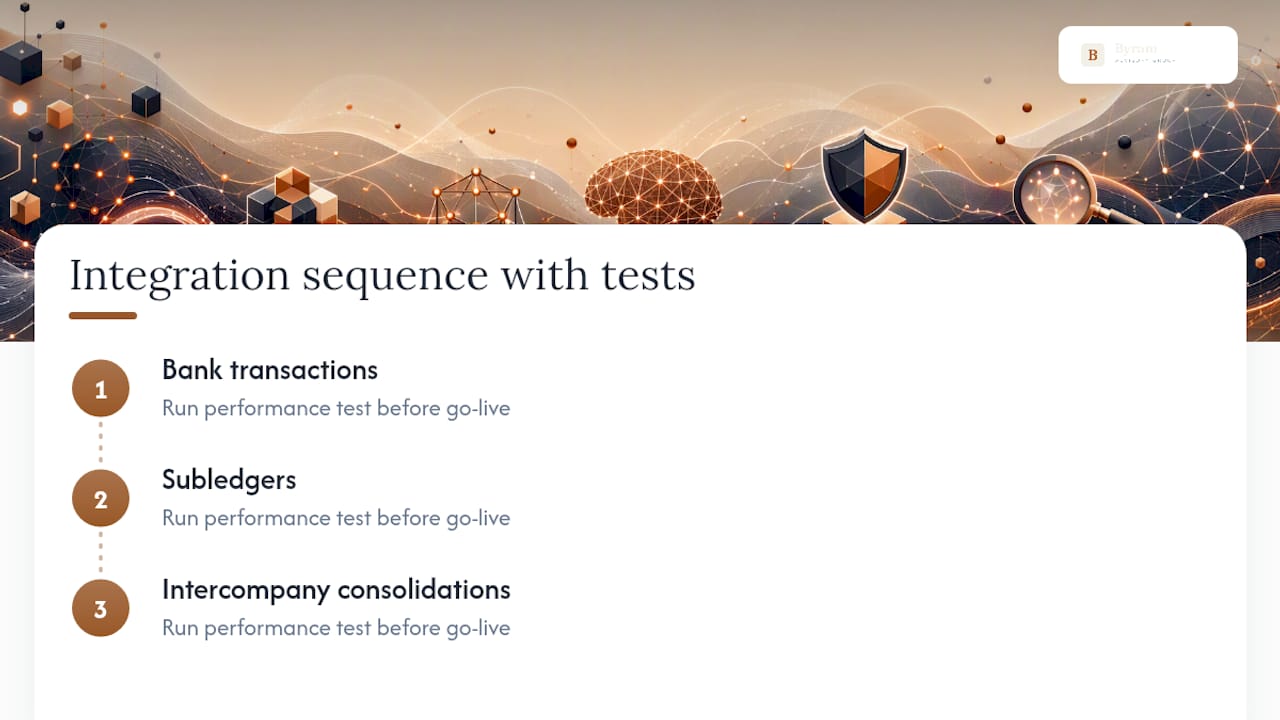
Sequence the integration in layers instead of trying to connect everything at once. Start with the highest-volume, lowest-complexity feed (bank transactions are usually the easiest), prove the control works there, then extend to subledgers, then to intercompany or multi-entity consolidations if you serve clients with that complexity. Each layer should get its own performance test before it goes live, because a control that works cleanly on bank data can behave very differently against messier subledger detail.
One underrated integration decision: where the control enforces its checkpoint. A control that only reads from the ERP after the fact is a monitoring tool, not a preventive control. A control that intercepts a transaction before it posts, and requires sign-off before it clears, is doing real ICFR work. For anything touching materiality, insist on the second pattern.
Data Quality and Preprocessing Requirements for Reliable Outcomes
An AI control is only as good as the data it reads, and most finance teams underestimate how much cleanup that requires before a model ever sees a transaction.
Start with chart-of-accounts consistency. If five different bookkeepers over three years have coded the same vendor to four different expense accounts, no anomaly detection model will produce a clean signal. Standardize the chart of accounts and vendor naming conventions before, not after, you deploy an AI control against that data.
Missing or malformed fields cause the second most common failure. A reconciliation agent that expects a transaction date, amount, and memo field will silently misclassify or skip records where any of those fields are blank, inconsistently formatted, or truncated. Run a data-completeness check as a preprocessing gate, not as an afterthought discovered three months into production.
Historical data matters too. If you're deploying anomaly detection, the model needs enough clean historical periods to establish what "normal" looks like for that specific client. A newer client with only two quarters of data will produce noisier flags than one with three years of stable history, and that difference should shape how much you trust the model's output early on. A generative AI framework for master data management shows that traceability and adaptive master data practices measurably improve reconciliation speed and accuracy, which is really just a formal way of saying: clean inputs make AI controls trustworthy, and dirty inputs make them dangerous.
Risk Management for AI Model Failures and Bias in Controls
Two failure modes deserve separate attention: the model that's simply wrong, and the model that's systematically wrong in one direction, which is a key concern addressed in AI Governance & Compliance for Financial Services.
For outright failure, the safest design choice is detect-flag-review rather than letting a model automatically modify the ledger. Research on financial error correction makes the case directly: preserving human oversight at the point of correction prevents a wrong automatic ledger change from compounding into a bigger problem before anyone notices. An AI control that can flag an anomaly but cannot post an adjustment on its own is a safer control, full stop.

Bias in a finance context usually isn't demographic, it's structural. A model trained mostly on one client's transaction patterns may flag a legitimate but unusual vendor payment for a different client as anomalous simply because it doesn't match the training distribution. That's a false positive problem, and it erodes trust in the control faster than almost anything else, because staff start ignoring flags once they learn most of them are noise.
Manage both risks the same way: keep a challenger model or a manual spot-check running in parallel during the first few months of any new deployment, track false positive and false negative rates explicitly, and set a revalidation trigger tied to client onboarding, not just a calendar date. A model that performed well on your existing client base needs retesting before it touches a client in a different industry or of a different size.
Security Considerations and Access Control for AI Control Systems
An AI control that can read financial data and flag exceptions is, functionally, a system with access to sensitive client information. Treat the access model with the same rigor you'd apply to your accounting software itself, not as a separate, lighter-touch category.
Role-based access is the starting point. The person configuring a model's thresholds should not be the same person approving its flagged exceptions. That separation of duties matters as much here as it does in any manual control, and it's often the first thing an auditor checks when reviewing an AI-enabled process.
API keys and credentials connecting an AI tool to your ERP or QuickBooks instance need the same rotation and least-privilege discipline as any other system credential. A tool that only needs read access to bank transactions should never be granted write access to the full general ledger just because it's convenient during setup.
Logging access itself is a control. Every time someone changes a model's configuration, adjusts a threshold, or overrides a flagged exception, that action needs a timestamp and an identity attached to it. Without that log, you can't answer the question an auditor will eventually ask: who changed this, and why. Vendor contracts should specify who at the vendor can access your client data, under what circumstances, and how quickly you'd be notified of a breach affecting your financial information.
A Practitioner's View on Deploying AI Controls
Most firms fail their first AI control deployment for one of two reasons: dirty source data, or nobody actually enforcing the review step once the novelty wears off. Byram Advisory Group builds its Peregrine platform around QuickBooks specifically to close the first gap, because integration quality determines whether a reconciliation agent sees clean transactions or a mess.
The second gap is behavioral, not technical. A reviewer who rubber-stamps every AI flag without reading it has recreated the exact risk the control was supposed to remove. The fix that works in practice is a triage model: score each reconciliation on variance materiality, explanation coverage, historical consistency, aging, and preparer activity, then auto-clear the low-risk items and route only the flagged ones to a human. Teams that adopt this see faster investigation cycles almost immediately, because staff stop wasting time re-checking accounts that were already clean.
— Owen
Get Started With Byram Advisory Group
Byram Advisory Group built its practice specifically on the problem this article covers: turning AI reconciliation and anomaly detection into controls you can actually defend to an auditor, not just a productivity trick. Where most AI tools stop at "faster," Peregrine is built to preserve the audit trail, review checkpoints, and evidence package your engagement already requires.

If you're running the discovery sprint described above, start with The Field Guide to AI for Accounting Firms, a free download built to help you inventory AI use cases and risk-rank them the same way this article walks through. Teams ready to move faster on enablement can use the DIY AI Implementation Course for Accounting Firms at $500 to get a team trained and pilot-ready without waiting on a full consulting engagement. And if you'd rather have a platform do the integration work, some solutions connect directly to QuickBooks to automate reconciliations while keeping the audit trail, reviewer log, and period-locking your ICFR needs intact. Book a discovery conversation at Byram Advisory Group to see whether a pilot engagement fits your client roster.
Sources
- Deloitte: AI transparency and reliability in finance (2025)
- KPMG Handbook: Internal control over financial reporting (2025/2026)
FAQ
What Are AI Controls in Accounting?
AI controls are AI-enabled internal controls that automate checks like reconciliations, anomaly detection, and workflow-enforced approvals while preserving human review over material transactions.
Are AI Controls the Same as AI Governance?
No. AI controls in a finance context refer to ICFR, meaning controls over financial reporting accuracy, while AI governance covers broader risk and safety policy for AI systems generally.
How Long Does It Take to Deploy an AI Control?
A single reconciliation agent typically moves from a one-week discovery sprint to production in a few weeks when the pilot scope stays fixed and a test dataset is ready before launch.
Do Auditors Accept AI-Generated Reconciliations?
Auditors accept them when the firm documents model version, inputs, reviewer sign-off, and performance test results, treating the AI output as an assertion requiring evidence, not a fact taken on faith.
What Should I Ask an AI Vendor Before Trusting Its Output?
Ask whether the AI feature falls under SOC 1 coverage and how often the vendor revalidates the model; without clear answers, treat the vendor's output as unvalidated input.