

AI in accounting already automates document processing, transaction classification, and continuous reconciliation, cutting the time firms spend on routine close work. Firms using generative AI finalize monthly statements 7.5 days faster and report 12% more granular line items. None of that removes the need for a human to check the work. AI shifts staff toward advisory and analysis, but only firms that pair it with real governance see the gains hold up past the pilot stage.
TL;DR:
- AI automates routine accounting tasks such as document processing, transaction classification, and reconciliation, leading to faster monthly closing times.
- Generative AI enables a 12% increase in reporting detail and reduces close time by an average of 7.5 days, primarily benefiting senior staff.
- Proper governance, including quality control, sign-offs, and data security, remains essential to prevent errors and ensure compliance.
- Starting AI implementation with narrow, measurable pilots on high-impact areas like invoice extraction or reconciliation is the most effective approach.
- Ethical and regulatory considerations demand transparency with clients and active verification of AI outputs against established standards.
Table of Contents
- What Does AI Actually Do in Accounting?
- What Do the Numbers Actually Say About AI's Impact?
- What Can Go Wrong When AI Handles the Books?
- How Should a Firm Roll Out AI in Accounting?
- How Byram-Advisory Builds AI Into Real Accounting Workflows
- What Should Firms Do in the Next 30 to 90 Days?
- Where Bias and Ethics Actually Show Up in AI Accounting Tools
- What's Next for AI in Accounting?
- What Regulations Govern AI Use in Accounting Right Now?
- Why Governance Matters More Than the Model You Pick
- Get Hands-On Help Implementing AI in Your Firm
- Sources
What Does AI Actually Do in Accounting?
Most of the AI running inside accounting firms today falls into five categories, and understanding which one you need matters more than which vendor you pick.
- Intelligent document processing: OCR combined with structured extraction pulls line-item data from invoices, receipts, and contracts, turning a PDF into usable rows in your general ledger instead of a manual data-entry task.
- Transaction classification: A blend of rule-based logic and machine learning assigns categories to bank and credit card feeds, learning from corrections so the same vendor stops needing a manual override every month.
- Continuous reconciliation and anomaly detection: Instead of reconciling once at month-end, the system flags mismatches and outliers daily, so a duplicate payment or miscoded expense surfaces in hours, not weeks.
- Summarization and narrative generation: AI drafts the plain-English commentary behind a variance report or client update, giving staff a starting draft instead of a blank page.
- Retrieval-augmented generation (RAG): This lets staff query firm policy manuals, GAAP or IFRS guidance, and prior workpapers in natural language, pulling the right passage instead of searching a shared drive.
Thomson Reuters' survey of how firms use AI found bookkeeping automation, invoice processing, and reconciliation are the three most common entry points. That pattern shows up again and again in real deployments, which is worth knowing before you build a roadmap around something more exotic.
What Do the Numbers Actually Say About AI's Impact?
The clearest data point on AI's impact in accounting comes from a Stanford Graduate School of Business study of 79 small and mid-sized firms.
The Stanford Numbers: Accountants using generative AI finalized monthly statements 7.5 days faster, spent 8.5% less time on routine back-office work, and saw a 12% increase in reporting granularity, meaning broad categories broke down into more actionable line items.
That last figure matters more than it sounds. A 12% jump in reporting granularity means clients get sharper answers to "where exactly is our money going" instead of a lump "operating expenses" line.
The gains were not evenly distributed:
- Senior staff captured larger productivity gains than junior staff, likely because they had the judgment to direct the tool and catch its mistakes.
- Firms in the study also supported more clients per staff member without adding headcount.
- Quality control time did not disappear. It shifted from data entry to reviewing AI output.
That third point is the one firms tend to skip past. AI compresses the input work, not the oversight work.
What Can Go Wrong When AI Handles the Books?
AI models occasionally hallucinate, inventing a plausible-looking figure or misreading a scanned invoice total, and a wrong number that flows into a financial statement is far more expensive than the seconds it saved. Client data moving through a third-party model also raises real questions about encryption, access controls, and where that data physically lives.
IFAC's guidance on AI and accounting puts the responsibility squarely on the practitioner: accountants must verify AI outputs against GAAP or IFRS standards, not just trust the interface. The professional becomes an active governor of the tool, not a passive user of it.
Firms that manage this well tend to build the same four guardrails:
- A confidence threshold below which output routes automatically to a human reviewer.
- Mandatory sign-off from a named staff member before anything posts to the ledger.
- A logged, retained record of prompts and outputs for audit purposes.
- Defined data residency and access rules for any client information the model touches.
Pro Tip: Treat every AI-generated number the way you'd treat a junior staffer's first draft. It's often right, occasionally wrong in a way that looks completely plausible, and always worth a second set of eyes before it reaches a client.
How Should a Firm Roll Out AI in Accounting?
Firms that get real value from AI almost always start narrow and scale deliberately. Here's the sequence that tends to work.
- Pick one high-impact pilot. Transaction classification, invoice extraction, and reconciliation are the three most common starting points. This is largely because pilots scoped tightly around them show measurable ROI fast.
- Decide build versus buy. Buying a point solution is faster to start but limits how deeply it integrates with your existing stack and how much control you keep over client data. Building or customizing, the approach Byram-advisory takes with its Peregrine platform, costs more upfront but keeps data control and integration depth in your hands.
- Fix your data hygiene first. Normalize your chart of accounts, clean up inconsistent vendor names, and map your source-document flow before you automate classification. Feeding a model messy inputs just teaches it your bad habits faster.
- Set pilot KPIs before you start, not after. Track close time, hours spent resolving exceptions, error rate under human review, and client satisfaction. A pilot without a baseline is just a demo.
- Assign governance ownership. Name who owns model review, who signs off on outputs, and what the escalation path looks like when something looks wrong.
- Scale by unit, not all at once. Once a pilot holds steady for two full reporting cycles, standardize the templates and roll it to the next team, keeping continuous monitoring in place rather than assuming it will run itself.
Pro Tip: Run your pilot on a client relationship you know well before touching a high-risk or high-complexity account. You want your first mistakes to happen where you have context to catch them.
Agentic workflows, where the AI prepares work for a human to approve rather than posting automatically, tend to be the right middle ground for firms that want automation without giving up control.
How Byram-Advisory Builds AI Into Real Accounting Workflows
Byram-advisory takes a build-over-buy approach for a reason: off-the-shelf tools rarely fit a firm's exact chart of accounts, client mix, or reporting standards. Its Peregrine platform integrates directly with QuickBooks, automating repetitive reconciliation and classification work without pulling data control away from the firm running it.
Clients working this way get a few concrete outcomes:
- Real-time cash flow monitoring instead of a monthly snapshot that's already stale by the time it lands.
- A structured, consistent reporting format that holds up under external scrutiny, whether that's a lender, an investor, or an auditor.
- Better data integrity because the same automated checks run every cycle, not just when someone remembers to run them.
For firms building this capability internally, Byram-advisory publishes The Field Guide to AI for Accounting Firms alongside tailored training programs designed to get a team from curious to operational.
What Should Firms Do in the Next 30 to 90 Days?
Turning all of this into action doesn't require a full platform overhaul on day one.
- Run a 30-day pilot on one narrow use case, with KPIs defined before you start.
- Map your current data flow end to end, from source document to posted transaction, before automating any step of it.
- Assign one named owner for AI governance, review protocols, and escalation.
| Metric | What to track | Signal to scale |
|---|---|---|
| Close time | Days to finalize monthly statements | Consistent reduction over 2+ cycles |
| Exception volume | Number of flagged items needing manual review | Trending down, not flat or rising |
| Error rate | Mistakes caught during human review | Stable or falling under oversight |
| Advisory capacity | Hours freed for client-facing analysis | Measurable increase per staff member |
If exception volume isn't dropping after two full cycles, that's your signal to pause and fix the input data before scaling further, not to add more automation on top of an unstable base.
Where Bias and Ethics Actually Show Up in AI Accounting Tools
The ethical risk in AI-driven accounting rarely looks like a dramatic scandal. It looks like a model trained on historical transaction data that quietly encodes old patterns, flagging transactions from certain vendor types or regions as "anomalous" simply because they're less represented in the training set, not because anything is actually wrong. That kind of bias can skew audit sampling or make a classification tool systematically slower to learn a smaller client's spending patterns.
There's also a subtler issue: over-trust. When a tool is right 95% of the time, staff naturally start skimming its output instead of reviewing it, and that's exactly when the other 5% slips through into a client report. Generative AI is genuinely useful for synthesizing standards and speeding research, but it isn't yet a substitute for the final professional judgment a CPA is licensed to provide, and treating it as one is where the ethical line gets crossed.
Transparency with clients matters too. If AI drafted the narrative behind a variance report or flagged the anomalies in a reconciliation, clients generally have a right to know that a model, not just a human analyst, touched their numbers. Firms that build this disclosure into their standard reporting process avoid an awkward conversation later, and it tends to build more trust, not less, once clients understand the human review layer sitting on top of it.
What's Next for AI in Accounting?
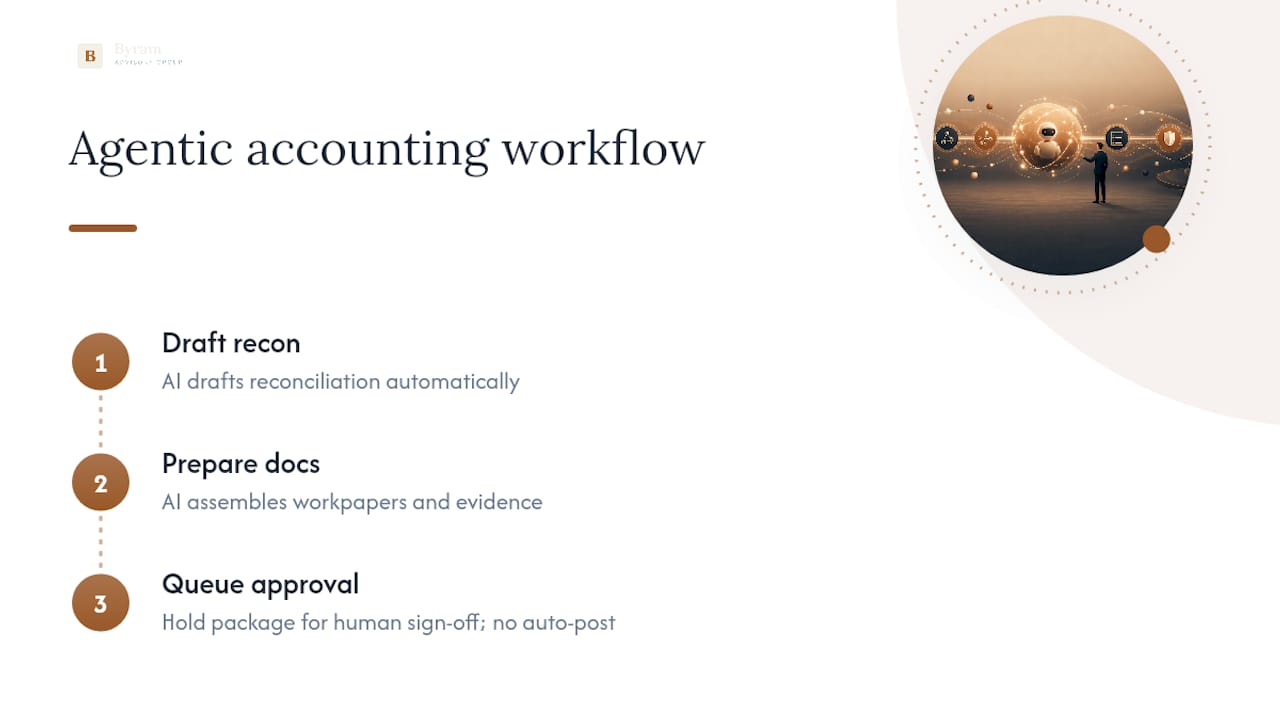
The next wave of AI in accounting is less about faster data entry and more about agents that can carry a task from start to near-finish before a human steps in. Agentic workflows, where an AI agent drafts a reconciliation, prepares the supporting documentation, and queues it for approval rather than posting it automatically, are already moving from experimental to standard practice at firms that need both speed and control.
Retrieval-augmented generation is also maturing past a novelty feature. Instead of a generic chatbot answering generic questions, RAG systems built over a firm's own workpapers, engagement letters, and policy manuals are turning into genuine research assistants, the kind that can tell a junior staffer exactly which prior year's treatment applied to a similar transaction. Enterprise deployments already show this working at scale with secure, private GenAI platforms hosted over internal knowledge bases, which solves the compliance problem that public chatbots can't.
Expect continuous, real-time auditing to become more common too, where anomaly detection runs constantly against live transaction feeds instead of a periodic sample review. That shifts audit work from a once-a-year event to an ongoing monitoring function, and it changes what an auditor's actual job looks like day to day. None of this replaces the accountant. It just moves the valuable part of the job earlier, into judgment and interpretation, and later, into oversight and sign-off, and away from the middle, where most of the manual work used to sit.
What Regulations Govern AI Use in Accounting Right Now?
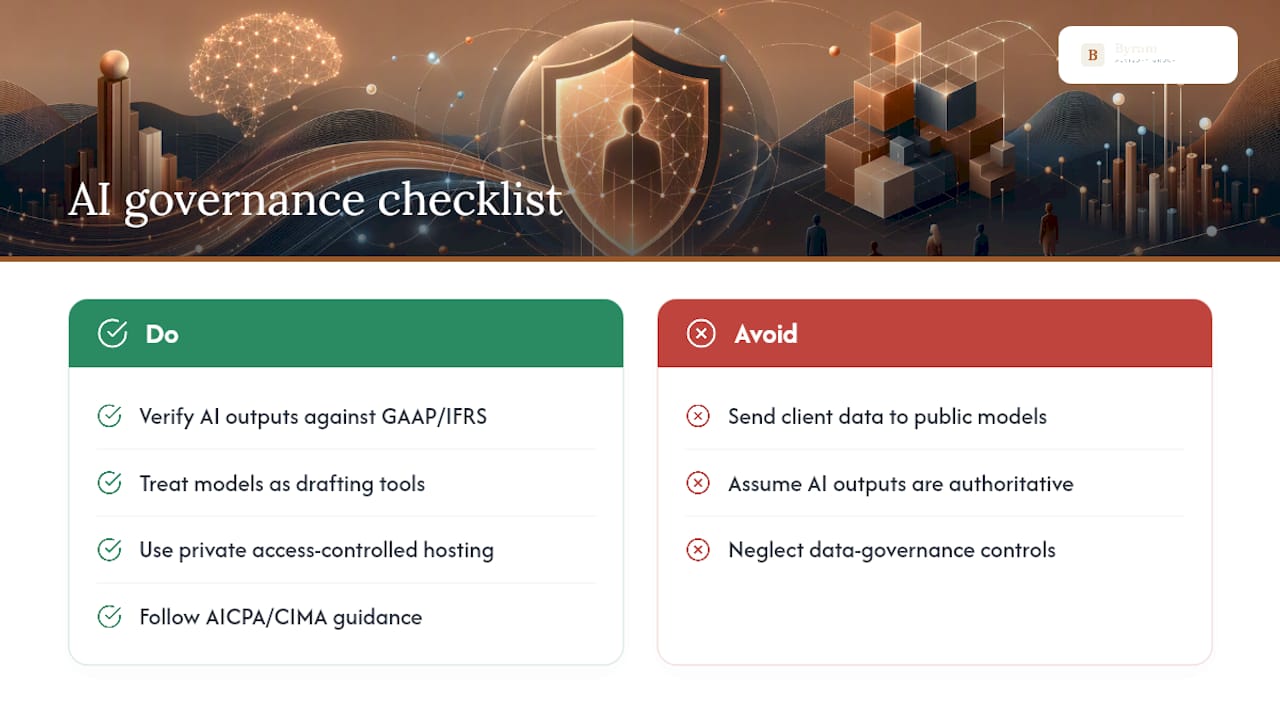
There's no single AI-specific law governing accounting practice yet, which puts the weight on existing professional standards to fill the gap. IFAC's guidance frames the core challenge as governance: firms are expected to verify AI outputs against GAAP or IFRS themselves, treating the model as a drafting tool rather than a source of authoritative judgment. That expectation applies whether the firm built the tool internally or licensed it from a vendor.
Client confidentiality rules haven't changed just because AI is involved, but they're harder to satisfy without deliberate controls. Sending client financial data through a public AI model with no data-handling agreement can put a firm on the wrong side of its own confidentiality obligations, regardless of how good the output looks. That's why enterprise deployments increasingly favor private, access-controlled hosting rather than consumer-facing tools.
AICPA & CIMA maintain a growing library of AI resources aimed at helping practitioners build competence in exactly this area, from data governance to output verification, because the professional bodies see this as a skills gap as much as a technology gap. Expect state boards of accountancy and audit oversight bodies to start issuing more specific guidance on AI-assisted work papers and disclosure requirements over the next few years, following the same pattern seen with other emerging technologies before formal rules catch up to practice.
Why Governance Matters More Than the Model You Pick
Every accounting technology cycle produces the same argument: the tool versus the judgment. Spreadsheets didn't replace accountants, and neither will AI, but I think the profession is underestimating how much the shape of the job is about to change. The routine tasks that used to fill a junior staffer's first two years, the categorizing, the reconciling, the chasing down a missing receipt, are exactly what AI handles best. That leaves a real question about how new accountants build judgment if the reps that used to teach it get automated away.
The firms that get this right treat AI governance as a training investment, not a compliance checkbox. Someone has to own verification, someone has to know when to escalate, and someone has to keep teaching the fundamentals even as the tool does the grunt work. If your firm hasn't assigned that ownership yet, start there before you pick another tool. Byram-advisory's Field Guide is a reasonable place to begin that conversation.
— Owen
Get Hands-On Help Implementing AI in Your Firm
Reading about AI governance and actually building it into your firm's daily workflow are two different problems, and Byram-advisory exists to close that gap without locking you into a rigid, off-the-shelf tool that doesn't fit your chart of accounts.
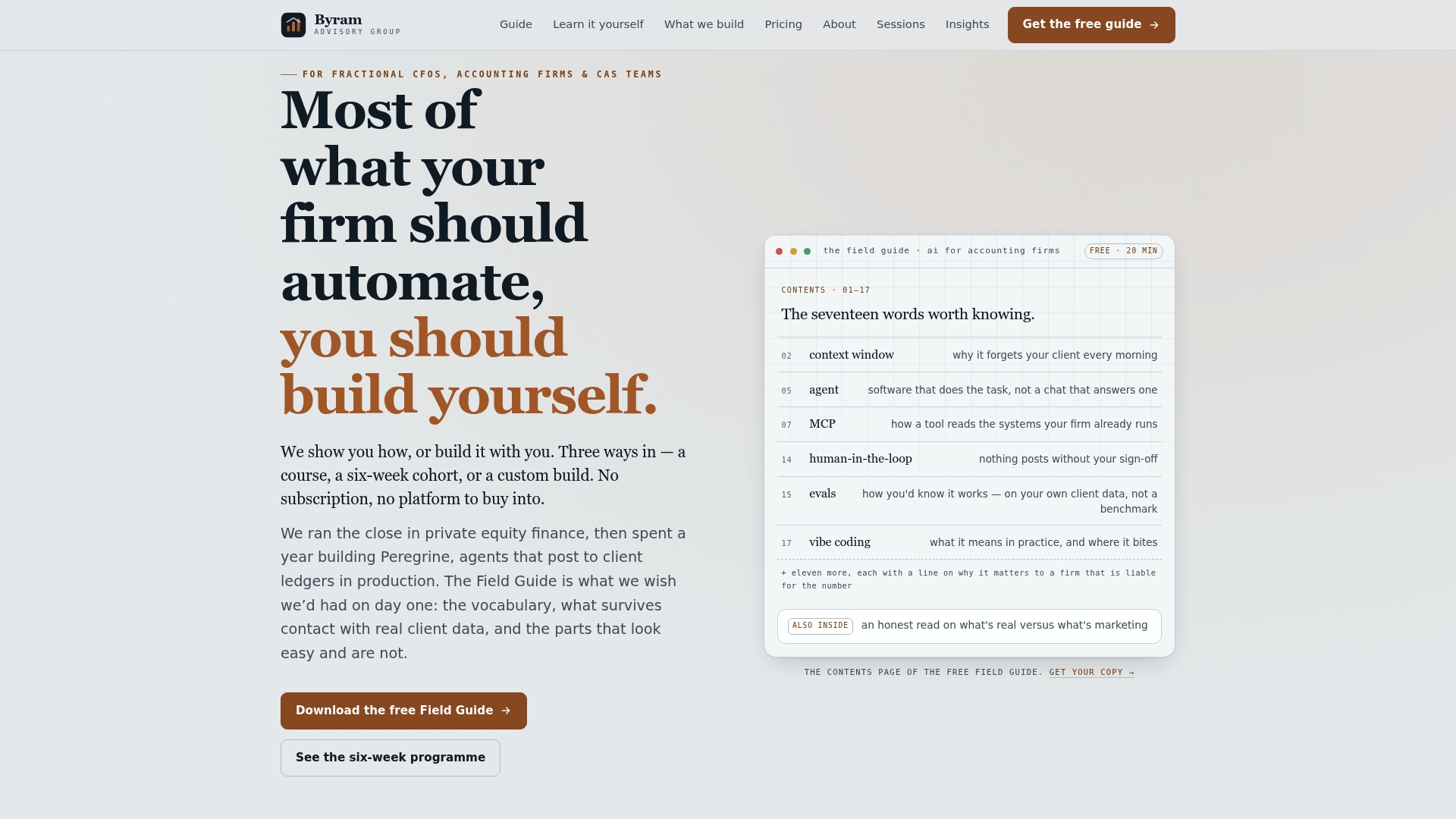
Start with The Field Guide to AI for Accounting Firms, a free resource that walks through exactly the pilot-to-scale sequence covered above, built specifically for firms figuring out where to start. If you want structured, self-paced training instead, the DIY AI Implementation Course runs $500 and gives your team templates and a guided path through the same rollout steps. For firms that need a custom build rather than a course, Byram-advisory works directly with fractional CFOs and accounting teams on Peregrine integrations built around your existing QuickBooks setup. Download the Field Guide first, then reach out if a custom build makes more sense than a self-guided course.
Sources
- AI Is Reshaping Accounting Jobs by Doing the “Boring” Stuff | Stanford Graduate School of Business
- Artificial Intelligence & Accounting | IFAC