

Cash position reporting is the consolidated, up-to-the-minute view of available liquidity that finance teams use to make same-day payment and funding decisions. Its operational value is simple: it tells a controller or CFO exactly how much cash is usable right now, across every bank account and entity, before that money gets committed elsewhere. This article walks through the metrics, the data architecture behind a trustworthy daily number, and the implementation steps that turn a manual morning scramble into an automated, auditable process.
TL;DR:
- Automate bank feeds for high-value accounts and reconcile expected inflows and outflows to ensure daily cash positions are accurate and timely.
- Prioritize maintaining a complete, up-to-date account inventory with designated owners before automating or analyzing ratios to prevent missing accounts and stale data.
- Focus on automating reconciliation processes and setting exception alerts to catch discrepancies early and reduce manual review time.
- Use live foreign exchange rates and confirm feed timestamps daily to prevent false alarms caused by currency swings or delayed updates.
- Track key ratios like cash ratio weekly to identify liquidity trends, with a downward CPR indicating emerging liquidity issues before they become critical.
Table of Contents
- What Cash Position Reporting Actually Covers
- Key Metrics and Formulas Behind the Daily Number
- The Data Architecture Behind a Trustworthy Morning Position
- How to Build a Reliable Daily Cash Position Process
- What Finance Leaders Actually Use This For
- Where Cash Position Reports Go Wrong
- Automating the Morning Number: What Actually Works
- Why Most Teams Get Cash Position Reporting Backward
- Get Your Daily Cash Position Right, Without the Manual Grind
- Sources
What Cash Position Reporting Actually Covers
A cash position report answers one question: how much cash can this business actually touch today? That's different from a cash balance, which is just what a bank statement shows at a point in time, and it's different from cash flow reporting, which projects movement over weeks or months. The GFOA's guidance on cash positioning frames this as a core treasury responsibility built on two habits: polling every bank account daily and reconciling expected inflows against expected outflows before the money actually moves.
Cash flow forecasting looks forward, sometimes weeks or several months. Cash position reporting looks at right now or the very near term. J.P. Morgan's treasury guidance describes these as complementary, not competing, disciplines: the position tells you what you can do today, and the forecast tells you what you'll be able to do next month. Confusing the two is one of the most common mistakes finance teams make when building their reporting stack.
A well-built daily position report typically includes:
- Opening bank balances for every account, pulled fresh each morning
- Expected inflows for the day (customer payments, intercompany transfers, investment maturities)
- Expected outflows (payroll runs, vendor payments, debt service, tax remittances)
- Restricted or segregated cash that isn't available for operational use, even though it shows up in the bank balance
- Net position by entity and currency, before consolidation
That last point matters more than it sounds. A business with three subsidiaries and a euro-denominated account can look flush on paper while one entity is actually short. Position reporting is where that gap gets caught, ideally before 9 a.m., not during a board meeting three weeks later.
Key Metrics and Formulas Behind the Daily Number
The core calculation behind any cash position report is straightforward, but the metrics that give it context are where most teams get sloppy. Start with the net cash position formula:
Net Cash Position = Opening Bank Balance + Expected Inflows − Expected Outflows − Restricted Cash
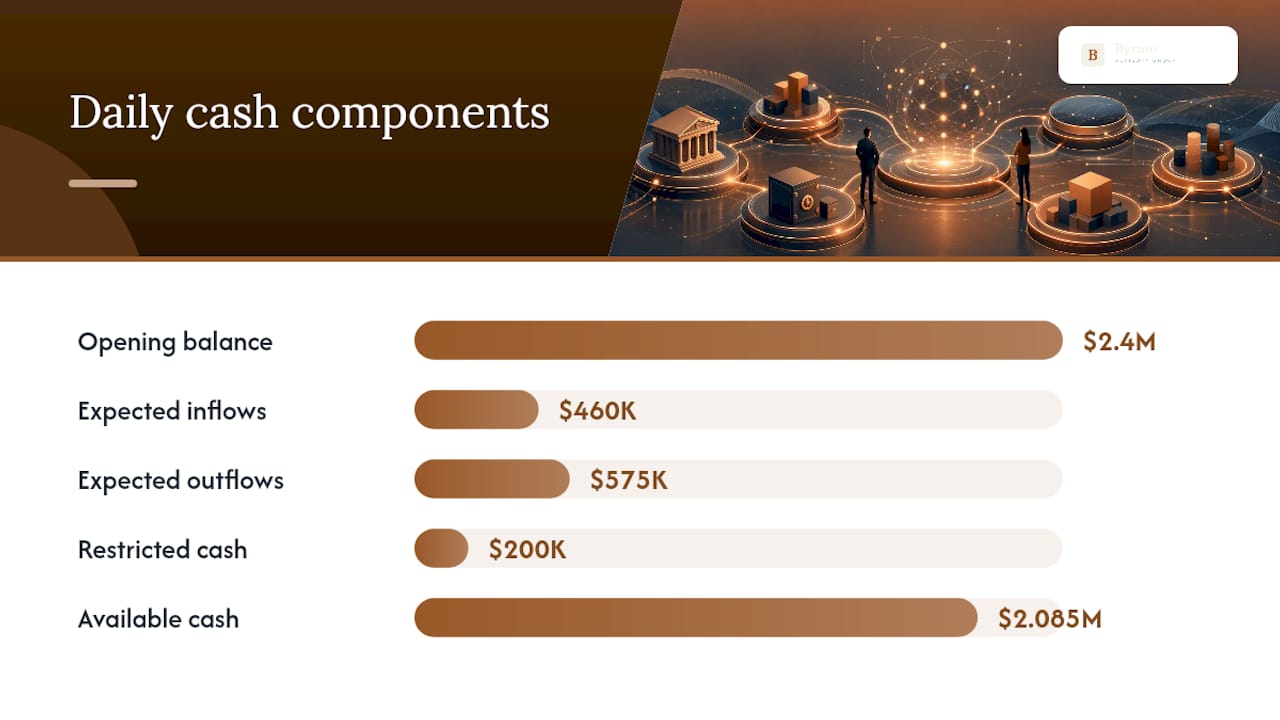
Say a company opens the day with $2,400,000 across its operating accounts. It expects $310,000 in customer receipts and a $150,000 intercompany transfer to land before close of business. Scheduled outflows include a $480,000 payroll run and $95,000 in vendor payments. There's also $200,000 sitting in a restricted account tied to a loan covenant. The math:
$2,400,000 + $310,000 + $150,000 − $480,000 − $95,000 − $200,000 = $2,085,000 available
That's the number a treasurer actually acts on, not the raw bank balance.
Beyond the daily number, three ratios give the position context over time:
| Metric | Formula | What it tells you |
|---|---|---|
| Cash Position Ratio (CPR) | Available Cash ÷ Total Current Liabilities | How much of near-term obligations cash alone could cover |
| Cash Ratio | (Cash + Cash Equivalents) ÷ Current Liabilities | Strictest liquidity test; excludes receivables and inventory |
| Current Ratio | Current Assets ÷ Current Liabilities | Broadest liquidity view; includes receivables, inventory, prepaid items |
The cash ratio is the one worth watching daily because it strips out everything that isn't already cash or a cash equivalent under IAS 7's definitions. A cash ratio consistently below 0.2 usually signals the business is leaning on receivables collection timing to cover short-term obligations, which is fine until a big customer pays late. The current ratio is more useful for quarterly board reporting than for daily operational decisions, since it moves slowly and includes assets that take time to convert.
Pro Tip: Track your cash position ratio weekly even if you report the raw number daily. A single day's dip usually means nothing; a four-week downward trend in CPR is the earliest warning sign of a real liquidity problem.
The Data Architecture Behind a Trustworthy Morning Position
The accuracy of a daily cash position depends entirely on what feeds it, and this is where most reporting breaks down long before anyone looks at a formula. Bank connectivity comes in several flavors, each with different latency:
- File-based feeds (BAI2, MT940) update once or twice daily and can lag by hours
- Host-to-host connections offer more frequent updates but require heavier IT setup
- API-based feeds deliver near-real-time balances and are increasingly the standard for active accounts
- ISO 20022/camt messaging is replacing older formats and materially improves intraday freshness once migrated
If your team is still running file-based feeds for high-volume accounts, treat that migration as a project risk, not a someday task. Format and timeline changes during a bank switch can quietly break a position report for weeks.
Bank balances only tell half the story. Expected inflows and outflows come from the ERP, the accounts receivable and payable systems, and often a treasury management system (TMS) layered on top. The tricky part is that ERP data shows expected flows, not cleared ones, so a payment marked "sent" in QuickBooks or a similar system might not clear the bank for another two business days. Reconciling expected against cleared is the single most common source of a wrong morning number.
Multi-entity businesses add currency risk on top of that. For intraday decisions, use live mid-market FX rates rather than a fixed daily rate, but document your policy for hedgeable exposures and cutoff timing. Without that documentation, intraday FX swings create false alarms that send people chasing a "shortfall" that's really just exchange-rate noise.
Before trusting any morning position, run a freshness check: confirm the timestamp on every bank feed, flag any account that hasn't updated in the expected window, and reconcile at least the largest three accounts against the previous day's cleared transactions.
How to Build a Reliable Daily Cash Position Process
Most finance teams don't fail at cash position reporting because the formulas are hard. They fail because the process around collecting and validating the data was never built with intention. Here's a sequence that works whether you're starting from spreadsheets or upgrading an existing setup.
- Inventory every bank account. List every account across every entity, currency, and business unit, and assign an owner to each one. This sounds basic; it's also the step most teams skip, and missing accounts are the number one cause of a wrong position.
- Establish a daily polling routine. Pull balances at the same time each morning, ideally before 8 a.m. local time, so the number reflects overnight settlement.
- Connect ERP-expected flows. Layer in scheduled payables and receivables from your accounting system so the report shows expected movement, not just static balances.
- Automate the largest-value accounts first. Automation delivers value fastest when teams start with feeds for high-dollar accounts and expand from there, rather than trying to automate every account simultaneously.
- Build multi-entity consolidation. Once individual entities report cleanly, roll them up into a group-level view with documented FX conversion rules.
- Set exception alerts. Configure flags for unexpected balance drops, missing feed updates, or accounts that fall below a defined threshold.
- Reconcile weekly against the general ledger. A daily position that never ties back to formal books eventually drifts from reality.
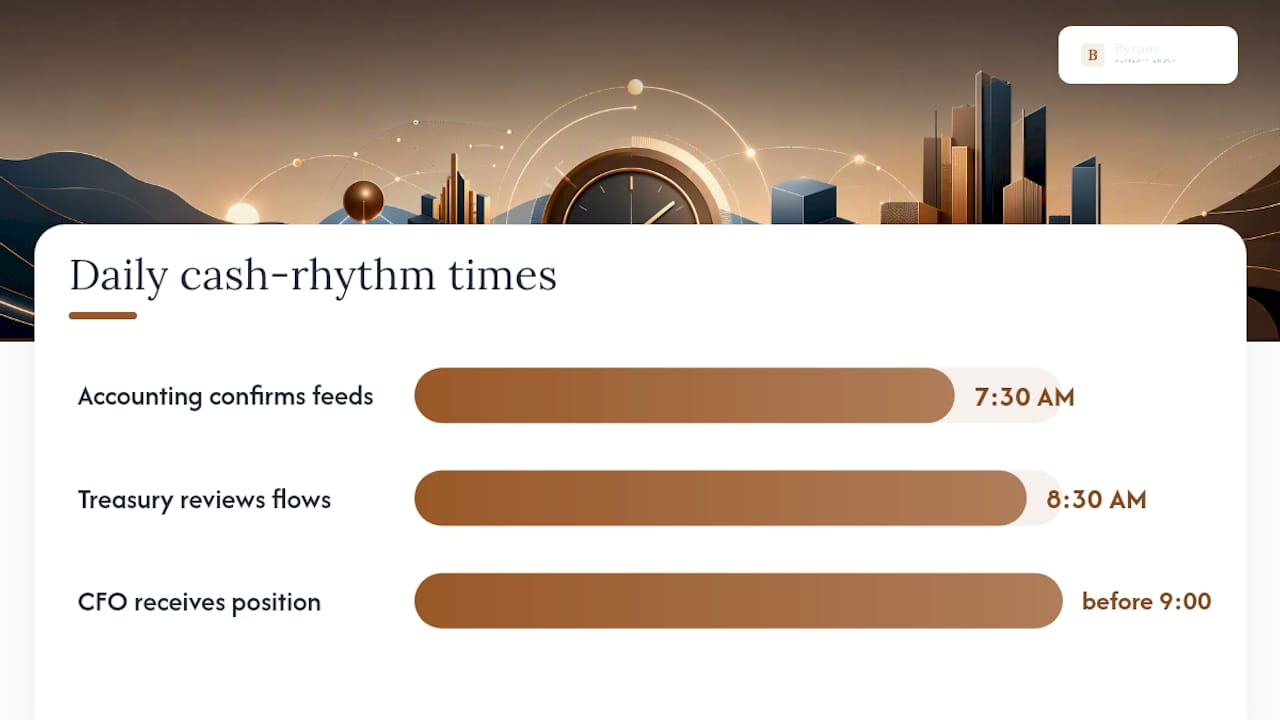
A workable daily rhythm typically looks like this: the accounting team confirms overnight bank feeds by 7:30 a.m., the treasury analyst or controller reviews expected flows and flags exceptions by 8:30, and the CFO or fractional CFO gets a consolidated position before 9. Roles matter here. Someone owns data accuracy, someone owns the review, and someone owns the decision. Without that split, the report becomes a shared responsibility that nobody actually checks.
The controls that keep this honest over time include:
- A documented account inventory with named owners
- Automated bank-to-ledger reconciliation, not manual matching
- A defined exception triage process (who investigates a flagged item, and by when)
- A weekly variance review comparing forecasted flows to what actually cleared
When evaluating technology to support this, prioritize connectivity breadth (how many banks and formats it supports), native ERP sync rather than manual export/import, built-in reconciliation automation, and configurable alerting. A platform that checks those four boxes will outperform one with a nicer dashboard but weaker integrations.
Pro Tip: Don't try to automate everything in month one. Start with your three highest-balance accounts, prove the reconciliation logic works, then expand. Teams that try to automate the full account list on day one usually stall out for months.
What Finance Leaders Actually Use This For
A reliable daily position isn't a reporting exercise for its own sake. It drives real decisions, several times a week, in almost every finance function.
Treasury teams use it to decide intraday funding moves, block a payment before it clears if a shortfall shows up, sweep surplus cash into short-term investments, and catch fraud patterns like an unexpected outbound wire that doesn't match any expected outflow. Controllers use it to avoid overdraft fees, which sounds minor until you calculate the annualized cost of chronic overdraft coverage. CFOs use it as an early warning system that catches liquidity stress weeks before it shows up in a monthly close.
The operational benefits compound over time:
- Reduced overdraft risk from catching shortfalls same-day instead of after the fact
- Faster funding and investment decisions because the number is trusted, not double-checked
- Audit readiness, since a documented daily process with clean reconciliation is exactly what external auditors want to see
- Fewer surprises in month-end close, because discrepancies get caught daily instead of accumulating
If you want to measure whether your own process is working, track time-to-report (how long it takes from bank open to a finalized position) and exceptions reduced month over month. Both numbers should trend down as automation matures.
Where Cash Position Reports Go Wrong
Bad positions almost always trace back to a handful of repeat offenders. Missing accounts top the list, usually a dormant account someone forgot to include in the inventory, or a new subsidiary account nobody added to the feed. Uncleared items are next: a payment marked as sent that hasn't actually settled, inflating the apparent balance. FX mismatches happen when a stale exchange rate gets applied to a multi-currency consolidation. And stale files, particularly on older file-based bank feeds, can silently show yesterday's balance as today's.
Watch for these red flags in a morning report:
- A balance that hasn't changed in more than one business day
- An account missing from the report that appeared yesterday
- A net position that swings more than expected with no matching transaction explanation
- Inflows or outflows still marked "pending" more than 48 hours after the expected date
The fix isn't more scrutiny at review time. It's structural: maintain a live account inventory, automate bank-to-ledger reconciliation instead of matching by hand, and build an exception triage process so flagged items get investigated the same day, not the same week. Manual morning consolidation commonly takes 80 to 110 minutes when done by hand across multiple accounts, which is often the real reason exceptions pile up unreviewed.
Automating the Morning Number: What Actually Works
The pattern that holds up across most finance teams looks like this: bank aggregation feeds pull balances automatically, that data syncs against ERP-expected flows, and an agentic workflow layer flags anything that doesn't reconcile before a human ever opens a spreadsheet. That's the structure Byram Advisory Group builds into client engagements, connecting directly with platforms like QuickBooks rather than asking teams to re-key data across systems.
The value shows up in two places: time and trust. Teams spend less time assembling the morning number by hand, and the number itself carries fewer silent errors because reconciliation happens automatically instead of through manual matching. That combination is what lets a controller sign off on a position with confidence instead of a second gut-check.
A few patterns worth adopting regardless of which platform you use:
- Automate the highest-value accounts before touching the long tail of smaller ones
- Sync expected flows from the ERP rather than re-entering them
- Build exception alerts into the workflow itself, not a separate manual review step
Byram Advisory's Field Guide to AI for Accounting Firms walks through this automation pattern in more detail, and the firm's agentic workflow resources cover how the reconciliation layer reduces manual handoffs specifically.
Why Most Teams Get Cash Position Reporting Backward
Most advice on this topic starts with metrics: calculate your cash ratio, track your CPR, build a dashboard. That's backward. The formulas in this article take five minutes to understand. The real work, and the real failure point, is in the data plumbing underneath them.
I'd argue the conventional wisdom overweights the math and underweights the account inventory. A perfectly calculated cash ratio built on a position report that's missing two dormant accounts and running on a stale bank file from Tuesday is worse than useless. It's actively misleading, because it looks precise.
If you're building or fixing a cash position process, prioritize in this order: account inventory and ownership first, reconciliation automation second, and only then worry about which ratios to track weekly versus daily. Teams that skip straight to dashboards end up with beautiful reports built on unreliable inputs. The survey data on treasury pain points backs this up: most treasury professionals cite forecasting and positioning accuracy, not formula complexity, as their hardest challenge. Fix the plumbing first. The math takes care of itself.
— Owen
Get Your Daily Cash Position Right, Without the Manual Grind
If you've read this far, you already know the hard part of cash position reporting isn't the formulas. It's the account inventory, the reconciliation, and the daily grind of chasing down stale bank feeds by hand. A platform called Peregrine aims to remove that grind for fractional CFOs and accounting firms by syncing directly with QuickBooks so expected flows and cleared balances stay reconciled automatically instead of through a spreadsheet someone rebuilds every morning.

That fits firms managing multiple client entities just as well as it fits an internal finance team juggling several subsidiaries. Instead of building your own reconciliation logic from scratch, you get a platform already built around the same automation pattern this article describes: bank aggregation, ERP sync, and exception flagging that catches problems before they reach a client's desk. Start with the free Field Guide to AI for Accounting Firms to see the framework in detail, or visit Byram Advisory to talk through what a custom-built cash position workflow would look like for your firm.
This article is general information, not a substitute for advice from a qualified financial advisor. Consult a qualified financial professional about your own circumstances before acting on anything here.
Sources
For cash classification and statement presentation, IAS 7 and ASC 230 guidance from KPMG are the two references worth keeping close. For treasury process design, the GFOA's cash positioning materials remain a solid technical grounding.
- Your Position: The Ins and Outs — GFOA
- Cash flow management and reporting guide for businesses — J.P. Morgan
- Cash positioning: What it is & how to automate it — Embat