

Financial data integrity means your numbers are accurate, complete, consistent, unique, and traceable back to their source, every time someone pulls a report. The only way to hold that standard is to stop treating it as a monthly cleanup task and start enforcing it continuously, with automated validation and reconciliation running under real governance. Frameworks like ICFR under COSO and NIST's guidance on monitoring modules exist because manual quarterly checks catch problems months too late.
TL;DR:
- Continuous, automated validation and reconciliation are essential to maintain data accuracy, completeness, consistency, uniqueness, and traceability in financial reporting.
- Preventive, detective, and corrective controls must work together, with clear ownership assigned to each critical data domain beyond just system-based accountability.
- Normalizing data at ingestion, implementing staged matching, and adopting real-time continuous reconciliation significantly improve data integrity and reduce manual effort.
- Mapping data controls to the ICFR, COSO, and NIST frameworks ensures audit readiness and strengthens compliance with regulations like SOX, GDPR, and IFRS.
- Real-world failures, such as Citi’s $136 million fine, highlight the importance of addressing longstanding data issues through profiling, rule automation, and ongoing monitoring.
Table of Contents
- What Is Financial Data Integrity and Why Does It Matter?
- What Causes Financial Data Integrity Failures?
- How Do You Prevent and Correct Data Integrity Failures?
- How Should Finance Teams Structure Their Data Architecture?
- How Do ICFR, COSO, and NIST Guide Compliance Testing?
- How Do You Measure Financial Data Integrity Over Time?
- How Does Poor Data Integrity Affect Business Decisions?
- Which Regulations Govern Financial Data Integrity?
- What Do Real Data Integrity Failures and Fixes Look Like?
- Can Blockchain Solve Financial Data Integrity Problems?
- How Byram Advisory Puts Continuous Integrity Into Practice
- Lessons From Implementing Continuous Integrity Controls
- Sources
What Is Financial Data Integrity and Why Does It Matter?
Financial data integrity rests on five dimensions, and finance teams that treat them as a checklist rather than a system tend to fail audits for the same reasons year after year.
Accuracy means a number reflects what actually happened: the invoice amount matches the contract, the bank feed matches the ledger. Completeness means nothing is missing. A vendor payment with no corresponding purchase order is a completeness gap, even if every field that exists is correct. Consistency means the same data element means the same thing across systems. When your CRM calls a customer "Acme Corp" and your ERP calls it "Acme Corporation LLC," you have a consistency failure waiting to break your reconciliation. Uniqueness prevents duplicate records, duplicate invoices, and duplicate journal entries from inflating balances. Traceability ties every number back to its origin document, its approver, and its transformation history.
None of this matters equally across every field you track. Finance teams narrow their focus to critical data elements (CDEs), the specific fields where an error would actually distort a financial statement or a compliance filing, such as vendor tax IDs, transaction amounts, and account codes in the chart of accounts. Profiling those fields for null rates and duplicate rates does more for data quality management than trying to perfect every column in every table.
These principles map cleanly onto the datasets finance teams already own:
- Vendor master data: tax IDs, banking details, and payment terms, where duplicates cause double payments
- Transaction data: amounts, dates, and currency codes, where format drift breaks automated matching
- Chart of accounts: account mappings, where inconsistent coding scrambles consolidated reporting
The governance baseline for all of it is internal control over financial reporting (ICFR) built on the COSO framework, which ties data quality directly to the control environment auditors test every year.
What Causes Financial Data Integrity Failures?
Most integrity problems trace back to one of three roots, and diagnosing which one you're dealing with determines whether you need a technical fix, a process fix, or both.
- Technical causes. Format mismatches (dates stored as text in one system, as date objects in another), missing unique identifiers, migration errors when moving to a new ERP, and legacy systems that were never built to talk to modern APIs.
- Operational causes. Manual spreadsheet reconciliations that live outside any audit trail, ad-hoc corrections made without documentation, unclear ownership of who is accountable for a given dataset, and reconciliation processes that depend on one person's institutional memory.
- Event-driven causes. A vendor changes their invoice feed format without notice. A system upgrade silently changes a field's data type. A cyber incident corrupts or exposes records before anyone notices the gap.
The impact compounds fast. A single format mismatch in a bank feed can generate a reconciliation backlog that takes a controller's team a full week to unwind manually. Audit findings tied to data integrity gaps routinely trigger expanded testing scope the following year, which means more auditor hours and more fees. At the extreme end, regulators have directly cited data and transaction-monitoring failures as the root cause behind enforcement actions, including a $136 million fine against Citi tied to longstanding data issues the bank had not remediated. That is not a hypothetical risk for a mid-size firm's client base. It is the ceiling of what happens when data problems go untreated long enough.
How Do You Prevent and Correct Data Integrity Failures?
Controls fall into three buckets, and most finance teams over-invest in one while neglecting the other two.
Preventive controls stop bad data from entering the system in the first place:
- Edit and limit checks at the point of ingestion, rejecting transactions outside expected ranges
- Canonical identifiers that force every system to reference the same vendor, customer, or account the same way
- Mandatory fields that block a record from saving until required data is present
Detective controls find problems that got through anyway:
- Continuous reconciliation rather than month-end batch reconciliation
- Duplicate detection running against new records as they arrive
- Exception routing that flags anomalies to a specific owner within hours, not weeks
Corrective controls close the loop once an issue is found: documented remediation workflows with a clear approval chain, a permanent audit trail showing who fixed what and when, and automated fixes for well-understood error patterns (a mistyped currency code, for instance) where human review would just slow things down without adding judgment.
None of it works without governance. Someone needs to own each critical dataset. Data stewardship assigns a specific person or team accountability for a specific data domain, and that ownership needs to be tested periodically, the same way a financial control gets tested during an audit cycle.
Pro Tip: Assign data stewardship by data domain, not by system. The person who owns vendor master data quality should own it whether the record lives in your ERP, your AP automation tool, or a spreadsheet someone still uses as a workaround. Ownership tied to a system creates gaps the moment data crosses a boundary.
How Should Finance Teams Structure Their Data Architecture?
Architecture decisions made early determine whether integrity is testable later or just a matter of trust.
Start with normalization at ingestion. Dates, currency codes, and identifiers need to be converted into a single canonical format the moment data enters your system, not cleaned up after the fact. This is the highest-leverage move most teams skip, because most of the "mismatches" flagged in reconciliation are not real transactional discrepancies. They are formatting inconsistencies that a normalization layer would have caught before the mismatch was ever recorded.
From there, matching should run in two stages. Deterministic matching handles the easy cases, where identifiers line up exactly. Probabilistic matching handles everything else, scoring likely matches based on amount, date proximity, and description similarity. The smart move is building confidence bands into that scoring: auto-resolve matches above a high threshold, route the middle band to human review, and hold anything below the threshold for investigation. Feed every confirmed resolution back into your normalization rules, so the system gets sharper with use instead of repeating the same manual review every month.
A well-tuned automated reconciliation setup typically aims for a 95% or higher automatic match rate. Once match rates drop below 90%, the manual investigation burden rises fast enough to erase most of the time automation was supposed to save.
The last piece is the operational ledger: an authoritative, continuously reconciled record that reflects reality in real time rather than the last time someone ran a batch job.
- Normalize at ingestion, not after the fact
- Match deterministically first, probabilistically second
- Build confidence bands with human review only where it adds judgment
- Treat reconciliation as continuous, not a month-end event
- Feed resolved exceptions back into the rules that generate them
How Do ICFR, COSO, and NIST Guide Compliance Testing?
Data integrity controls only count if they hold up under audit scrutiny, and that means mapping them explicitly to the frameworks examiners already use.
ICFR under COSO breaks controls into entity-level controls (your overall control environment and governance tone), process-level controls (the specific checks embedded in a workflow), and IT general controls, or ITGCs (access management, change management, and system security). Every data integrity control you build should slot into one of those three categories so an auditor can trace it directly to the COSO component it satisfies.
NIST's guidance on monitoring modules gives you the practical mechanism: embedding edit checks, limit checks, and duplicate detection directly into the system, with an integrated test facility that runs test transactions through production logic without touching real records.
- Map every automated check to a specific ICFR component before an auditor asks you to
- Use integrated test facilities to prove controls work without risking live data
- Keep change management evidence for every rule update, since auditors will ask what changed and when
- Document control testing frequency, not just control existence
The Citi enforcement action is the clearest recent proof that regulators treat data integrity gaps as control failures, not IT footnotes.
How Do You Measure Financial Data Integrity Over Time?
Integrity is only manageable if it is measurable, and the metrics that matter are narrower than most dashboards suggest.
Track exception volume as a raw count and as a trend. A rising exception count with a stable match rate usually points to a new data source or a vendor feed change, not a system failure. Track time-to-detection, how long an error sits undetected, and days-to-remediate, how long it takes to close once found. Track lineage coverage, the share of your critical data elements where you can trace a number back to its source document.
Below a 90% automatic match rate, the manual investigation cost climbs sharply enough that most of the automation's efficiency gain disappears.
Leadership dashboards should show trend lines: match rate over the last six months, exception volume by category, days-to-remediate by severity. Operational dashboards need more granularity: which specific accounts, vendors, or feeds are generating the exceptions right now.
- Automatic match rate (target 95%+)
- Exception volume, tracked by category and trend
- Time-to-detection and days-to-remediate
- Lineage coverage across critical data elements
Alerts should trigger a root-cause workflow automatically, not just a notification. An alert that just says "exception found" without routing to an owner and a resolution deadline is a metric nobody acts on.
How Does Poor Data Integrity Affect Business Decisions?
Bad data doesn't just create audit headaches. It changes what leadership decides to do, often without anyone realizing the input was wrong.
A cash flow forecast built on a chart of accounts with inconsistent coding will misstate which business lines are actually profitable. A fractional CFO advising a client on a hiring decision based on that forecast is giving advice built on a false premise, and neither the CFO nor the client will know until the gap shows up months later as a cash crunch. Duplicate vendor records lead to duplicate payments that sit unnoticed on the balance sheet until a reconciliation catches them, sometimes a full quarter later.
Compliance exposure compounds the business risk. A board relying on management reports built from unreconciled data is making capital allocation decisions on numbers that may not survive an audit. When those numbers later get restated, the credibility cost with lenders, investors, and regulators tends to outlast the financial correction itself.
The pattern shows up most clearly at growth-stage companies bringing on new debt or equity. Lenders and investors run due diligence specifically looking for data integrity gaps, because a gap in the historical financials is a signal that the current financials might have gaps too. A firm that can show continuous reconciliation, clean lineage, and low exception volume walks into that diligence process with leverage. A firm that can't spends weeks manually reconstructing records the diligence team is asking for, often under deadline pressure that makes new errors more likely, not less.
Which Regulations Govern Financial Data Integrity?
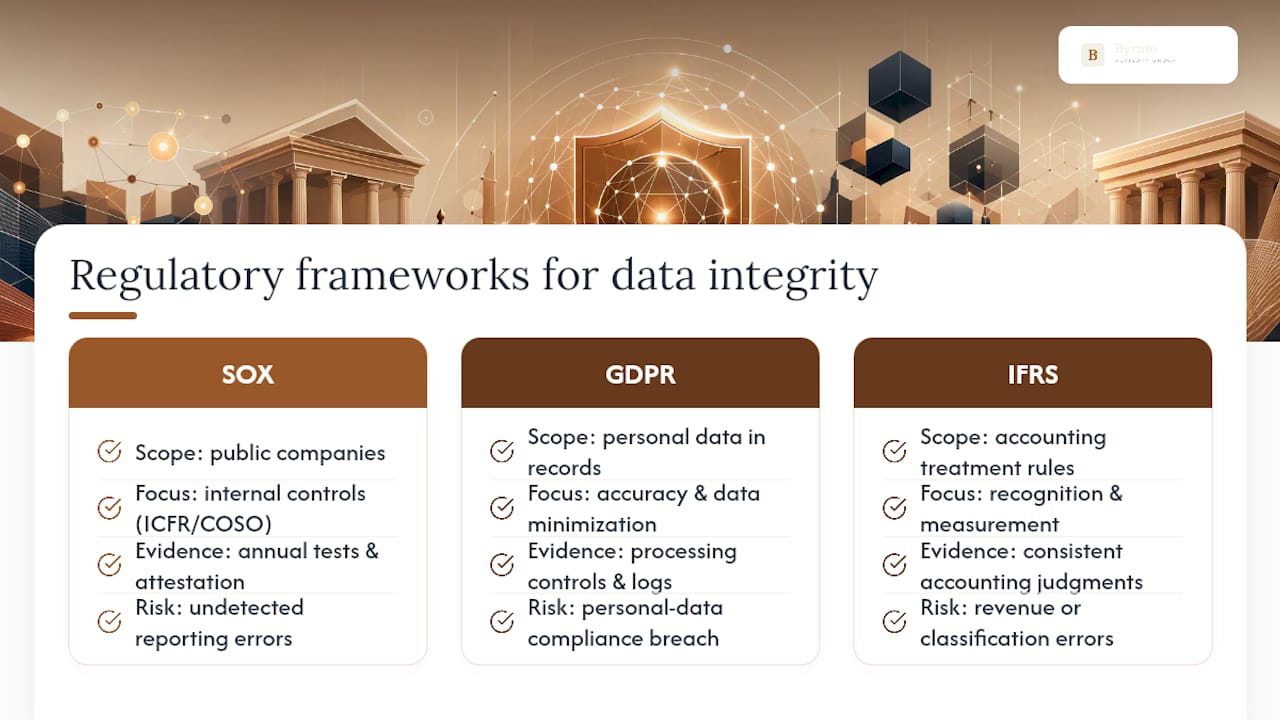
Three frameworks dominate how finance teams in the United States think about data integrity obligations, and each targets a different layer of the problem.
The Sarbanes-Oxley Act (SOX) requires public companies to maintain internal controls over financial reporting and to have those controls tested and attested annually. SOX is the reason ICFR and COSO show up everywhere in this conversation: SOX compliance is largely a matter of proving your controls actually catch the errors they're designed to catch, with evidence an external auditor can independently verify.
The General Data Protection Regulation (GDPR) applies more narrowly, governing how personal data embedded in financial records, customer names, payment details, employee information, gets stored, processed, and protected. A finance team consolidating customer billing data across jurisdictions needs data integrity controls that also satisfy GDPR's accuracy and minimization principles, since inaccurate personal data is itself a compliance violation under that regulation, separate from any financial reporting concern.
International Financial Reporting Standards (IFRS) set the accounting treatment rules that determine what "accurate" even means for a given transaction, revenue recognition timing, lease classification, and fair value measurement all depend on IFRS judgment calls that data integrity controls need to enforce consistently. A control that catches a formatting error but lets a revenue recognition misclassification through has not actually protected reporting integrity in any way that matters to an auditor or a regulator.
None of these frameworks require the same evidence, but all three reward the same underlying practice: continuous, documented, testable controls over the data that feeds the reports.
What Do Real Data Integrity Failures and Fixes Look Like?
The clearest illustration of what happens when data integrity failures go unaddressed for years, rather than months, is the enforcement action against Citi. Regulators fined the bank $136 million for failing to address data issues that had been flagged as longstanding, meaning the bank knew about the gaps and had not closed them fast enough. The enforcement wasn't about a single bad transaction. It was about a pattern of unresolved data quality problems that regulators concluded represented an ongoing control failure.
The resolution pattern that works, based on how practitioner frameworks describe recovery from these situations, generally follows the same sequence regardless of company size. First, profile the critical data elements to find where null rates and duplicate rates are actually concentrated, rather than trying to fix everything at once. Second, define business rules with finance stakeholders directly involved, since a rule written by IT alone often misses the accounting judgment a transaction actually requires. Third, automate the recurring checks so the same error class doesn't require manual detection every cycle. Fourth, keep monitoring continuous rather than treating the fix as a one-time cleanup project.
Smaller firms face a scaled-down version of the same failure mode constantly: a fractional CFO inherits a client's books where the vendor master file has forty duplicate entries for the same twelve vendors, built up over years of different bookkeepers entering data slightly differently. The fix isn't dramatically different from Citi's, just smaller in scope. Someone has to define the canonical identifier, merge the duplicates, and put a control in place so it doesn't happen again.
Can Blockchain Solve Financial Data Integrity Problems?
Blockchain gets pitched constantly as a data integrity solution, and the pitch is only half right.
A blockchain ledger is genuinely good at one thing: making a record immutable once it's written, with a cryptographic trail showing exactly when and by whom. That solves traceability well. It does nothing for accuracy. If the transaction data entering the blockchain is wrong, duplicated, or inconsistent with your chart of accounts, the blockchain will faithfully and permanently preserve that error. Immutability is not the same thing as correctness, and treating it as such is the most common mistake finance teams make when evaluating blockchain-based reporting tools.
The integration challenges are practical, not conceptual. Most finance teams run a chart of accounts, an ERP, and a handful of point solutions that were never built with blockchain interoperability in mind. Writing every transaction to a distributed ledger in real time requires normalization work upstream, the same normalization work that a well-built reconciliation system needs anyway, plus new infrastructure to manage the write process itself. For most mid-size firms, that infrastructure cost outweighs the traceability benefit blockchain offers, especially when a well-documented, continuously reconciled operational ledger already provides an audit trail auditors accept today.
Where blockchain genuinely adds value is in specific high-friction use cases: cross-border payments with multiple intermediaries, or supply chain finance where multiple counterparties need to trust the same record without a shared system of record. For standard month-end close and financial reporting, the operational discipline matters more than the ledger technology underneath it.
How Byram Advisory Puts Continuous Integrity Into Practice
Everything above is a framework. Putting it into practice means automating the checks that used to depend on someone remembering to run them. Byram Advisory Group built its platform, Peregrine, specifically to give fractional CFOs and accounting teams that continuous layer without ripping out the tools they already run.

Peregrine integrates directly with QuickBooks, so ingestion checks, duplicate detection, and reconciliation run against the client's actual books rather than a parallel system someone has to maintain separately. Exception routing sends anomalies to the right person automatically instead of surfacing them three weeks later during month-end close. Firms using this kind of continuous approach typically see fewer manual corrections, a faster close cycle, and financials that are already buyer-ready and audit-ready before an external party ever asks to see them.
You don't have to build this from scratch to see the benefit. Byram-advisory's Field Guide to AI for Accounting Firms is a free starting point for firms figuring out where to automate first. For teams ready to build the skill set in-house, the DIY AI implementation course walks through hands-on setup for $500. And if you'd rather have the platform handle it directly, start with a look at what Peregrine automates and where your firm's biggest exception volume is likely hiding right now.
Lessons From Implementing Continuous Integrity Controls
The biggest surprise firms run into when automating data integrity isn't technical. It's political. Someone on the team has been the informal owner of "fixing the numbers" for years, and automation threatens that role before it earns their trust. Bring that person into the rule-building process early, or the rollout stalls.
Automation should handle volume, not judgment. Auto-resolve the clean matches, route the ambiguous ones to a human, and never let a system silently override a professional's read on an unusual transaction.
Start with one dataset, not everything at once. Pick the vendor master file or the bank reconciliation, prove the match rate improves, and use that result to get budget and buy-in for the next dataset. Firms that try to automate the whole general ledger in one pass tend to stall six months in with nothing shipped.
— Owen
Sources
For readers who want the primary material behind these controls: the KPMG ICFR handbook is the clearest walkthrough of COSO-based control design available. NIST's monitoring module guidance explains integrated test facilities in technical depth. NAYA's operational accuracy framework covers normalization and reconciliation architecture. Reuters' Citi enforcement reporting shows the regulatory stakes in practice.
- NIST Special Publication: Self-Monitoring Accounting System (Monitoring Module)
- Financial data quality in fintech: Operational accuracy framework — NAYA
- Financial Data Quality Management: Framework, Risks and Best Practices — Tale of Data