

Intercompany eliminations automation replaces manual matching and journal entry with rule-based and AI-assisted matching, automated elimination journals, and built-in governance, all applied within ASC 810 consolidation requirements. The payoff is a faster, lower-risk close: fewer manual touchpoints, fewer audit adjustments, and a consolidated set of books that reflects the company as one economic entity rather than a patchwork of subsidiaries.
TL;DR:
- Automated elimination tools significantly reduce manual reconciliation time by automatically matching transactions across multiple ERPs and staging ledgers.
- Continuous eliminations post transactions and automatic handling of currency and timing differences speed up close cycles and improve accuracy.
- Proper implementation requires mapping recurring account patterns, establishing approval workflows, and ensuring consistent NCI attribution to maintain audit trail integrity.
- Automating eliminations does not eliminate oversight; formal approvals and documentation are essential to preserve control and compliance.
- Focusing on chart-of-accounts alignment and NCI policies first ensures more reliable automation from the start and reduces errors.
Table of Contents
- What intercompany eliminations are and why they matter
- Why manual eliminations create bottlenecks
- Core automation capabilities finance teams should require
- Step-by-step implementation roadmap for automation
- Accounting rules and a worked example for inventory profit elimination
- Benefits and KPIs to track post-automation
- Publisher perspective: how Byram Advisory implements controlled automation
- What finance teams get wrong about automating eliminations
- How Byram Advisory can help with intercompany elimination automation
- FAQ
- Sources
What intercompany eliminations are and why they matter
Consolidated financial statements present a parent and its subsidiaries as a single economic entity. To do that, every transaction between related entities has to disappear from the group's books even though it is real at the entity level. ASC 810 consolidation guidance requires that intra-entity balances, sales and purchases, interest, dividends, and intra-entity profit or loss be eliminated in consolidation.
Transactions that commonly trigger eliminations include:
- Intercompany sales of goods or services between subsidiaries
- Intercompany loans and the related interest income and expense
- Dividends paid from a subsidiary to its parent
- Management fees, royalties, and cost allocations charged between entities
Where a subsidiary is not wholly owned, noncompany profit eliminated on intercompany sales may need to be attributed between the controlling interest and noncontrolling interest, depending on the group's chosen policy. That attribution detail matters later, because an automated process has to apply it consistently, not case by case.
Why manual eliminations create bottlenecks
Most of the pain in intercompany accounting comes from the same handful of structural problems repeating every close cycle.
- Entities often run on different ERPs or legacy spreadsheets, so matching requires exporting, reformatting, and reconciling data by hand.
- Cut-off timing differences and currency revaluation create balances that look like mismatches even when both sides are correct.
- High transaction volume means a large share of matches are routine, but the exceptions still need a human to chase them down.
- Journal entries made outside a formal workflow leave a thin audit trail, which auditors flag during testing.
- Adding headcount to keep pace with growth is slow to ramp and expensive relative to the actual judgment required.
None of these problems are accounting problems. They are process and data problems, which is exactly what automation is built to solve.
Core automation capabilities finance teams should require
Not every elimination tool solves the same problem, so it helps to map each capability to the bottleneck it removes.
- Matching engines that combine rule-based logic with AI-assisted confidence scoring catch exact matches automatically and flag only the ambiguous ones for review, leveraging advanced Enterprise Payment Operations to identify discrepancies and prepare consolidation elimination entries.
- A shadow GL or staging ledger pulls feeds from multiple ERPs into one surface, so matching doesn't depend on manual exports from each subsidiary.
- Continuous eliminations generate elimination journal entries as transactions post, instead of waiting for a month-end batch run.
- Currency and cut-off logic handles revaluation and timing differences automatically, rather than leaving them as recurring manual adjustments.
- Governance features, including approval workflows, version control, and a built-in audit trail, keep every automated entry traceable to its source data and its approver.
Pro Tip: Start by automating matching and leave journal posting as a reviewed, one-click approval until your team trusts the exception logic.
Step-by-step implementation roadmap for automation
A staged rollout protects the close from surprises while still moving fast. Teams that automate eliminations successfully tend to follow the same broad sequence.
- Assess: Scope which entities, ERPs, and subledgers are involved, and estimate transaction volume and chart-of-accounts alignment across entities.
- Map: Identify recurring intercompany account patterns and build matching rules and exception criteria around them.
- Integrate: Connect ERPs and subledgers to a staging layer or shadow GL, and set up data validation checks before any entry is created.
- Pilot: Run the new process in parallel with the existing manual close, tune match thresholds, and route exceptions to a reviewer.
- Govern and document: Lock in approval workflows, assign entry ownership, and capture audit evidence as entries are created, not after the fact.
- Scale: Move from periodic batch runs to continuous eliminations and add KPI dashboards that track close performance over time.
Pro Tip: Keep the pilot running in parallel with your existing manual close for at least one full cycle before retiring the old process entirely.
Accounting rules and a worked example for inventory profit elimination
Automated journals still have to follow the same accounting logic a controller would apply by hand. Under ASC 810 consolidation guidance:
- Intra-entity profit embedded in inventory still held by the buying entity at period end is deferred and eliminated until the inventory is sold outside the group.
- If the buying entity later writes the inventory down to net realizable value, that write-down affects the amount of intercompany profit left to eliminate.
- When the selling entity is partially owned, eliminated profit may be allocated to the controlling interest or shared proportionately with the noncontrolling interest, depending on the group's policy, and the method must be applied consistently.
Illustrative example. Say a subsidiary sells inventory to its parent for $120,000, and the subsidiary's cost was $100,000, leaving $20,000 of intercompany profit. If the parent still holds that inventory at period end, the consolidation entry defers the profit:
Debit: Intercompany sales $120,000; Credit: Intercompany cost of goods sold $100,000; Credit: Inventory $20,000.
The entry removes the sale and the unrealized profit from consolidated results until the inventory is sold to a third party. Tax departments typically need visibility into these eliminations too, since book and tax treatment of intercompany profit can diverge.

Benefits and KPIs to track post-automation
Automation is only worth the investment if you can show it moving the numbers that matter to the close.
- Close days: the calendar time from period end to final consolidated statements.
- Percent auto-matched: the share of intercompany transactions cleared without manual intervention.
- Exception backlog: the volume and age of unresolved mismatches at any point in the cycle.
- Audit adjustments: the count and size of corrections auditors require after the fact.
Finance teams that track close automation performance typically monitor close days, match rates, exception backlog, and audit adjustments as the core set of signals for whether an automation project is working.
ROI math is straightforward once you have a baseline: multiply hours saved per cycle by loaded staff cost, add reduced rework from fewer reopened periods, and add any reduction in external audit fees tied to faster evidence retrieval. The operational payoff shows up as a more predictable close cadence and a stronger control posture going into audit season.
Publisher perspective: how Byram Advisory implements controlled automation
Byram Advisory builds automation for fractional CFOs and accounting teams through Peregrine, a platform that integrates with accounting software like QuickBooks. Its approach to controlled automation runs every AI-driven step through written process documentation, code-level checks, and mandatory human signoff, so elimination entries stay auditable and defensible rather than opaque.
What finance teams get wrong about automating eliminations
The common mistake is treating elimination automation as a matching problem to solve and then walking away. The exceptions, the NCI attribution policy, the write-down adjustments, these are where judgment actually lives, and a tool that just posts entries without a review step quietly erodes the audit trail it was supposed to strengthen.

The other overrated idea is that automation means less oversight. The opposite is true: the firms that get the most out of automated eliminations are the ones that formalize approvals and documentation at the same time they automate the matching. Automation without governance just moves errors faster.
If you're prioritizing where to start, don't start with the fanciest matching algorithm. Start with your chart-of-accounts alignment across entities and your NCI attribution policy. Get those settled first, and the automation layer on top of them becomes far more reliable.
— Owen
How Byram Advisory can help with intercompany elimination automation
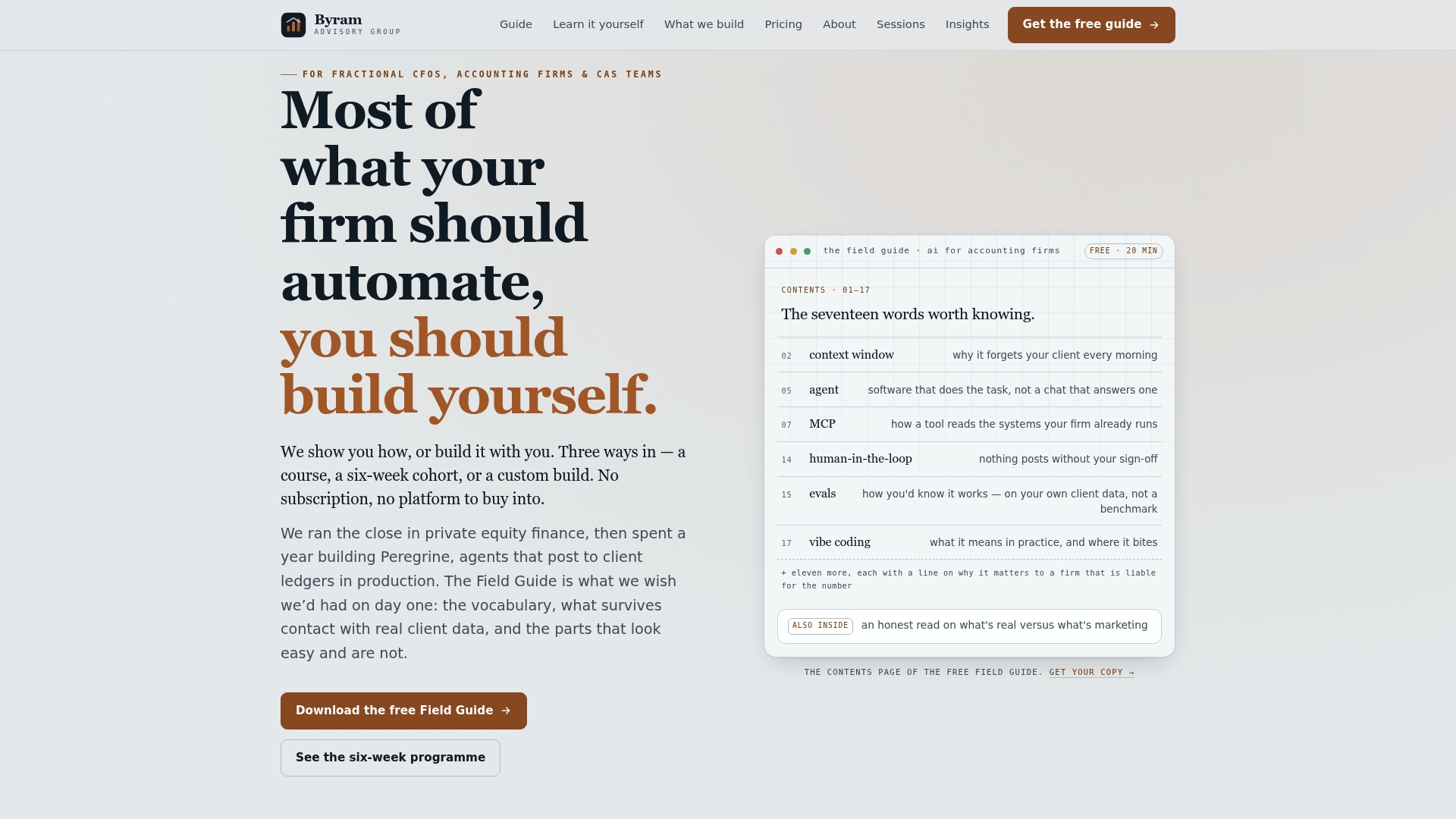
Most finance teams don't need another generic close tool, they need a system built around their own entity structure, ERP mix, and NCI attribution policy, with the code and process documentation left in their hands afterward. Several service paths are available depending on starting points:
- The Sprint is a one-off engagement for a short, focused automation build, often used to pilot elimination automation on a single entity pair.
- The Bootcamp is cohort-based training for teams looking to build internal capability to run and govern automation.
- The build is a custom engagement for teams needing a tailored elimination workflow integrated with existing ERPs.
- Peregrine, an underlying platform, connects to accounting software and keeps approvals and audit evidence in one place.
If you want to see what a pilot would look like for your entities, have your entity list, ERP systems, and a rough sense of monthly intercompany transaction volume ready, then request an assessment with Byram Advisory to scope the build.
This article is general information, not a substitute for advice from a qualified financial advisor. Consult a qualified financial professional about your own circumstances before acting on anything here.
FAQ
How are intercompany transactions eliminated?
Intercompany transactions are eliminated by matching the corresponding entries between related entities and posting a consolidation journal that removes both sides, following the intra-entity elimination requirements in ASC 810 consolidation guidance. Automated systems do this by matching transactions first, then generating the elimination entry once both sides reconcile.
Can you provide an example of an intercompany elimination entry?
Yes: if a subsidiary sells inventory to its parent for $120,000 with a cost of $100,000, and the parent still holds that inventory at period end, the elimination entry debits intercompany sales for $120,000 and credits intercompany cost of goods sold for $100,000 and inventory for $20,000. That removes the unrealized profit until the inventory sells outside the group.
How can I eliminate profit from intercompany inventory?
Profit on intercompany inventory sales is deferred and eliminated for as long as the inventory stays within the group, per ASC 810 guidance. If the buying entity later writes the inventory down to net realizable value, that write-down reduces the amount of profit still subject to elimination.
What are the three main types of intercompany transactions?
The most common categories are intercompany sales and purchases of goods or services, intercompany financing such as loans and the related interest, and intercompany equity transactions like dividends. Each type requires its own elimination treatment under consolidation accounting, and a given company may have all three in the same period.
Sources
For the full consolidation requirements behind eliminations, see PwC's consolidation guidance on intercompany transactions. For implementation detail, read Byram Advisory's approach to building AI workflows and download the Field Guide to AI for accounting firms.
- 8.2 Intercompany transactions — PwC consolidation guidance