

Internal controls are the procedures that keep your operations efficient, your financial reporting accurate, and your business compliant with the rules that apply to it. The single most impactful first step for most small businesses is fixing segregation of duties where you can, adding owner oversight where you can't, and starting monthly bank reconciliations this week. That combination catches errors and fraud faster than almost anything else you could do.
TL;DR:
- Most small businesses can significantly reduce fraud risk by implementing owner oversight and monthly bank reconciliations before investing in software automation.
- Segregation of duties should be prioritized for disbursements, vendor management, and reconciliations, with compensating controls like owner review when staff is limited.
- Automation tools such as role-based permissions and alert systems can strengthen controls but should complement, not replace, proper oversight and process fixes.
- Applying COSO's five control components is practical through simple documented policies, regular reconciliations, and informal risk assessments tailored to the business size.
- Fixing high-risk control gaps early and sequencing improvements—starting with owner review and reconciliations—prevents costly mistakes as the business grows.
Table of Contents
- What internal controls are and why they matter for your business
- Core accounting controls every small business should implement
- Compensating controls when your staff is too small to separate duties
- Apply a risk-based approach: COSO's five components for small firms
- A 30/60/90 implementation checklist and timeline
- Monitoring, detecting fraud, and responding to control failures
- Byram Advisory's take: automation reduces control friction
- Where small business control advice usually falls short
- How we can help you build these controls faster
- FAQ
- Sources
What internal controls are and why they matter for your business
Internal controls exist to serve three objectives: reliable operations, accurate financial reporting, and compliance with laws and agreements that govern your business. The COSO Internal Control—Integrated Framework built the model most auditors and accountants use to think about this, and it explicitly applies to entities of every size, not just public companies with compliance departments.
The stakes are higher than many owners assume. The ACFE's 2024 Report to the Nations found that organizations with fewer than 100 employees suffer a median fraud loss per case, often from the same handful of weaknesses: one person handling payments end to end, no second set of eyes on reconciliations, and no one reviewing vendor changes. Smaller firms also tend to add controls only after an incident rather than before one, which means the median loss figure understates how often prevention was possible.
Small businesses carry more exposure than their size suggests. You likely have fewer staff to split duties across, less formal oversight than a larger finance team, and an owner who is too busy running the business to review every transaction. That combination is exactly what COSO's framework and the ACFE's data point to as the highest-risk profile, and it's also the profile controls are cheapest to fix at this stage, before volume and headcount make the gaps harder to close.

Core accounting controls every small business should implement
Start with segregation of duties: split authorization, custody, and recordkeeping across different people wherever you can, according to Penn's operational internal controls guidance. A single person who approves a payment, signs the check, and records it in the books can hide a mistake or a theft indefinitely, because no one else ever looks at the full picture.
From there, build out the controls that protect your highest-risk cycles:
- Segregation of duties: no one person should both approve and record the same transaction, especially cash disbursements and payroll.
- Payment and vendor controls: require a second approval above a set dollar threshold and a documented review before adding any new vendor to your system.
- Reconciliations: reconcile every bank and credit card account monthly, and have someone other than the preparer sign off on it.
- Access management: give each employee their own login, limit who can edit vendor records or approve payments, and keep an audit log of changes.
These four categories cover the areas where missing segregation does the most damage: disbursements, accounts payable, and period-end close, according to Penn's guidance.
Compensating controls when your staff is too small to separate duties
Most small businesses can't fully separate authorization, custody, and recordkeeping because they don't have enough people. Compensating controls close that gap without adding headcount, and owner oversight is the highest-leverage one available, according to a small-business segregation of duties guide.
- Review bank and credit card statements yourself before anyone reconciles them, so you see raw activity first.
- Sign off personally on monthly reconciliations rather than delegating the final review.
- Approve payroll name by name each cycle instead of approving a lump total.
- Run surprise spot checks on vendor payments and expense reports a few times a year.
- Outsource high-risk functions like payroll processing or vendor master maintenance to a firm whose job is to catch errors, which is often cheaper and more reliable than hiring a second internal employee for the same task.
Software can do some of this work for you. Role-based permissions limit who can edit vendor records, dual authorization requires two people to release a wire or ACH payment, and positive pay matches checks against a list you authorized before the bank clears them.
Pro Tip: If you can only add one compensating control this month, make it owner review of bank statements before anyone else touches them.
Apply a risk-based approach: COSO's five components for small firms
COSO's framework breaks internal control into five components, and you don't need a compliance department to apply them. You need documented judgment calls that match your actual risk.
Control environment means setting tone at the top: write down who can approve what, even if it's a single paragraph in a shared document. Risk assessment means naming your critical cycles, usually cash disbursements, payroll, and revenue recognition, and asking where a mistake or theft would most likely slip through unnoticed. Control activities are the specific procedures you attach to those risks, like a second approval on any payment over a set threshold. Information and communication covers recordkeeping and how often you report numbers to yourself or your lenders, which should be at least monthly if you want to catch problems early. Monitoring activities are the ongoing checks, reconciliations, spot tests, that confirm the other four components are actually working, not just written down.

Small firms can satisfy every one of these principles informally, through simple written policies and regular reconciliations, without building the elaborate bureaucracy larger companies use to document the same ideas, per COSO's own framework.
A 30/60/90 implementation checklist and timeline
Treat this as a short project, not an open-ended initiative. Here's a realistic sequence:
- Month 1: Identify your two or three highest-risk cycles (usually cash disbursements and payroll), set a dollar threshold for second approvals, and start monthly bank reconciliations signed by someone other than the preparer.
- Month 2: Lock down system access so each person has a unique login, implement dual authorization for wire and ACH payments, and add a documented review step before any new vendor is added.
- Month 3: Automate the recurring, high-frequency tasks (bank feed categorization, routine reconciliations), write down your policies in plain language, and schedule your first surprise spot check.
By the end of the quarter, you should have:
- Documented delegations showing who approves what and at what dollar threshold.
- Monthly reconciliations with a signed second reviewer.
- Unique logins and basic audit logs for anyone who touches payments or vendor records.
- At least one automated control, like a bank-feed rule or an exception alert.
After month 90, shift to an ongoing cadence: monthly reconciliations, quarterly spot checks, and an annual review of who has access to what. The goal isn't a one-time project, it's a rhythm you keep without thinking about it.
Monitoring, detecting fraud, and responding to control failures
Controls only work if someone actively checks them. Active detection, reconciliations, data checks, surprise spot tests, and regular audit-log reviews, finds problems faster than waiting for a complaint or an annual audit to surface them.
Watch for these common red flags:
- A vendor address or bank account that changed recently with no documented reason.
- Round-number or just-under-threshold transactions that avoid a required approval.
- An employee who resists taking vacation or won't hand off their reconciliation duties.
- Reconciling items that reappear month after month without explanation.
If you spot something, act quickly and carefully. Secure the records first, don't alert the suspected individual before you've preserved evidence, and bring in a CPA or forensic specialist for anything involving suspected theft above a few thousand dollars. After any incident, document a formal corrective action, root cause, what changed, who owns it, and a due date, according to Penn State's audit readiness guidance, because fixing the immediate problem without a documented fix leaves the same gap open for the next person who finds it.
Byram Advisory's take: automation reduces control friction
We see the same pattern across small accounting teams: controls fail not because owners don't understand them, but because manual processes make them exhausting to maintain every single month. Automation changes that equation. Some platforms connect directly to QuickBooks and automate the repetitive parts of reconciliations and approval workflows, so the control happens by default instead of depending on someone remembering to do it.
The highest-value automation projects are usually the smallest ones: bank-feed categorization rules, automated reconciliations, and exception alerts that flag anything outside a normal pattern. These create a consistent audit trail and cut the manual handoffs where controls typically break down.
We built our Field Guide to AI for Accounting Firms, our Bootcamp training program, and our Sprint build engagement around the same idea: delivered intellectual property that your team owns and can run independently, so the controls outlast the engagement.
Where small business control advice usually falls short
Most internal controls guidance is written for companies that already have a finance department, then gets awkwardly resized for a five-person shop. That's backwards. The real priority for a small business isn't replicating a large company's control structure, it's identifying the two or three places where one person's mistake or dishonesty could go unnoticed for months, and closing those gaps first.
Owner review is underrated. It costs nothing, takes twenty minutes a month, and catches more problems than most of the software controls owners rush to buy before they've even looked at their own bank statement. Conversely, full segregation of duties is often treated as the gold standard when, for a three-person team, it's simply not achievable, chasing it wastes time that's better spent on compensating controls that actually fit your headcount.
If you take one thing from this, make it sequencing: fix oversight and reconciliations before you buy software, and automate only the parts of the process that are already correct on paper. Automating a broken approval process just makes the mistake happen faster.
— Owen
How we can help you build these controls faster
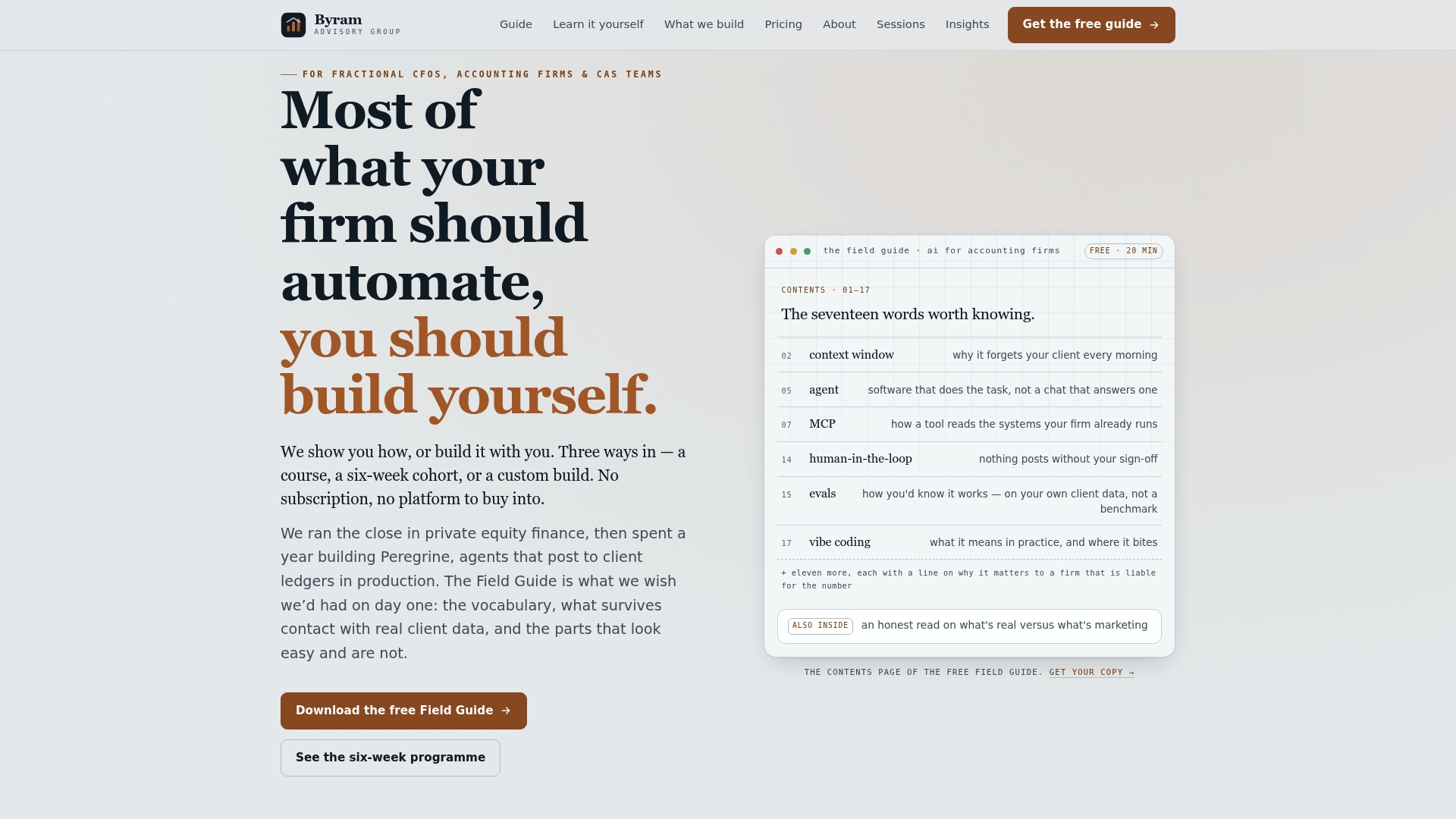
If you want to get started without hiring anyone, our Field Guide to AI for Accounting Firms walks through the automation projects most likely to close your biggest gaps first.
For teams that want structured training, our Bootcamp walks your staff through building and maintaining these controls hands-on. For firms that want a fixed-scope build instead, The Sprint delivers a prioritized set of automated workflows, reconciliations, approval gates, exception alerts, built around your actual risk areas, with the code and process documentation yours to keep. A first engagement typically starts with an assessment of where your controls are thinnest, then moves straight into the quick wins. Visit our homepage to see which option fits where you are right now.
This article is general information, not a substitute for advice from a qualified financial advisor. Consult a qualified financial professional about your own circumstances before acting on anything here.
FAQ
What are the 5 main internal controls?
The five components come from the COSO framework: control environment, risk assessment, control activities, information and communication, and monitoring activities. Small businesses can apply all five informally, through simple documented policies and regular reconciliations, without a formal compliance department.
What are examples of internal controls in accounting?
Common examples include segregation of duties, requiring a second approval above a set payment threshold, monthly bank reconciliations signed by someone other than the preparer, and restricted system access with individual logins. Vendor onboarding reviews and surprise spot checks on expense reports are also widely used compensating controls.
What are the 7 principles of internal control?
Definitions vary by source, but most accounting references group them around separation of duties, authorization and approval requirements, documentation standards, physical and system security over assets, regular independent reviews, proper recordkeeping, and consistent application of these procedures across the business.
What types of internal control are used in financial accounting?
Controls are generally grouped into preventive controls (segregation of duties, approval limits, access restrictions) and detective controls (reconciliations, audit log reviews, surprise spot checks). The ACFE's Report to the Nations found that active detection methods are associated with faster fraud discovery and lower losses than passive methods like tips alone.
Can software replace segregation of duties in a small business?
Software cannot fully replace segregation of duties, but tools like role-based permissions, dual authorization for payments, and positive pay can meaningfully reduce the risk when a team is too small to separate every function. These are compensating controls, not a complete substitute for having more than one person involved in high-risk transactions.
Sources
- COSO Internal Control—Integrated Framework
- ACFE Report to the Nations (2024)
- Operational internal controls — OACP / Penn