

Run a five-phase, owner-assigned month-end close checklist: pre-close, transaction processing, reconciliations, consolidation, and review. Done right, it produces a clean trial balance and a management package ready for signoff within 5 to 10 business days. Skip a phase or leave a task ownerless, and you'll spend the next close cycle chasing the same reconciling items.
The outcome you're building toward is simple to state and hard to fake: a trial balance that ties out, supporting schedules that reconcile to the general ledger, and a management report you'd hand to an auditor without flinching.
Three tasks to lock down before this month's window opens:
- Confirm cutoff dates with AP, AR, and payroll owners in writing, not verbally.
- Finalize payroll processing and confirm the last pay run posted to the correct period.
- Pull bank and credit card statements the moment they're available, even if reconciliation happens later.
Key Takeaways
A defensible month-end close depends on assigning an owner to every task, enforcing cutoffs before processing begins, and archiving evidence as you go, not after.
| Point | Details |
|---|---|
| Run five phases in order | Pre-close, transaction processing, reconciliations, consolidation, and review, each with a named owner. |
| Enforce cutoffs early | Communicate and lock cutoff dates before transaction processing starts to prevent cascading delays. |
| Prioritize by materiality | Reconcile high-value, high-risk accounts first; don't spend equal time on every balance-sheet line. |
| Automate technical schedules first | Lease, deferred commission, and fixed asset rollforwards save the most time when automated. |
| Archive as you close, not after | Attach support to every entry and reconciliation immediately for audit-ready evidence. |
| Consider a custom build for complexity | Byram-advisory's Peregrine platform automates reconciliations and technical schedules for multi-entity, ASC 606/842 closes. |
Table of Contents
- What Is a Month End Close Checklist, and How Is It Structured?
- Pre-Close Checklist: Cutoffs, Subledgers, and Open Items
- Posting Journal Entries: Accruals, Deferrals, and Payroll
- Reconciling Bank, Credit Card, and Balance-Sheet Accounts
- Technical Schedules: Deferred Revenue, Leases, and Fixed Assets
- Consolidation and the Management Reporting Package
- Final Review, Flux Analysis, and Audit-Ready Archiving
- Where Automation Actually Helps During Month-End Close
- How to Build Your Own Checklist Template This Month
- Common Close Mistakes and How to Fix Them
- Copy-Paste Task List: Day-by-Day With Owners
- What Automation Actually Changes About the Close
- Get Help Implementing This Checklist With Byram-Advisory
- Frequently Asked Questions
- Sources
What Is a Month End Close Checklist, and How Is It Structured?
A month end close checklist is a phased task sequence, usually five stages, that moves a company from raw transaction data to a signed-off financial statement package. Each phase has a distinct purpose, a set of owners, and dependencies on the phase before it.
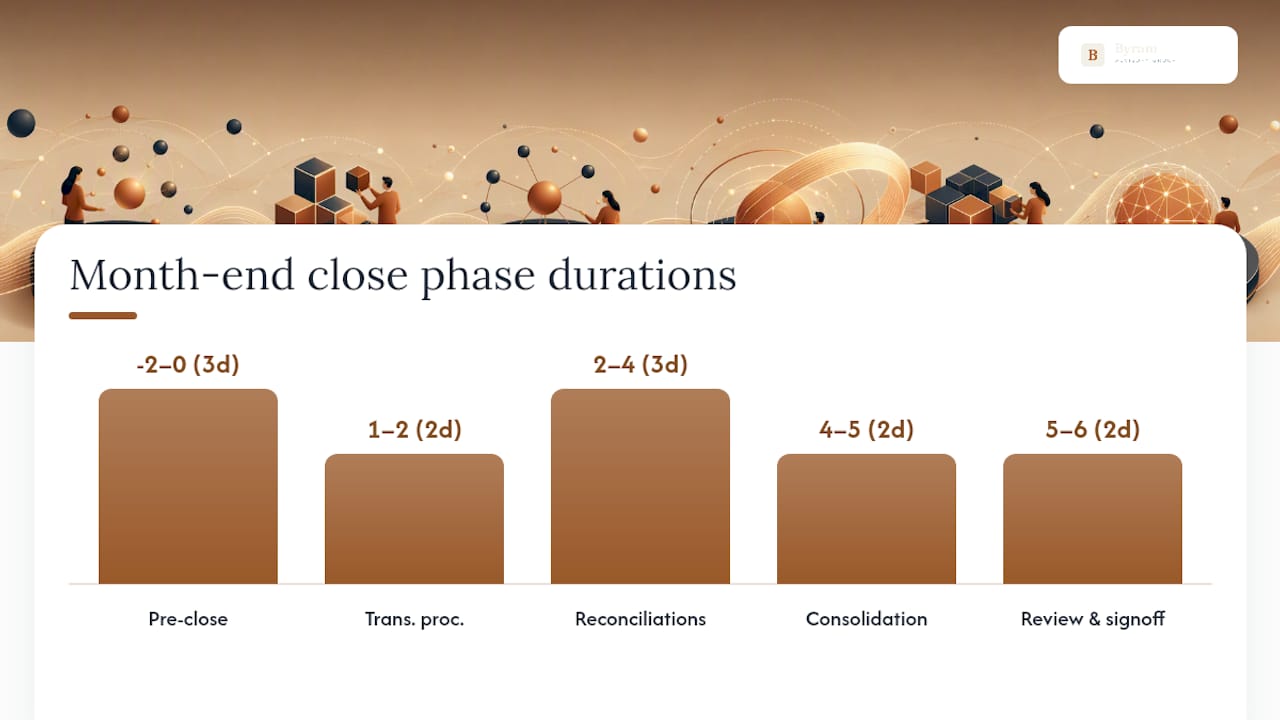
Here's how the phases typically break down across a 5 to 10 day close:
- Pre-close (days -2 to 0): Cutoffs get communicated, subledgers get verified, and open items from last month get reassigned. Owner: controller, with input from AP/AR leads.
- Transaction processing (days 1 to 2): Accruals, deferrals, depreciation, and payroll journal entries get posted. Owner: staff accountant or senior accountant, reviewed by the controller.
- Reconciliations (days 2 to 4): Bank, credit card, and balance-sheet accounts get reconciled against subledgers and bank statements. Owner: accounting manager or dedicated reconciliation lead.
- Consolidation (days 4 to 5): Intercompany eliminations run, currency translation gets applied if relevant. Owner: controller or corporate accounting.
- Review and signoff (days 5 to 6): Flux analysis, management package assembly, and certification. Owner: CFO or controller.
AICPA's best-practice guidance on month-end close points to the same structural insight: standardized templates and clear ownership are what actually shorten the cycle, not just working faster within a chaotic process.
The dependencies matter more than the calendar. You can't reconcile a bank account before the subledger posts, and you can't consolidate before every entity's trial balance is locked. Compressing the calendar without respecting these dependencies just moves the chaos from day 10 to day 4.
Pre-Close Checklist: Cutoffs, Subledgers, and Open Items
The pre-close phase is where most delays actually get created, even though the damage doesn't show up until days later. Three things need to happen before a single journal entry gets posted.
First, verify every subledger feed has actually landed. AP invoices, AR collections, payroll runs, fixed asset additions, and lease schedules all need to hit their respective subledgers before you can trust the numbers flowing into the general ledger.
- Confirm AP has processed all invoices received through the cutoff date, including ones sitting in an approval queue.
- Confirm AR has posted all cash receipts and issued credit memos for the period.
- Confirm payroll has run and posted the correct pay period, including any manual adjustments.
- Confirm fixed asset additions and disposals for the month are logged before depreciation runs.
- Confirm lease additions, modifications, or terminations are reflected in the lease schedule.
Second, cutoffs need to be enforced, not just announced. A cutoff date that lives in an email nobody reread carries no weight. Put it in the close calendar, tag every subledger owner, and treat late submissions as exceptions that require sign-off, not routine.
Third, pull last month's open item log and assign fresh owners with target resolution dates. Open items that roll forward without a name attached to them tend to roll forward indefinitely.
Pro Tip: Build a "soft close" checkpoint two days before your hard cutoff. It catches missing subledger data early enough to fix without blowing the calendar, and it keeps the final close from becoming a scramble.
Posting Journal Entries: Accruals, Deferrals, and Payroll
Transaction processing is where the close either stays on schedule or starts slipping. The goal here is getting every adjusting entry posted, supported, and reviewed before reconciliations start, because reconciling against incomplete journal entries just creates rework later.
Recurring entries, accrued expenses, prepaid amortization, standard depreciation, should be templated and automated wherever your general ledger or close tool allows. These are the entries most likely to get miscoded under time pressure because they're treated as routine when they actually need the same scrutiny as one-off entries.
- Accrue expenses for goods or services received but not yet invoiced, tied to a specific vendor and amount.
- Post depreciation and amortization schedules from your fixed asset and intangible asset registers.
- Reconcile payroll journal entries against the payroll provider's report, not an estimate.
- Post deferred revenue recognition entries tied to the actual delivery or service period, not the invoice date.
Every non-recurring journal entry needs supporting documentation attached at the point of posting, not retrieved later when someone asks. That means an invoice, a calculation worksheet, or a signed approval, linked directly to the entry in your system or workbook.
The most common pitfalls are also the most preventable. Double posting happens when a recurring entry template runs alongside a manual entry for the same accrual. Miscoded entries happen when someone posts to the nearest account instead of the correct one under time pressure. Both get caught by a second reviewer checking entries against a control total before they hit the trial balance, which is why no material journal entry should post without a second set of eyes.

Reconciling Bank, Credit Card, and Balance-Sheet Accounts
Reconciliations are where data integrity either gets confirmed or falls apart. The sequence matters: work from the accounts with the highest transaction volume and highest risk of error toward the ones that rarely move.
- Bank reconciliation first. Match every transaction on the bank statement to the general ledger, flag outstanding checks and deposits in transit, and document the reason for every item still open after three business days.
- Credit card reconciliation second. Match statement transactions to expense coding, catching any personal or misclassified charges before they hit the books permanently.
- Balance-sheet accounts by materiality. Prioritize accounts above your materiality threshold first: accounts receivable, accrued liabilities, and any account with unusual activity this period.
- Intercompany accounts last, but tracked continuously. Match intercompany balances between entities, flag disputes immediately, and set a resolution target of no more than two business days per dispute.
Materiality should drive how much time you spend on each reconciliation, not habit. A $500 discrepancy in a rarely-used account doesn't deserve the same attention as a $50,000 variance in accounts receivable, yet plenty of close processes treat every reconciliation with identical rigor and burn hours on accounts that barely move.
Intercompany differences are consistently the biggest source of consolidation delay in multi-entity environments. When entities book intercompany transactions on different dates or with different amounts, the mismatch doesn't surface until consolidation, by which point it's a fire drill instead of a two-minute fix.
Pro Tip: Don't wait until the reconciliation phase to review flux. Treat variance review as continuous validation, flagging anything unusual the moment a reconciliation surfaces it, so you're not discovering five surprises on the last day.
Technical Schedules: Deferred Revenue, Leases, and Fixed Assets
Some schedules don't fit neatly into a daily reconciliation rhythm, and they're exactly the ones that create the worst delays when neglected. Deferred revenue, deferred commissions under ASC 606, lease accounting under ASC 842, and fixed asset rollforwards all need dedicated, standing schedules that tie out to the general ledger every single month.
Each schedule has a clear owner and a clear tie-out requirement:
- Deferred revenue schedule: must tie to the deferred revenue balance on the balance sheet; owned by revenue accounting or the controller.
- Deferred commissions schedule (ASC 606): must tie to the capitalized commission asset; owned by the controller, reviewed against sales compensation records.
- Lease schedule (ASC 842): must tie to right-of-use asset and lease liability balances; owned by the controller or a dedicated lease accountant.
- Fixed asset rollforward: must tie to gross asset, accumulated depreciation, and net book value; owned by the fixed asset accountant.
Controllers who automate these rollforwards instead of rebuilding them from scratch each month save meaningful processing time, particularly on lease and commission schedules where manual amortization calculations are tedious and error-prone. A rollforward template with a formula-driven amortization schedule updates automatically each month, rather than one rebuilt from a blank sheet. It is the single highest-leverage template in the entire close.
Consolidation and the Management Reporting Package
Consolidation is where individual entity closes become one coherent financial picture, and it's the phase most likely to blow past its scheduled window if intercompany items weren't resolved earlier.
The elimination checklist covers a short but non-negotiable list: eliminate intercompany receivables and payables, intercompany revenue and expense, and any intercompany profit still sitting in inventory. If you operate across currencies, apply your translation policy consistently and document the exchange rate source you used.
The management package itself needs to answer one question for its reader: what happened this month, and why? That means:
- Income statement, balance sheet, and cash flow statement in comparative format (current month, prior month, budget or forecast).
- Key performance indicators tracked consistently period over period.
- Written variance commentary for any line item that moved outside your materiality threshold.
Entity certification closes the loop. Each entity controller or accounting lead signs off that their trial balance is complete and accurate before consolidation runs, and the CFO or controller signs off on the consolidated package before it goes to leadership or the board. Nobody's name goes on a number they haven't reviewed.
Final Review, Flux Analysis, and Audit-Ready Archiving
The review phase is your last checkpoint before the numbers become official, and it deserves more rigor than most teams give it. Flux analysis compares this period's results against last period and against budget, and every variance crossing your materiality threshold needs a documented explanation, not a shrug.

Manual journal entries and material adjustments need a reviewer who wasn't the preparer. That single control, separation between who posts and who approves, catches more errors than any downstream reconciliation ever will.
Archiving is where a lot of otherwise solid closes fall apart under scrutiny. The IRS recordkeeping guidance is explicit that organized, retrievable records are the foundation of defensible reporting, not an afterthought filed away after the fact.
- Archive every reconciliation with supporting statements attached, not just the reconciled balance.
- Retain evidence of reviewer signoff on every material journal entry and adjustment.
- Store variance explanations alongside the flux analysis, not in a separate email thread.
- Keep a change log for any restated or corrected prior-period figures.
A defensible close isn't just accurate numbers. It's evidence links and change logs an auditor can trace without asking you to reconstruct anything from memory, a standard reflected in evidence-collection frameworks like this SOC 2 evidence playbook, which applies the same discipline to compliance audits that a strong close applies to financial ones.
Where Automation Actually Helps During Month-End Close
Automation earns its place in the close when it removes repetitive, low-judgment work while leaving your review controls intact, not when it removes the controls themselves.
The highest-return targets are the tasks that eat hours but require little judgment call to call: bank and credit card reconciliations, recurring journal entries, intercompany matching, and evidence collection for audit files. These are volume problems, not decision problems, which makes them ideal candidates for automation.
When you're evaluating an automation tool or platform, a few questions separate the ones worth adopting from the ones that just add another login:
- Does it integrate directly with your general ledger and subledgers, or does it require manual export and upload?
- Does it preserve a full audit trail showing who changed what and when?
- Can a reviewer override an automated match or entry, and is that override logged?
- Can you export evidence packages in a format an auditor can actually use?
Practical AI applications in the close right now include extracting invoice data directly into AP without manual keying, flagging anomalies in flux analysis that a human might miss until it's too late to fix cleanly, and orchestrating task handoffs so the next owner in the sequence gets notified the moment their dependency clears.
Pro Tip: Automate the schedule with the most rows and the least judgment first, usually fixed asset rollforwards or recurring accruals. It's the fastest way to prove automation's value to a skeptical team before you touch anything requiring real interpretation.
Byram-advisory's Field Guide to AI for accounting firms walks through exactly this kind of sequencing for firms deciding where to start.
How to Build Your Own Checklist Template This Month
A checklist template only works if your team actually maintains it, and that starts with the right columns. At minimum, your workbook needs: task name, owner, due date, status, a clear "done" definition, a link to supporting documentation, and a reviewer signoff field.
- Start from a working example. A structure like this monthly close checklist workbook shows how a day-by-day task list with owners translates into a usable spreadsheet, which is a faster starting point than building one from scratch.
- Map each task to your chart of accounts and entity structure. A single-entity company needs one tab; a multi-entity company needs a tab per entity plus a consolidation tab, with tasks tagged to the specific accounts they touch.
- Build in your export path. If tasks or reconciliations live in a general ledger or close-management tool, set up a routine export so the workbook stays the single source of truth without duplicate manual entry.
Keep the workbook lean. One well-referenced source notes that a shared checklist covering roughly 42 tasks and 18 subledger reconciliations is easier for a team to actually adopt than a sprawling multi-tab system nobody opens past week one.
Pro Tip: Add a "days outstanding" formula next to each open item. A reconciling item sitting for 15 days looks very different from one that's three days old, and the formula surfaces that automatically without anyone checking dates by hand.
Common Close Mistakes and How to Fix Them
Most close problems trace back to the same handful of habits, and none of them require a new tool to fix, just a different default.
Waiting until period-end to start reconciling is the biggest one. Bank and credit card statements are usually available well before the period closes; reconciling continuously catches errors while they're still cheap to fix.
- Scattered documentation: fix by requiring every entry to link its support at the moment of posting, not after the fact.
- Uncategorized transactions piling up: fix by reviewing the uncategorized queue weekly, not monthly.
- No owner on a task: fix by refusing to add a task to the checklist without a name attached to it.
- Skipping the retrospective: fix by running a 15-minute post-close review asking what slipped and why, every single month.
That last one matters more than it sounds. A close process that never gets reviewed for its own failures just repeats them on a monthly loop.
Copy-Paste Task List: Day-by-Day With Owners
This is the sequence you can drop straight into a workbook or close-management tool this month.
Days -2 to 0 (pre-close):
- Confirm and communicate hard cutoff dates to all subledger owners.
- Verify AP, AR, and payroll subledger feeds are complete through the cutoff.
- Finalize payroll processing and confirm correct period posting.
- Pull prior-period open item log and assign new owners with resolution dates.
- Confirm fixed asset additions/disposals and lease changes are logged.
Days 1 to 3 (transaction processing and early reconciliation): 6. Post recurring accrual and deferral journal entries from templates. 7. Post depreciation, amortization, and payroll journal entries. 8. Begin bank and credit card reconciliations as statements become available. 9. Run balance-sheet reconciliations in materiality order. 10. Flag and assign owners to reconciling items over three days old.
Days 4 to 6 (consolidation, review, and archive): 11. Run intercompany eliminations and resolve outstanding disputes. 12. Complete consolidation and apply currency translation if applicable. 13. Run flux analysis and document all variances over threshold. 14. Assemble the management package with statements, KPIs, and commentary. 15. Obtain entity certifications and final CFO/controller signoff. 16. Archive all reconciliations, journal support, and variance documentation.
What Automation Actually Changes About the Close
The biggest misconception about automating month-end close is that it's about speed. Speed is the byproduct. What automation actually fixes is inconsistency, the fact that the same reconciliation gets done three different ways depending on who's covering it that month.
I've seen the same pattern across firms adopting workflow automation for the first time: the close doesn't get dramatically faster in month one. It gets more predictable. The tasks that used to take an unpredictable four to eight hours because of missing documentation or a confused handoff start taking a consistent two hours, because the system enforces the same sequence every time regardless of who's running it.
That predictability is what actually shortens the calendar over two or three cycles, not a single tool swap. If you're weighing where to start, the Field Guide to AI for accounting firms is a reasonable place to begin before committing to a bigger platform decision. Run a 30 to 60 day pilot on your highest-volume reconciliation before automating anything else.
Get Help Implementing This Checklist With Byram-Advisory
A workbook gets you organized. It doesn't fix a close that's slow because reconciliations are manual, subledger data is scattered across disconnected systems, or nobody has real-time visibility into cash until the books are already closed. That's the gap Byram-advisory built Peregrine to close.

Byram Advisory Group builds custom financial workflow automation for fractional CFOs and accounting firms, with Peregrine integrating directly into QuickBooks to automate the repetitive parts of your close, recurring entries, reconciliation matching, and anomaly flagging, while keeping your review controls fully intact. If your close involves multiple entities, ASC 606 deferred commission schedules, or ASC 842 lease accounting, a custom-built workflow tends to save far more time than a generic template ever will. Start with the free Field Guide to AI for accounting firms to see where automation fits your process, then visit Byram Advisory to talk through a tailored bootcamp or a custom build for your team.
Frequently Asked Questions
How long should a month-end close checklist take to complete? Most companies target several business days from period-end to a signed-off management package, depending on entity count and how automated the reconciliation and technical schedules are.
What's the difference between a month end close checklist and a month end closing checklist template? They describe the same thing. The checklist is the task sequence and logic; the template is the actual workbook, in Excel or a close-management tool, where you track owners, due dates, and signoffs against that sequence.
Who should own the month-end close process? The controller typically owns the overall close calendar and final signoff, while subledger owners (AP, AR, payroll, fixed assets) own their respective sections and report status against the shared checklist.
Do small companies need the same five-phase process as large multi-entity firms? The five phases apply at any size, but a single-entity company can compress consolidation to almost nothing, while a multi-entity firm needs dedicated time for intercompany eliminations and currency translation.
What technical schedules most often delay the close? Deferred commission schedules under ASC 606 and lease accounting under ASC 842 are the most common bottlenecks because they require ongoing amortization calculations that are easy to let fall behind if not automated.
Sources
- Recordkeeping | Internal Revenue Service
- Best practices for month-end close | AICPA
- Closing Process (monthly close checklist workbook) | The Wallace Foundation