

Revenue waterfall automation turns contract, billing, and usage events into ASC 606–aligned recognition schedules and audit-ready journal entries without manual spreadsheet rebuilds every close. The primary payoff is speed with defensibility: finance teams cut days off close, catch allocation errors before an auditor does, and produce a time-stamped trail for every recognized dollar. The mechanics of building and governing one follow below.
TL;DR:
- Automated revenue waterfalls require accurate feeding of contract, billing, deferred revenue, recognized revenue, and unknown movement data to ensure reliable recognition schedules.
- Typical failure points include formula brittleness in spreadsheets and loss of traceability, which can cause material errors during audit reviews.
- Embedding consistent modification logic and periodic policy re-evaluation is essential to prevent recognition inaccuracies caused by contract amendments.
- An automation system should integrate contract management, billing, and usage data flows directly into a dedicated recognition engine, not solely rely on ERP modules.
- Building a controlled, human-reviewed process with audit trails and exception queues ensures audit readiness while maintaining control over recognition judgments.
Table of Contents
- What Is a Revenue Waterfall Automation Chart?
- What Data Feeds an Automated Revenue Waterfall?
- How Do You Build an Automated Revenue Waterfall?
- How Should Systems Integrate With the Revenue Engine?
- How Does Automation Map to the ASC 606 Five-Step Model?
- What Pitfalls Cause Revenue Waterfall Errors?
- What Reporting Does Revenue Waterfall Automation Enable?
- How Byram Advisory Implements Revenue Waterfall Automation
- Should You Build, Buy, or Bring in a Consulting-Led Partner?
- Get Revenue Waterfall Automation Built Right the First Time
- Where to Read More on ASC 606 and Revenue Automation
- Sources
- FAQ
What Is a Revenue Waterfall Automation Chart?
A revenue waterfall is the bridge between what a SaaS company sells and what it can legally call revenue in a given period. Bookings represent signed contract value. Billings represent what gets invoiced. Deferred revenue sits on the balance sheet until the company actually delivers the service. Recognized revenue is what shows up on the income statement, and it only moves once a performance obligation has been satisfied under the ASC 606 framework.
Finance teams typically build two flavors of this chart, and mixing them up causes more confusion than any other reporting error in subscription accounting.
- ARR waterfalls track annual recurring revenue movement: new bookings, expansions, contractions, and churn, measured against a run rate metric that GTM teams care about.
- Deferred revenue waterfalls track the accounting recognition schedule: the beginning deferred balance, additions from new billings, the amount recognized in the period, and the ending deferred balance that reconciles to the general ledger.
The two waterfalls answer different questions. ARR tells the board how the business is growing. The deferred revenue waterfall tells the auditor whether the company recognized revenue correctly under the five-step model that KPMG's revenue recognition handbook walks through in detail. Confusing one for the other, or presenting an ARR bridge as if it satisfies GAAP disclosure requirements, is a fast way to fail an audit sample test.
Cadence matters too. Monthly waterfalls suit companies with usage-based components, mid-contract amendments, or multi-element arrangements where recognition timing shifts often. Annual waterfalls work for simpler, flat-fee subscription books where the recognition pattern barely changes month to month. Most growth-stage SaaS companies need monthly granularity at minimum, because a single contract modification mid-quarter can distort quarterly numbers if it is not caught and reallocated on a monthly cycle.
What Data Feeds an Automated Revenue Waterfall?
An automated waterfall is only as reliable as the data feeding it. Before any recognition engine can produce a defensible schedule, five categories of financial movement need to be captured and reconciled to each other.
- Bookings: the signed contract value and terms, sourced from the CRM or contract management system.
- Billings: what was actually invoiced, which can lag or lead bookings depending on billing frequency.
- Deferred revenue: the unearned balance sitting on the balance sheet at any point in time.
- Recognized revenue: the portion earned and moved to the income statement in the period.
- Unplanned movements: credits, refunds, contract amendments, and cancellations that disrupt the standard schedule.
Getting those five categories right depends on integrating the right systems, not just importing a spreadsheet export once a quarter. The CRM supplies contract terms, start and end dates, and any embedded performance obligations. The billing system supplies invoice timing and payment terms. A usage engine, where the business has consumption-based pricing, supplies the metered data that determines how much revenue can actually be recognized in a given period. And the accounts payable or invoicing subledger supplies amendments, which are often the messiest input because they arrive as free-text change orders rather than structured data.
Beyond the transactional feeds, automation needs two configuration layers that many teams underestimate during setup.
The first is standalone selling price, or SSP, reference data. ASC 606 requires that when a contract bundles multiple distinct performance obligations, such as software access plus implementation services plus premium support, revenue gets allocated across those obligations based on their relative standalone selling prices. If a company has never formally documented its SSP methodology, the automation build stalls immediately, because there is nothing to allocate against. EY's guidance on the five-step model stresses that this allocation step requires consistent methodology applied period over period, which means the SSP table needs to be a governed reference dataset, not a one-time spreadsheet exercise, according to EY's financial reporting developments guide.
The second layer is the recognition policy configuration itself: straight-line versus usage-based recognition, the treatment of variable consideration, and the rules for handling ramped contracts or free trial periods. These policies need to be encoded once, tested against real contract samples, and version-controlled so that a policy change in Q3 does not silently rewrite Q1 schedules without an audit note explaining why.
How Do You Build an Automated Revenue Waterfall?
Building a revenue waterfall automation pipeline is a five-stage process: ingest, model, allocate, recalculate, and post. Each stage has a distinct failure mode, and skipping validation at any one of them tends to surface as a reconciliation break three months later, usually right before an audit.
-
Ingest and normalize contract and billing data. Pull structured data from the CRM and billing platform, then parse unstructured elements like order forms and amendment PDFs into canonical fields. Assign every contract a persistent unique identifier that survives renewals, upsells, and system migrations, because losing that identifier is the single most common reason revenue schedules become impossible to trace back to source documents.
-
Model performance obligations and SSP tables. For every contract, break out the distinct performance obligations, whether that is a core subscription, an onboarding service, or an add-on module, and map each to its standalone selling price. This is where most manual processes break down, because analysts tend to shortcut the allocation on complex multi-year deals. Automation should force every contract through the same allocation logic regardless of deal size.
-
Select recognition methods and the variable-consideration approach. Flat subscriptions typically recognize straight-line over the contract term. Usage-based components recognize as consumption occurs. Where a contract includes variable consideration, such as a volume discount that only applies if the customer hits a usage tier, the system needs to estimate that variable amount and apply the constraint under ASC 606, meaning it only recognizes the portion that is probable not to reverse later.
-
Implement modification logic for prospective versus cumulative catch-up treatment. This is the real technical test of any automation build. When a customer upgrades, downgrades, or extends a contract mid-term, the accounting treatment depends on whether the modification adds a distinct good or service at its standalone price (handled prospectively, with no adjustment to prior recognition) or whether it changes the scope of existing obligations (handled with a cumulative catch-up adjustment that restates recognition in the current period). KPMG's handbook is explicit that this determination requires judgment applied consistently, and automation must embed that modification logic rather than leaving it to a manual override every time a sales rep restructures a deal.
-
Generate period schedules and reconcile to the general ledger. Once recognition amounts are calculated for the period, the system generates the schedule and posts corresponding journal entries: a debit to deferred revenue and a credit to recognized revenue for the earned portion, with supporting detail tying each line back to its originating contract. A typical entry might debit deferred revenue $42,000 and credit subscription revenue $42,000 for a monthly tranche of a annual contract, with the contract ID and obligation reference attached to the entry for traceability.
Pro Tip: Run every new contract type, especially unusual bundles or heavily negotiated enterprise deals, through the automation engine in a sandbox before it touches production. If the system cannot correctly allocate a three-way bundle with a mid-term upsell, you want to find that in testing, not in the auditor's sample selection.
Once the schedule is generated, reconciliation is not optional. The ending deferred revenue balance calculated by the waterfall needs to tie exactly to the deferred revenue account balance in the GL. Any variance, even a small one, needs an exception flag and a documented explanation before the books close. Cloud ERP platforms like NetSuite build this reconciliation directly into their reporting layer: NetSuite's Deferred Revenue Waterfall Detail report generates revenue elements and recognition plans that tie deferred balances to the GL automatically, which is the kind of built-in check any automation approach should replicate whether it runs inside an ERP or in a dedicated subledger.
How Should Systems Integrate With the Revenue Engine?
The architecture question that trips up most SaaS finance teams is where the recognition logic should actually live. Piping data directly from billing into the ERP and hoping the ERP's native revenue module handles every edge case works fine for simple flat-subscription businesses. It falls apart the moment usage-based pricing, multi-element bundles, or frequent mid-term amendments enter the picture.
The pattern that scales better is a dedicated revenue subledger sitting between the source systems and the ERP. The subledger ingests contract events from the CRM, billing data from the invoicing platform, and consumption data from the usage engine, then centralizes all recognition rules, SSP tables, and modification logic in one place. The ERP's job narrows to what it does best: posting the resulting journal entries to the GL and supporting financial statement reporting. Zuora's guidance on operationalizing ASC 606 describes exactly this division of labor, noting that a revenue subledger keeps recognition logic centralized while the ERP stays focused on ledger integrity rather than trying to be an accounting rules engine.
Key integration points to design deliberately include:
- CRM to recognition engine: contract terms, renewal dates, and amendment triggers flow in near real time, not on a monthly batch delay.
- Billing platform to recognition engine: invoice data and payment terms sync so billed-versus-recognized variances are visible immediately.
- Usage engine to recognition engine: consumption data feeds recognition calculations for metered or hybrid pricing models.
- Recognition engine to ERP/GL: summarized journal entries post on a defined schedule, with detail-level support retained in the subledger for audit drill-down.
Automated posting needs a reconciliation checkpoint built in, not bolted on afterward. Every automated journal entry batch should generate a reconciliation report comparing the calculated deferred and recognized balances against the prior period plus current-period movements, flagging any variance above a defined threshold for manual review before the entry posts to the GL.
Gartner's survey work found that a large share of organizations expected external audit fees to keep climbing, a trend that puts direct financial pressure on finance teams to reduce audit prep time through better automation and audit-readiness.
Governance is what keeps this from becoming a black box. Every exception, whether it is a variance above threshold, an unusual contract modification, or a manual override, needs to land in an exception queue that a human reviews and signs off on before it clears. Forrester's guidance on evaluating revenue technology makes the case directly: the most effective automation balances AI-driven extraction with human-in-the-loop controls, so finance retains final authority on judgment calls rather than trusting a black-box calculation. Every posted entry should carry a time-stamped audit trail linking it back to the originating contract event, invoice, and any amendment that changed the schedule.
How Does Automation Map to the ASC 606 Five-Step Model?
Automated revenue waterfalls do not replace the ASC 606 five-step model. They operationalize it, turning each accounting judgment into a repeatable, traceable process step rather than an annual spreadsheet reconstruction.
- Step 1, identify the contract: automation ingests signed agreements from the CRM and assigns a canonical contract ID, establishing the record that every downstream calculation traces back to.
- Step 2, identify performance obligations: the system parses contract line items and classifies each as distinct or combined, feeding the obligation-level model described in the build process above.
- Step 3, determine the transaction price: automation calculates total consideration, including any variable elements like usage overages or performance bonuses, and applies the constraint on variable consideration so only the probable, non-reversing amount gets estimated up front.
- Step 4, allocate the price to performance obligations: the SSP reference table drives allocation across bundled obligations, applying the same methodology to every contract regardless of size or complexity.
- Step 5, recognize revenue as obligations are satisfied: the recognition engine applies the configured method, straight-line, usage-based, or milestone-based, to generate the period schedule and post it to the GL.
EY's summary of the five-step model is direct about where judgment persists even with a fully automated pipeline: entities still need to select consistent measurement methods and re-evaluate judgments as business practices change, meaning automation encodes the rules but does not eliminate the need for periodic policy review.
Variable consideration is where automation earns its keep and also where it needs the tightest human oversight. A contract with a usage-based true-up or a rebate tied to annual volume requires an estimate of the variable amount, then a constraint check limiting recognition to the amount unlikely to reverse. Automating the calculation is straightforward. Automating the judgment about whether an estimate is reasonable is not, which is why this step almost always routes through an exception queue for finance review rather than posting on autopilot.
Modification logic is the other place where the five-step model gets tested hardest. A contract modification that adds a distinct service at its standalone price gets treated prospectively, recognized going forward with no restatement. A modification that changes the scope of an existing obligation, like extending a term without adding new deliverables, typically requires a cumulative catch-up adjustment that restates recognition in the current period to reflect the change. Automation needs to correctly classify every modification into one bucket or the other, every time, because misclassifying even a handful of amendments across a large contract book compounds into a material misstatement risk.

What Pitfalls Cause Revenue Waterfall Errors?
The most common failure mode is spreadsheet brittleness. A finance team builds a waterfall model in Excel, it works fine for twenty contracts, and it quietly breaks once contract count crosses a few hundred and formulas start referencing the wrong rows after an insert. The second most common failure is lost traceability: a recognized revenue number on the income statement that nobody can trace back to a specific contract, invoice, or amendment when an auditor asks for support.
Incorrect allocation after modifications ranks close behind. Practitioners consistently find that handling contract modifications correctly, applying prospective or cumulative catch-up treatment, is the real technical test separating a functioning automation engine from a script that only handles clean, unmodified contracts.
The controls that prevent these failures are not exotic:
- Time-stamped audit trail: every recognized dollar links to its originating contract event, invoice, and amendment, with a timestamp showing when the calculation ran.
- Evidence packs: pre-assembled documentation for a sample of contracts, ready to hand an auditor without a scramble.
- Versioned contract records: amendments create a new version rather than overwriting history, preserving the original terms for comparison.
- Sample testing: periodic manual recalculation of a random contract sample to confirm the automated output matches an independent calculation.
Pro Tip: Before trusting an automated waterfall in production, pull ten contracts covering your messiest scenarios, a multi-year deal with a mid-term upgrade, a usage-based contract with a true-up, a bundled arrangement with three obligations, and manually recalculate the recognition schedule by hand. If the automated output matches your manual work on all ten, you have a validated baseline. If it does not, you have found the gap before your auditor did.
What Reporting Does Revenue Waterfall Automation Enable?
Once the recognition engine is running reliably, the reporting payoff extends well past the deferred revenue reconciliation that started the project. Cohort burn-down reports show how a specific signup or contract cohort's recognized revenue decays over its contract term, which helps forecast future recognizable revenue without rebuilding the model from scratch each quarter.
Product-line and GL-account waterfalls break recognized revenue down by product or service line, giving the finance team the same transparency on the P&L that a bookings dashboard gives sales leadership. This matters most for companies with multiple products at different margin profiles, where a single blended revenue number hides which lines are actually driving growth.
- Cohort-level forecasts: project recognized revenue for existing cohorts based on remaining contract terms and historical churn patterns.
- Product-line waterfalls: isolate recognition by product or service category for margin and P&L analysis.
- GL reconciliation reports: automatically compare calculated deferred and recognized balances against posted GL balances every period.
- Scenario forecasts: model the recognition impact of a pending contract amendment, a usage shift, or a pricing change before it happens.
That last use case is where automation shifts from a compliance tool to a planning tool. A finance team weighing a pricing change can run the proposed structure through the recognition engine against the existing contract book and see the recognition timing impact before finance leadership signs off, rather than finding out the effect three months after the change ships.
How Byram Advisory Implements Revenue Waterfall Automation
Most consulting-led automation engagements follow a similar arc: intake and diagnosis, rulebook definition, build and test, then training and handover. Projects often follow a similar structure to ensure SaaS finance teams gain both a working system and the internal capability to run it without permanent vendor dependence.
The engagement typically starts with an intake phase mapping the client's existing contract types, billing platform, and current close process, often surfacing the SSP documentation gap described earlier before any automation work begins. From there, the team builds a recognition rulebook that encodes the client's specific performance obligations, modification treatment, and variable consideration policies, tested against a sample of real contracts before anything touches production.
Deliverables at each milestone typically include:
- A documented recognition rulebook reviewed against ASC 606 requirements for the client's specific contract types.
- A tested automation build integrated with the client's existing accounting platform.
- Training sessions walking the finance team through exception handling, so the humans stay in the loop rather than blindly trusting output.
- A handover package documenting the system logic, so the client owns the resulting code and process intellectual property outright.
That last point separates Byram-advisory's approach from a typical vendor subscription: the client keeps the delivered code and process IP, meaning the system keeps running independently after the engagement ends and can be modified in-house without renegotiating a vendor contract. Every piece of AI-driven automation in the build passes through written process steps, code-level checks, and mandatory human signoff, which is the practical version of the human-in-the-loop control that Forrester identifies as the difference between defensible automation and a black box. Clients working through this model also get access to the free Field Guide to AI for Accounting Firms, which walks through the same implementation logic for teams starting the diagnostic work on their own before engaging further.
Should You Build, Buy, or Bring in a Consulting-Led Partner?
Buying an off-the-shelf platform is fastest when contracts are simple and volume is low, but customization options narrow fast and the recognition logic stays locked inside a vendor's black box. Building in-house gives full control but demands SSP modeling, ASC 606 modification logic, and reconciliation engineering that most controllers do not have staffed. A consulting-led, keep-and-own model splits the difference: an outside team builds the rulebook and integration, then hands over code the client owns outright, so there is no ongoing vendor lock-in once the engagement ends.
The right path depends on three questions. Does the team have engineering capacity to maintain custom logic long-term? Does the contract book include enough modifications and bundled obligations that off-the-shelf allocation rules will not hold up? Is audit readiness urgent enough that a slower internal build is not an option? Two or three "no" answers point toward a consulting-led build. Two or three "yes" answers point toward buying a platform and configuring it internally instead.
— Owen
Get Revenue Waterfall Automation Built Right the First Time
Byram-advisory gives finance teams a way to automate revenue recognition without handing over the recognition logic to a vendor's black box: you keep the code and process IP, so the system keeps running on your terms long after the engagement ends. Every automated step passes through documented checks and human signoff, which matters most the day an auditor asks how a number was calculated.
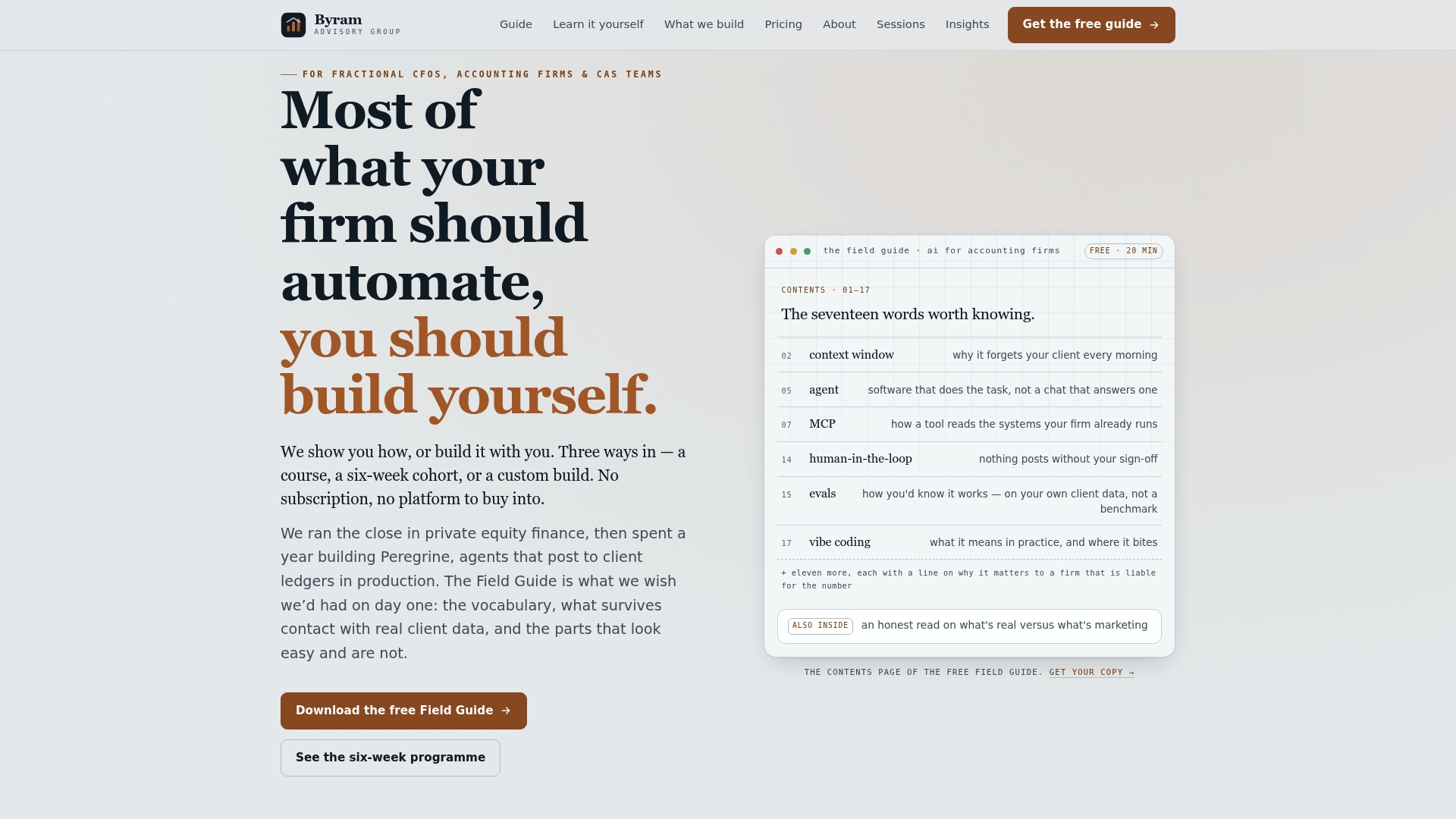
If your contract book is simple and stable, The Field Guide to AI for Accounting Firms is a free starting point for mapping your own SSP tables and recognition policies before you automate anything. If you are ready to move faster, The Sprint is a $2,000 fixed-fee engagement built for teams that need a working automation build without a long procurement cycle. Teams that need their people trained on exception handling and governance alongside the build should look at The Bootcamp for cohort-based training. Whichever entry point fits, the next step is the same: reach out and walk through your contract book so we can tell you exactly what a build would take.
Where to Read More on ASC 606 and Revenue Automation
For readers who want to go deeper on the accounting standard itself or see how other teams have approached automation, these sources cover the ground this article draws from.
- KPMG's revenue recognition handbook for the full ASC 606 five-step model and modification accounting detail.
- Forrester's guide to revenue waterfall functionality for evaluation criteria on automation platforms.
- NetSuite's Deferred Revenue Waterfall Detail report documentation for a working example of ERP-native reconciliation.
- Mastermind Advisor's compliance workflow guide for a related look at audit-readiness workflows for advisory firms.
Sources
- Forrester: revenue waterfall functionality to look for when choosing revenue technology
- KPMG: Handbook — Revenue recognition (Topic 606)
- Oracle / NetSuite: Deferred Revenue Waterfall Detail report
FAQ
What Is a Revenue Waterfall?
A revenue waterfall is a report showing how revenue moves from bookings and billings through deferred revenue to recognized revenue over the life of a contract. It reconciles what a company sold, what it invoiced, and what it can legally recognize as earned in each period under ASC 606.
What Is the Best Software for Revenue Recognition?
There is no single best platform for every company. ERPs with built-in modules like NetSuite's Deferred Revenue Waterfall Detail report suit simpler contract books, while companies with frequent modifications or bundled obligations often need a dedicated revenue subledger or a consulting-led custom build, such as the engagements Byram-advisory delivers through The Sprint.
Do Companies Still Use Waterfall Charts for Revenue?
Yes, revenue waterfalls remain standard practice for SaaS and subscription companies because they are the clearest way to reconcile deferred revenue balances to the general ledger for audit purposes. Most companies have simply moved from manual spreadsheet waterfalls to automated ones to keep pace with contract volume and modification frequency.
What Are the Five Steps in the Revenue Recognition Process?
The ASC 606 five-step model requires identifying the contract, identifying performance obligations, determining the transaction price, allocating that price across obligations, and recognizing revenue as each obligation is satisfied. KPMG's handbook covers each step in detail, including how modifications and variable consideration affect the calculation.
How Much Does Revenue Waterfall Automation Cost to Implement?
Costs vary widely depending on contract complexity and whether a company builds internally, buys a platform, or engages a consulting-led build. Byram-advisory's fixed-fee build engagement, The Sprint, is priced at $2,000, while other services like The Bootcamp and custom build engagements have pricing available on request.