

A rolling cash flow forecast continuously projects cash in and out across a fixed forward window, commonly 13 weeks, and it only works if you update it every week. That weekly roll and variance review is where the value actually lives, not in the spreadsheet template you build on day one. Miss the update and you have a static forecast wearing a rolling forecast's name.
Here's what that means in practice:
- The model always looks 13 weeks ahead, dropping the completed week and adding a new one on the far end.
- Starting cash gets reconciled to the bank every week, not estimated.
- You track actuals against last week's prediction to catch where your assumptions are wrong.
Key Takeaways
A rolling cash flow forecast only delivers value when the 13-week model is updated weekly, with reconciled starting cash and a tested minimum cash target driving every decision.
| Point | Details |
|---|---|
| Definition and default horizon | A rolling forecast continuously projects 13 weeks forward, dropping and adding a week every cycle. |
| Weekly cadence is the discipline | Update actuals, roll the model forward, and log variances every Monday to keep the forecast honest. |
| Lead time drives your response | Breaches inside four weeks need tactical fixes; longer lead time allows cheaper structural moves. |
| Use the direct method | List actual cash receipts and disbursements rather than reconciling from accrual net income. |
| Automation reduces manual drift | Byram-advisory's Peregrine platform integrates with QuickBooks to automate bank pulls and the weekly roll-forward. |
Table of Contents
- What "Rolling" Means and Why 13 Weeks Became the Default
- Why Finance Teams Rely on Rolling Forecasts to Manage Cash
- How To Build a 13-Week Rolling Cash Flow Forecast
- The Weekly Maintenance Cadence That Keeps the Model Honest
- What To Do When the Forecast Flags a Cash Shortfall
- The Mistakes That Quietly Break a Rolling Forecast
- How Automation Closes the Gap Between Forecast and Actual
- Why the 13-Week Model Gets Treated Like a Crisis Tool When It Shouldn't Be
- Byram-advisory Turns the Weekly Grind Into an Automated Routine
- Frequently Asked Questions About Rolling Cash Flow Forecasts
- Sources
What "Rolling" Means and Why 13 Weeks Became the Default
A static forecast gets built once, maybe revised quarterly, and grows stale within a month as actual receipts and payments diverge from the plan. A rolling forecast fixes that by continuously dropping the completed period and adding a new one, so the model never ages past a week old. That's the entire mechanical difference between rolling forecast vs budget thinking: a budget is a fixed target set once a year, while a rolling model is a living tool that answers "where is my cash next Tuesday" with current information.
Thirteen weeks isn't arbitrary. It's roughly one fiscal quarter, long enough to see a slow-paying customer's invoice cycle play out and short enough that the assumptions underneath stay defensible. Go much past 13 weeks and you're guessing at receivables that haven't been invoiced yet. Go much shorter and you lose the runway to act on what you see.
Other horizons still have their place:
- A 4 to 6 week view suits a business already in a liquidity crunch, where every day counts.
- A 12-month monthly projection supports strategic planning, financing rounds, and board reporting.
- Many finance teams run both: a weekly 13-week model for tactical liquidity and a monthly annual view for strategy, side by side, serving different audiences with the same underlying data.
Why Finance Teams Rely on Rolling Forecasts to Manage Cash
The practical payoff of forecasting cash flow this way is lead time. A shortfall that shows up in week 9 of a rolling model gives you nine weeks to fix it: renegotiate terms, draw a credit line, or push a payment. Find out about that same shortfall from your bank balance and you have days, not weeks, so it's crucial to leverage expert procurement insights when renegotiating vendor terms and managing cash outflows.
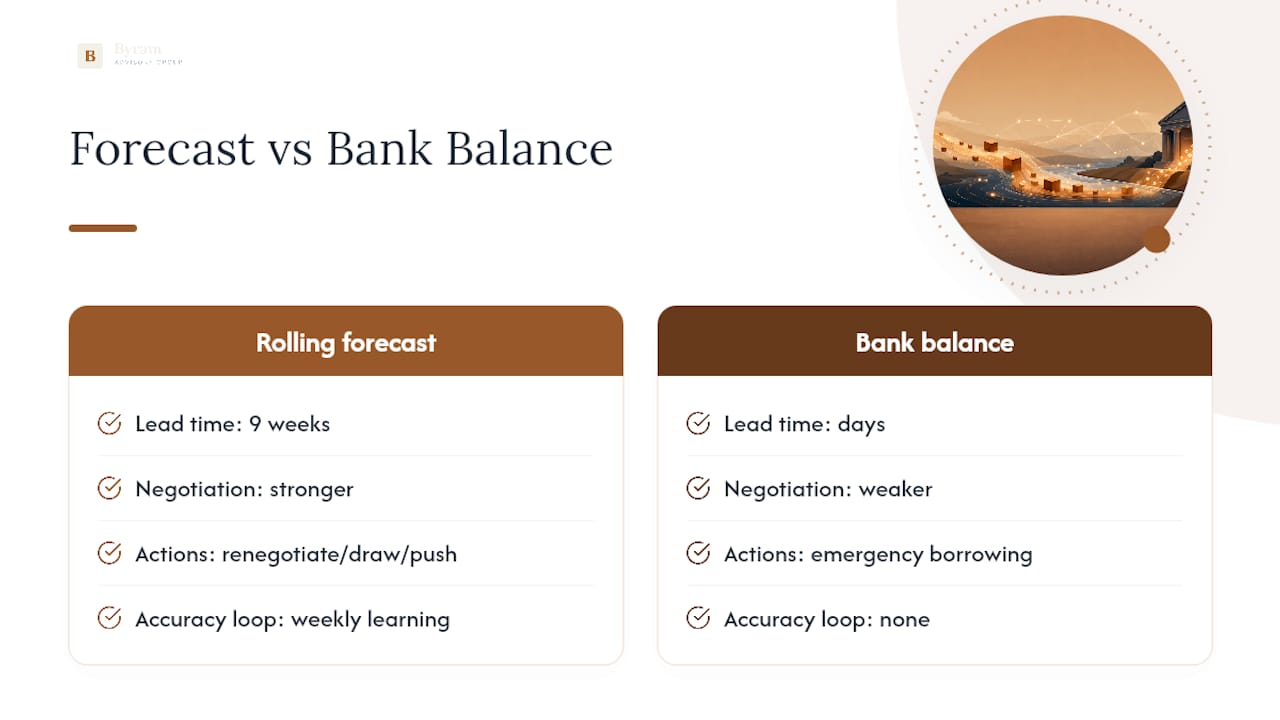
That lead time changes the conversations you have with lenders, too. A business that walks into a bank with a documented, weekly-updated cash position dashboard negotiates from strength. A business that calls a lender in a panic negotiates from weakness, often at a worse rate and under worse terms.
The other underrated benefit is accuracy that compounds. Every week you compare forecast to actual, you learn something about your own payment behavior, how customers really pay versus their stated terms, how vendors really get paid versus your intended schedule. That feedback loop is the single biggest lever for improving cash flow prediction over time, and it's free. You just have to do the work weekly.
How To Build a 13-Week Rolling Cash Flow Forecast
Building the model is mechanical once you know the order of operations. Here's the sequence that holds up in practice.
- Establish reconciled starting cash. Pull your actual bank balance across every operating account, consolidate if you run multiple entities, and exclude reserves or restricted funds that aren't available for operations. This number has to tie to the bank exactly, or every week that follows inherits the error.
- Map inflows from AR aging, not invoice terms. List every expected receipt by week based on when customers actually pay, not when the invoice says they should. If your average customer pays 15 days past terms, model 15 days past terms.
- Map outflows by type and week. Separate fixed costs (rent, payroll, loan payments) from recurring variable costs (utilities, subscriptions) from lumpy one-time payments (quarterly taxes, annual insurance, equipment purchases), and place each in the specific week it hits the bank.
- Build the model structure. Use weekly columns across the 13-week span, with core rows for opening cash, total inflows, total outflows, and closing cash, which becomes next week's opening balance. Add a minimum cash target row, often one to three months of fixed operating expenses, so a breach triggers a visible flag rather than a surprise.
- Document your assumptions. Write down the payment-timing assumption for every major customer and vendor category, so when actuals diverge, you know exactly which assumption to revisit.
Most practitioners build this using the direct method, listing actual cash receipts and disbursements rather than reconciling from accrual net income. It's more granular, but it's what makes short-term liquidity moves visible in the first place.
Pro Tip: Group line items at the decision level, "payroll," "rent," "top five customers," rather than every transaction. A model with 200 line items doesn't get updated weekly. A model with 25 does.
The Weekly Maintenance Cadence That Keeps the Model Honest
The build is a one-time project. The maintenance is the actual job, and it runs on a fixed weekly rhythm. Most teams anchor it to Monday morning, before the week's decisions get made.
- Pull actual bank balances and reconcile against last week's projected closing cash.
- Update AR and AP with anything that shipped, invoiced, or got paid since the last update.
- Convert week 1 from a projection into an actual, permanently.
- Roll the model forward: drop the completed week, add a new week 13, and carry updated assumptions into it.
- Log variances and the reason behind each one.
| Task | Typical Owner | Timing |
|---|---|---|
| Bank balance pull and reconciliation | Treasury or controller | Monday morning |
| AR aging refresh | AR/collections lead | Monday morning |
| AP schedule refresh | AP lead | Monday morning |
| Roll forward and variance log | FP&A or fractional CFO | Monday, midday |
The variance review is where the forecast actually improves. If a customer paid a week later than modeled three weeks running, that's not noise, that's a pattern worth updating in the model permanently.

What To Do When the Forecast Flags a Cash Shortfall
A projected breach of your minimum cash target isn't a crisis by itself. It's a decision point, and the right move depends entirely on how much lead time you have.
- Inside four weeks, act tactically. Accelerate collections on your largest overdue invoices, ask key vendors for a short payment deferral, or draw an existing line of credit. These are moves you can execute in days.
- Between four and thirteen weeks out, act structurally. Renegotiate vendor payment terms, pause discretionary spending before it commits cash, and start lender conversations early rather than waiting until the number turns negative.
- Escalate when tactical moves stop closing the gap. If accelerating collections and pausing discretionary spend still leave a projected shortfall, that's the signal to bring in financing conversations or ownership decisions, not to keep pushing the same levers harder.
The decision rule is simple: shorter lead time means faster, more expensive fixes. Longer lead time means cheaper, more durable ones. The whole point of running the forecast weekly is buying yourself the second kind of option instead of getting stuck with the first.
The Mistakes That Quietly Break a Rolling Forecast
The most common failure is forecasting revenue instead of cash, booking an invoice as money in the bank the day it's issued rather than the week the customer actually pays. The second most common failure is simpler: building the model once and never updating it, which turns a rolling forecast into a static one with better formatting.
A quick diagnostic checklist catches most problems before they compound:
- Does closing cash reconcile to the actual bank balance every single week?
- Are the same line items showing variance three weeks in a row? That's a pattern, not noise.
- Has the minimum cash target ever actually been tested against a real breach scenario?
Pro Tip: If you can't explain why a specific line item moved from last week's forecast, you don't have a forecast problem, you have a documentation problem. Write the "why" down every week.
How Automation Closes the Gap Between Forecast and Actual
The weekly cadence above is non-negotiable, but it doesn't have to be manual. Connected platforms that pull bank balances and refresh AR/AP automatically eliminate the copy-paste errors that creep into hand-built spreadsheets, and they can execute the roll-forward itself, which cuts the single biggest source of forecast drift: someone forgetting to update the model on a busy Monday.
- Automated bank feeds remove manual reconciliation as an error source.
- Direct integration with QuickBooks keeps AR and AP data current without a separate export step.
- Structured platforms make weekly variance review a five-minute check instead of a rebuild.
Pro Tip: If your firm manages this process across multiple client entities, the manual version of this workflow does not scale past a handful of clients before something gets missed.
For finance professionals who want to see the mechanics before committing to a platform, Byram-advisory's free Field Guide walks through the automation logic behind cash flow monitoring for firms managing multiple client books.
Why the 13-Week Model Gets Treated Like a Crisis Tool When It Shouldn't Be
Most firms only pull out a rolling cash flow forecast once things already look shaky, and that's backward. The entire value of the 13-week model comes from running it when nothing is wrong, so the pattern recognition is already built by the time something does go wrong. A forecast built during a crisis has no baseline to compare against. A forecast that's been running for six months has five months of variance data telling you exactly which customer pays late and which vendor invoice always shows up a week early.

The conventional advice treats this as a budgeting exercise, something you build once a quarter and revisit when leadership asks. That framing misses the point entirely. This is an operational rhythm, closer to a weekly ops meeting than a financial planning process. It should feel more like checking inventory than preparing a board deck.
If you're prioritizing one thing first, prioritize the weekly variance review over the initial model build. A mediocre model reviewed every week beats a perfect model reviewed once a month.
Byram-advisory Turns the Weekly Grind Into an Automated Routine
Running a 13-week rolling forecast by hand across several client entities eats hours every single week, hours that come straight out of billable capacity. Byram-advisory built Peregrine specifically for fractional CFOs and accounting firms carrying that exact workload: it connects directly to QuickBooks, pulls bank data automatically, and handles the weekly roll-forward so your team reviews variance instead of rebuilding spreadsheets.
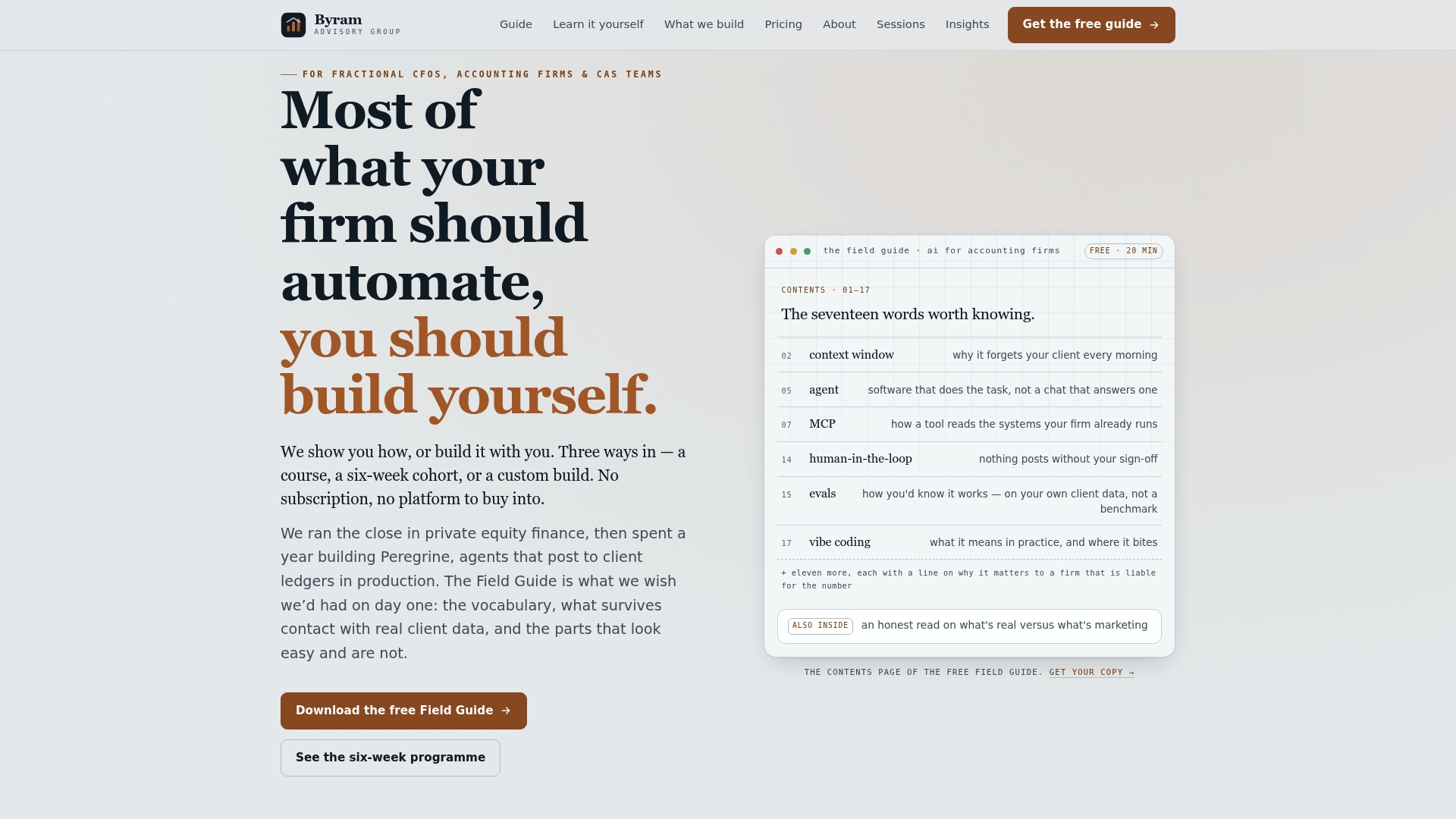
The platform pairs with structured training so your staff can actually run the process independently, not just watch a demo. If you manage cash flow analysis for multiple clients and want to see the mechanics first, start with the free Field Guide to AI for Accounting Firms. If you're ready for hands-on implementation, the DIY AI Implementation Course walks your team through building the automated workflow directly in your own client accounts.
Frequently Asked Questions About Rolling Cash Flow Forecasts
What is a rolling forecast, exactly? A rolling forecast is a cash projection that continuously moves forward, dropping the oldest period and adding a new one at the far end, updated on a fixed cadence rather than left static after the initial build.
How is a rolling budget template different from a regular budget? A rolling budget template updates on a recurring schedule, weekly or monthly, using current actuals, while a traditional budget is set once for a fixed period and rarely revisited until it expires.
Why do most models use 13 weeks instead of a full year? Thirteen weeks roughly matches a fiscal quarter, giving enough time to see a receivables cycle play out while keeping the underlying payment-timing assumptions realistic rather than speculative.
What's the difference between the direct and indirect method for cash flow prediction? The direct method lists actual cash receipts and disbursements by category, which is why practitioners favor it for tactical 13-week liquidity work; the indirect method reconciles from accrual net income and suits longer-range strategic forecasting better.
Can real time cash flow reporting replace a weekly rolling forecast? Real-time reporting shows where cash sits today, but a rolling forecast still requires deliberate weekly assumption updates and variance review, automation speeds up the inputs, it doesn't replace the judgment.
Sources
For deeper procedural detail, see Intuit's 13-week cash flow forecast guide and Beancount's direct-method walkthrough.
- What is the 13-week cash flow forecast?
- How to Build a Rolling Cash Flow Forecast for Your Small Business
- The 13-Week Rolling Cash Flow Forecast: A Direct-Method Guide for Small Businesses