

SaaS metrics automation replaces manual spreadsheet calculations with a governed system that pulls ARR, MRR, churn, and other key performance indicators straight from billing, CRM, and accounting data, then reconciles those numbers to the general ledger. The result is a single set of KPIs finance can defend in a board meeting or an audit, produced in hours instead of days. This article covers which metrics to automate, how the integrations work, a step-by-step rollout checklist, and the controls that keep the numbers audit-ready.
TL;DR:
- Automating SaaS metrics reduces manual effort and ensures data consistency by pulling from billing, CRM, and accounting systems with version-controlled formulas.
- Focus on automating ARR, MRR, and net revenue retention first, as these are critical for board decisions and require accurate reconciliation to the general ledger.
- Integration approaches include direct connectors, revenue subledgers, and data warehouses, with rules-based logic to handle edge cases like discounts and timing differences.
- Proper rollout involves staged testing, reconciliation to accounting, and detailed documentation to prevent definition drift and ensure audit readiness.
- Starting with small pilots or training programs helps avoid common pitfalls such as data hygiene issues and unversioned formulas, leading to more reliable automation.
Table of Contents
- What SaaS Metrics Automation Actually Means for Finance Teams
- Which SaaS Metrics to Automate and Why Each One Matters
- How the Integrations Actually Work
- Implementation Checklist for Rolling Out Metrics Automation
- Reconciliation, Controls, and Audit Readiness
- Common Pitfalls and How to Avoid Them
- Byram Advisory's Approach to Metrics Automation
- Why Most Metrics Automation Projects Underdeliver
- Where to Start: Byram Advisory's Path From Pilot to Full Rollout
- Sources
- FAQ
What SaaS Metrics Automation Actually Means for Finance Teams
Most finance teams already track SaaS performance metrics. The problem is where those numbers live: a dozen tabs, three different formula conventions, and a controller who has to explain every quarter why marketing's churn number doesn't match finance's. SaaS metrics automation solves this by centralizing the calculation logic in one system that reads directly from billing and accounting data.
That distinction matters for anyone building a saas metrics dashboard rather than another spreadsheet. A dashboard pulling live data still needs the underlying automation layer to define terms consistently and refresh them on a schedule. Ideally, this should be tied to your close calendar rather than someone remembering to update a formula.
Which SaaS Metrics to Automate and Why Each One Matters
Not every KPI deserves the same attention; aligning reporting to key business decisions is essential, as explained in structured metric frameworks for marketers. Some drive board decisions, others just tell you whether operations are healthy day to day. A useful automation build separates the two.
Metrics finance leaders bring to the board:
- Annual Recurring Revenue (ARR) should be calculated from the most recent month's MRR multiplied by 12, excluding one-time fees and professional services, according to the SaaS Metrics Standards Board. Multi-year contracts and usage-based pricing need their own handling rules, which is exactly where manual spreadsheets tend to drift.
- Monthly Recurring Revenue (MRR) and its movements (new, expansion, contraction, churned) show the mechanics behind the top-line number.
- Net Revenue Retention (NRR) and Gross Revenue Retention (GRR) separate growth from existing accounts out from new logo growth, a distinction investors ask about constantly.
- Logo churn and revenue churn rarely move together, and reporting only one hides which customers you're actually losing.
Metrics that drive operational monitoring:
- ARPA/ARPU (average revenue per account or user) flags pricing drift before it shows up in a full quarter's numbers.
- CAC (customer acquisition cost) and LTV (lifetime value) frame whether growth spending is sustainable.
- CAC payback period tells you how many months it takes to recover what you spent acquiring a customer.
Board metrics need a slower, more rigorous review cycle. Operational metrics can refresh daily without breaking anything, since nobody is basing a fundraising conversation on Tuesday's ARPA figure.
How the Integrations Actually Work
Automation depends entirely on where the data comes from and how well those systems agree with each other. Four sources typically feed a metrics automation build:
- Billing systems (Stripe, Chargebee, or a custom subscription ledger) supply invoice-level detail and payment timing.
- CRM platforms contribute deal stages, close dates, and account ownership.
- Accounting/GL software, usually QuickBooks for small and mid-sized firms, provides the ledger of record that everything else has to reconcile against.
- Usage or telemetry data matters most for consumption-based pricing models, where revenue recognition depends on actual product usage rather than a flat subscription fee.
Three architectural patterns handle the connections. A direct connector approach wires each source straight into a dashboard, which is fast to set up but brittle when a vendor changes its API. A revenue subledger sits between billing and the GL, recalculating metrics on a defined schedule and posting summarized entries. A warehouse-led approach lands raw data in a central store first, then computes metrics on top of it, which scales better for firms running multiple entities or products.
Whichever pattern you choose, the metric definitions themselves need version control. A formula editor that logs every change, who made it, and when, keeps your ARR calculation from quietly drifting between quarters. Good dashboards compute each metric directly from a source object like an invoice or subscription record, so any number can be traced back to where it came from, a principle Definite's guidance on reconciled dashboards lays out clearly.
Edge cases are where most automation projects stumble: one-off invoices that shouldn't count toward MRR, mid-cycle discounts, and timing differences between when a deal closes in the CRM and when billing actually starts.
Pro Tip: Build your exclusion rules (one-time fees, professional services, credits) before you connect a single data source. Retrofitting exclusion logic after metrics have been running for two quarters means restating numbers you already presented to the board.
Implementation Checklist for Rolling Out Metrics Automation
Rolling out SaaS metrics automation works best as a sequence, not a single big-bang deployment.
- Discovery. Inventory every data source, assign an owner to each one, and pull sample data to see how messy the raw numbers actually are.
- Define. Write down the exact formula for each metric, including what's excluded and how timing differences get handled. Treat this like documentation an auditor could read cold.
- Integrate. Connect the sources, set up reconciliation rules, and map customer IDs consistently across billing, CRM, and the GL so a single account doesn't fragment into three records.
- Test. Run the new calculations in shadow mode alongside your existing spreadsheets. Tie every output back to billing and GL balances, and document every discrepancy you find and fix.
- Rollout. Deploy in stages, starting with one metric or one business unit, and require signoff before the numbers replace the old process entirely.
- Measure. Track time-to-close, the number of reconciliation exceptions per cycle, and whether reporting accuracy actually improved against your baseline.
Pro Tip: Run the shadow-mode test for at least one full close cycle, not a few days. Timing differences between billing and revenue recognition often only surface at month-end, exactly when you need the numbers to be right.
Reconciliation, Controls, and Audit Readiness
Automated metrics only earn trust when they tie out to numbers your auditors already recognize. Every KPI should reconcile to two anchors: the billing system's invoice totals and the GL balances in QuickBooks or your accounting platform. If ARR doesn't match what billing actually collected, minus timing adjustments you can explain, something in the logic is wrong.
Automated revenue reconciliation replaces manual matching with a rules engine that compares billing, usage, and GL entries against each other, letting accounting teams spend their time on the exceptions rather than the routine matches, according to Zuora's guide to automated reconciliation. That shift, from processing every transaction to reviewing only the mismatches, is where most of the time savings in month-end close actually come from.
A defensible setup includes:
- Automated journal entry generation for recurring revenue postings, with a clear audit trail back to the source invoice.
- Exception routing with a defined SLA, so a mismatch doesn't sit unresolved for a week.
- Versioned metric definitions that show exactly when a formula changed and why.
- Calculation logs and approval records an auditor can review without asking you to reconstruct anything from memory.
ASC 606 revenue recognition rules should inform how your automation handles multi-element contracts and usage-based pricing, since misapplying recognition timing is one of the fastest ways to produce an ARR number that looks clean but doesn't hold up to scrutiny.
Common Pitfalls and How to Avoid Them
The most common failure isn't a broken integration. It's definition drift: someone quietly changes how churn is calculated in one dashboard, and six months later finance and sales are reporting different numbers with total confidence in both.
- Definition drift creeps in when metric formulas aren't version-controlled or reviewed on a schedule.
- Poor data hygiene, duplicate customer records or inconsistent IDs across systems, breaks reconciliation before it even starts.
- Skipping reconciliation to save time during rollout guarantees you'll find the errors later, at a worse moment.
- Scoping too large a rollout at once makes it nearly impossible to isolate where a calculation went wrong.
Pilot a small cohort first: one product line or a subset of customers. Require ledger tie-out before any metric goes live company-wide, assign a clear owner (a metric-owner RACI works well) for each KPI, and schedule a recurring review of every formula. Fix customer-impacting metrics like churn and NRR before you polish operational depth on secondary numbers.
Byram Advisory's Approach to Metrics Automation
Some firms build automated financial processes for fractional CFOs and accounting teams, combining custom-built tools with educational resources so firms can actually run what gets built. That pairing matters: a tool without training gets shelved after the first staff turnover.
The firm's platform, Peregrine, integrates directly with accounting software like QuickBooks to automate repetitive reporting tasks while keeping a human in the loop on every calculation. Clients may get detailed reporting, real-time cash flow monitoring, and a structured financial overview built to hold up under external scrutiny, whether that's an auditor, a lender, or a potential acquirer.
For firms that want to see the approach before committing to a build, Byram publishes a free Field Guide covering practical steps for implementing this kind of automation, along with tailored training programs for teams that need hands-on implementation support.
Why Most Metrics Automation Projects Underdeliver
The conventional advice on this topic treats metrics automation as a software problem: buy a dashboard tool, connect a few APIs, done. That framing is backwards. The hard part isn't the connection between Stripe and a chart. It's deciding, in writing, what counts as churn, what gets excluded from ARR, and who signs off when a definition needs to change. Skip that step and you've automated inconsistency, just faster than a spreadsheet could produce it.
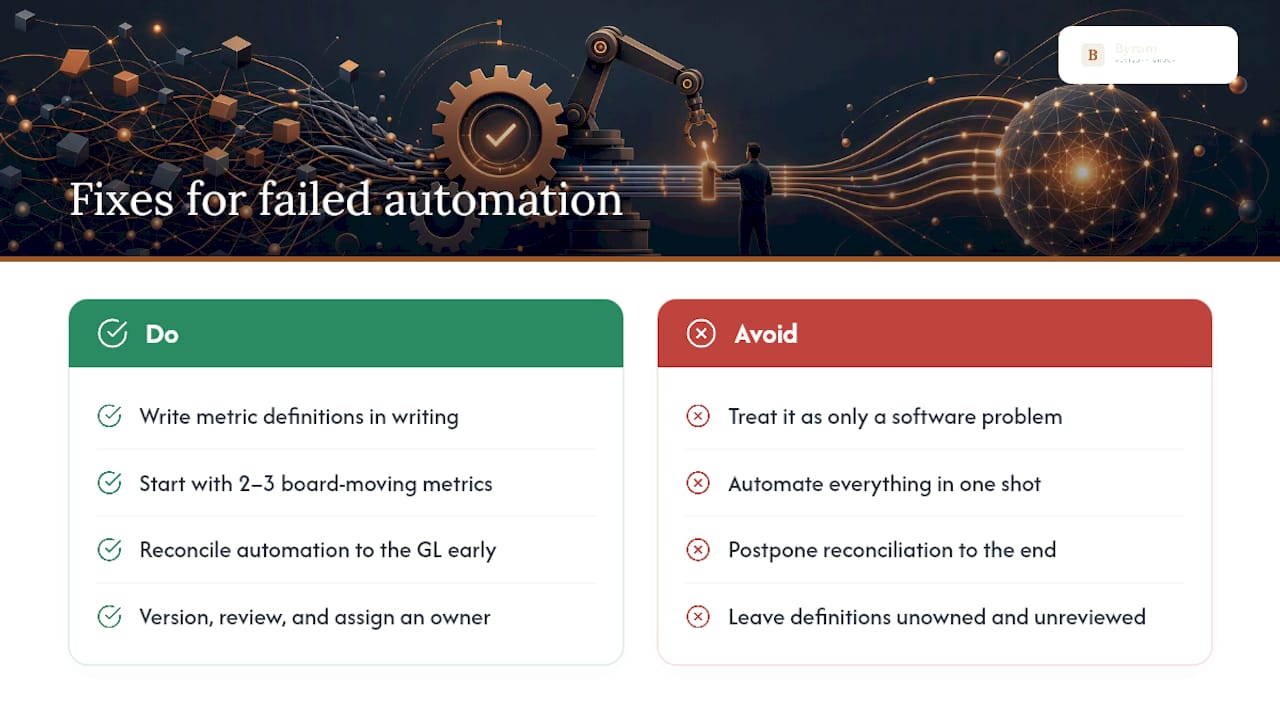
I'd also push back on the instinct to automate everything in one shot. Finance teams that succeed here start with the two or three metrics that actually change board decisions, ARR and NRR usually top that list, and get those bulletproof before touching anything operational. Reconciliation to the GL isn't a nice final step either. It's the test that tells you whether the automation is trustworthy at all, and it belongs early in the build, not at the end when restating numbers is expensive and embarrassing.
The teams that get the most value treat metric definitions the way engineers treat code: versioned, reviewed, and owned by a specific person. Everyone else just moves the spreadsheet problem into a nicer interface.
— Owen
Where to Start: Byram Advisory's Path From Pilot to Full Rollout
Some firms offer alternatives to hiring additional analysts or managing quarterly spreadsheet fire drills, with solutions that depend on internal capacity. If you need a fast, contained pilot to prove the concept, The Sprint is a $2,000 one-off engagement built for exactly that: a rapid automation build focused on one metric set or one business unit, not a months-long implementation.
If your team needs to build internal skill rather than outsource the whole project, The Bootcamp is a cohort-based training program that walks finance staff through implementing this kind of automation themselves. For firms weighing a full custom build, a reconciliation cleanup, or ongoing platform access through Peregrine, Byram's core offerings cover the Close teardown, The build, and the Base and Plus platform plans.
Not ready to commit to an engagement yet? Start with the free Field Guide for the practical framework, or explore the DIY AI Implementation Course for Accounting Firms at $500 if you'd rather learn the build process at your own pace before bringing in outside help.
Sources
- Annual Recurring Revenue (ARR) - Standards Document (V 1.0 - Published)
- Automated Revenue Reconciliation: Eliminating The Spreadsheet Nightmare - Zuora
FAQ
What Is SaaS Metrics Automation?
SaaS metrics automation is a system that calculates KPIs like ARR, MRR, and churn directly from billing, CRM, and accounting data, then reconciles those numbers to the general ledger. It replaces manual spreadsheet formulas with a governed, versioned calculation layer, as described in Definite's dashboard reconciliation guidance.
How Is ARR Calculated Correctly?
ARR should be calculated from the most recent month's MRR multiplied by 12, excluding one-time fees and professional services revenue, per the SaaS Metrics Standards Board. Multi-year contracts and usage-based pricing require additional handling rules to avoid overstating the number.
Which SaaS Metrics Should Be Automated First?
Start with the metrics that drive board decisions and reconciliation risk: ARR, MRR movements, and net revenue retention. These carry the most scrutiny and the most damage if they're wrong, so they should be automated and reconciled to the GL before operational metrics like ARPA or CAC payback.
How Does Automation Improve Audit Readiness?
Automated systems keep versioned metric definitions, calculation logs, and approval records that show exactly how a number was produced and who signed off on it. That audit trail, combined with tie-outs to billing and GL balances, is what separates a defensible KPI from a spreadsheet number nobody can reconstruct months later.
What Does Byram Advisory Offer for Getting Started?
Byram Advisory offers a free Field Guide for self-directed learning, a $500 DIY AI Implementation Course, a $2,000 Sprint engagement for a fast pilot, and The Bootcamp for teams that want cohort-based training. Custom builds and platform access are available through Byram's core service pages.