

Transaction anomaly detection flags bookkeeping errors before they become audit adjustments: duplicate deposits, mispostings, misdated journal entries, and reconciliation mismatches inside systems like QuickBooks. If you're running month-end close for multiple clients, start small. Pilot automated detection on bank reconciliations and recurring journal entries first, since automation flags and documents the exception, but a human still signs off before anything touches the ledger.
TL;DR:
- Automate anomaly detection on high-volume, rules-based exceptions such as bank reconcilings and recurring journal entries first to quickly reduce manual rework.
- Ensure master data is accurate and consistent before deploying detection rules, as misclassification and duplicates often stem from poor data quality.
- Measure rule effectiveness through metrics like false positive rate, alert aging, reviewer acceptance, and time-to-resolution to prevent alert fatigue and build trust.
- Start small with phased rollouts for a manageable scope, using flagged items with documented approval workflows, and expand gradually based on stable metrics.
- Use manual checks and basic statistical techniques for journal-entry testing, focusing on timing, dollar impact, and author roles, with automation acting as a continuous oversight layer.
Table of Contents
- What Counts as a Transaction Anomaly (and What Doesn't)
- Why Anomaly Detection Matters for Month-End Close
- A Phased Roadmap for Implementing Anomaly Detection
- Measuring Whether Your Detection Rules Are Actually Working
- How Byram Advisory Group Approaches This
- Journal-Entry Testing Deserves Its Own Attention
- Master-Data Assurance Catches the Errors Rules-Based Alerts Miss
- What Successful Implementations Actually Look Like
- What the First Two Years Usually Look Like
- Get Started With a Guided Anomaly-Detection Pilot
- Sources
- FAQ
What Counts as a Transaction Anomaly (and What Doesn't)
A transaction anomaly, in the bookkeeping sense, is any entry that breaks the expected pattern of your general ledger. Think duplicate bank feed transactions pulled in twice after a reconnection, deposits that never matched an invoice, journal entries posted on a Sunday at 2 a.m. by someone who's never posted a journal entry before, or expenses coded to the wrong class right before a client's board meeting. These are data-integrity problems, not criminal ones.
This is worth stating plainly because the phrase "anomaly detection" gets used elsewhere for something different: machine-learning systems that flag potentially fraudulent credit-card charges or suspicious payment activity for banks and payment processors. That's a separate discipline built for a separate audience. This article is about the errors that live inside your own books, not transactions moving through someone else's payment rails.
The data sources that matter here are the ones you already touch every close: bank feeds, accounts receivable and payable aging, journal-entry exports, and the master-data fields (customer names, class lists, chart-of-accounts mappings) that determine how a transaction gets classified in the first place. Anomaly detection for close purposes works across all four, and weaknesses in any one of them will show up as noise in the others.
Why Anomaly Detection Matters for Month-End Close
Catching a misclassified transaction on day two of close is a two-minute fix. Catching it after the financials go to the client, or worse, after an auditor pulls the sample, turns into a restated report and an uncomfortable conversation. Anomaly detection is fundamentally a timing tool: it moves error discovery earlier in the close cycle, which is where every controller wants it.
Reconciliation quality is the clearest link here. A clean bank reconciliation is one of the most basic internal controls a firm can run, and unresolved reconciling items are exactly what tends to surface in a lightweight financial review or a lender's request for supporting schedules.
SAPinsider's 2025 research on the record-to-report process found that many finance teams rank reconciliation management and journal-entry management as top automation targets — yet only a minority had automated most of their recording tasks. That gap between where teams want automation and where they've actually deployed it is precisely the opening a phased anomaly-detection pilot fills.
A Phased Roadmap for Implementing Anomaly Detection
Trying to automate everything at once is how these projects stall. A phased rollout, moving from the highest-volume repeatable exceptions toward more nuanced judgment calls, gets you a working system faster and with fewer false starts.
- Scope the highest-volume exceptions first. Reconciliations and recurring journal entries generate the most repetitive, rules-friendly exceptions, and they're the same two areas SAPinsider's survey respondents flagged as their top automation priorities. Start there, not with the exotic edge cases.
- Clean your master data and feeds before automating. A detection rule built on top of inconsistent class names or duplicate vendor records will just automate the mess faster. Fix your chart-of-accounts mapping and vendor/customer master lists first.
- Build detection rules around known failure modes. Duplicate transactions, rounding discrepancies, postings on holidays or weekends, and entries authored by someone outside the normal approval chain are the classic starting rules, and they catch a large share of real errors with relatively little tuning.
- Route every flagged item into a review queue with required metadata. Each alert needs to carry the source transaction, the rule that fired, and a required approver field. No alert should be able to close itself out silently.
- Write a remediation playbook and document every resolution. Every anomaly that gets cleared needs a paper trail showing what was found, who reviewed it, and what changed, because that evidence chain is what makes the close defensible later.
Inside QuickBooks itself, this looks less abstract than it sounds. Use bank feed matching instead of blindly adding transactions, keep an eye on the Undeposited Funds account so deposits don't get double-counted, and run your reconciliation routine on a fixed schedule rather than whenever there's time. When you need to test a broader population of journal entries, QuickBooks Support's own reconciliation troubleshooting guidance walks through exactly how to isolate and fix mismatches at the end of a reconciliation period. Exporting journal entries to Excel for targeted testing is still one of the most reliable ways to spot patterns that a dashboard alert might miss.
Pro Tip: Set up a standing rule that flags any bank feed transaction imported twice within the same date window. Duplicate imports after a bank reconnection are one of the most common, and most preventable, sources of reconciliation headaches in QuickBooks.
Measuring Whether Your Detection Rules Are Actually Working
An anomaly detector that fires constantly and gets ignored is worse than no detector at all, because it trains your team to click past every alert. Track these metrics from week one:
- False positive rate — how many flagged items turn out to be legitimate transactions.
- Unresolved alert aging — how long flagged items sit in the queue before someone acts.
- Reviewer acceptance rate — the percentage of flags your team agrees are real issues.
- Time-to-resolution — how long it takes from flag to documented fix.
- Reduction in manual postings — whether the automation is actually cutting rework, not just adding a review step on top of it.
The SAPinsider research supports a narrow pilot first, then expansion only after the metrics above look stable. That's the opposite of rolling detection out firm-wide on day one.
For journal-entry testing specifically, borrow from audit methodology. The Journal of Accountancy's guidance on journal-entry testing walks through recalculating trial balances, sampling by dollar impact, flagging rounded-number entries, and applying Benford's Law to spot digit patterns that don't match natural transaction distributions. These aren't exotic techniques. They're spreadsheet-level checks any controller can run.
Governance matters as much as the metrics. The GAO's Green Book frames internal control as a mix of preventive controls (stopping errors before they post) and detective controls (catching them after), and a mature anomaly-detection program needs both, with clear documentation of which control covers which risk.
How Byram Advisory Group Approaches This
Byram Advisory Group builds automation specifically for fractional CFOs and accounting teams who are running close for multiple clients without a full in-house engineering staff behind them. The firm's platform integrates with accounting software to assist with repetitive parts of the detection workflow, such as matching, flagging, and routing, while ensuring human review for every ledger change.
A few things worth knowing about how this works in practice:
- The platform supports automation of repetitive reconciliation and journal-entry checks without removing oversight from the process.
- Users benefit from detailed reporting and real-time cash flow monitoring to help prepare numbers for external scrutiny.
- Byram Advisory Group's blog publishes practical guidance on finance automation, including posts on boosting team productivity with AI and using agentic workflows in accounting teams.
- A free Field Guide and structured training programs walk firms through implementation step by step, rather than dropping a tool on your desk with no onboarding.
The throughline across all of it is that automation handles the pattern-matching, and your team keeps the signoff authority. That's not a limitation. It's what keeps the resulting books defensible when someone outside the firm asks to see them.
Journal-Entry Testing Deserves Its Own Attention
Journal entries are where the most consequential anomalies tend to hide, because unlike a bank transaction, a journal entry can move money between any two accounts with almost no natural constraint. That flexibility is exactly why auditors treat journal-entry testing as a distinct discipline rather than folding it into general reconciliation review.
Effective testing starts with population completeness. Before you can test journal entries for anomalies, you need confidence that you're looking at all of them, not a filtered export that quietly dropped system-generated entries or year-end adjustments. From there, the Journal of Accountancy's testing framework recommends layering several checks: recalculating trial balances to confirm the population ties out, isolating entries posted outside normal business hours, flagging round-dollar amounts that suggest estimates rather than actual transactions, and sampling high-dollar entries regardless of who posted them.
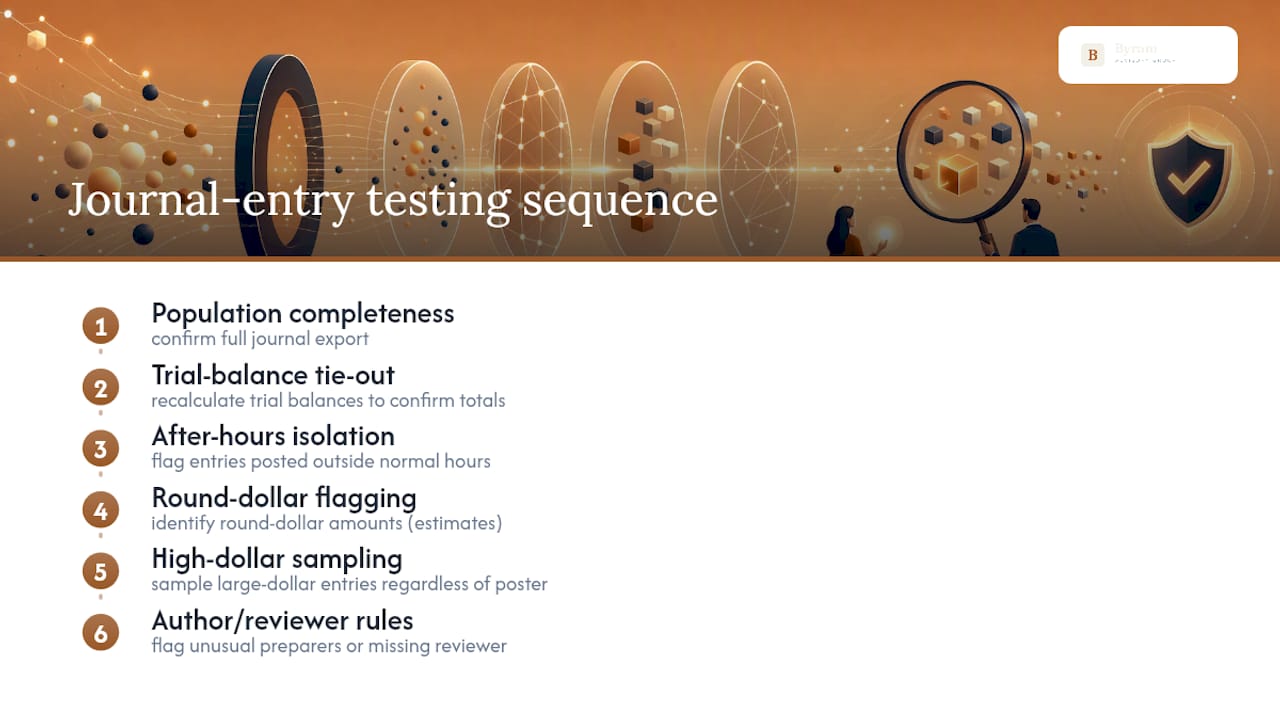
Author-based rules add another layer. An entry posted by someone whose normal role doesn't involve journal entries, or a first-time preparer working without a second reviewer, deserves a closer look even if the dollar amount is unremarkable. None of this requires exotic statistical software. A controller with Excel, a clean journal-entry export, and twenty minutes can run most of these checks manually, and an automated system just runs them continuously instead of once a quarter.
Master-Data Assurance Catches the Errors Rules-Based Alerts Miss
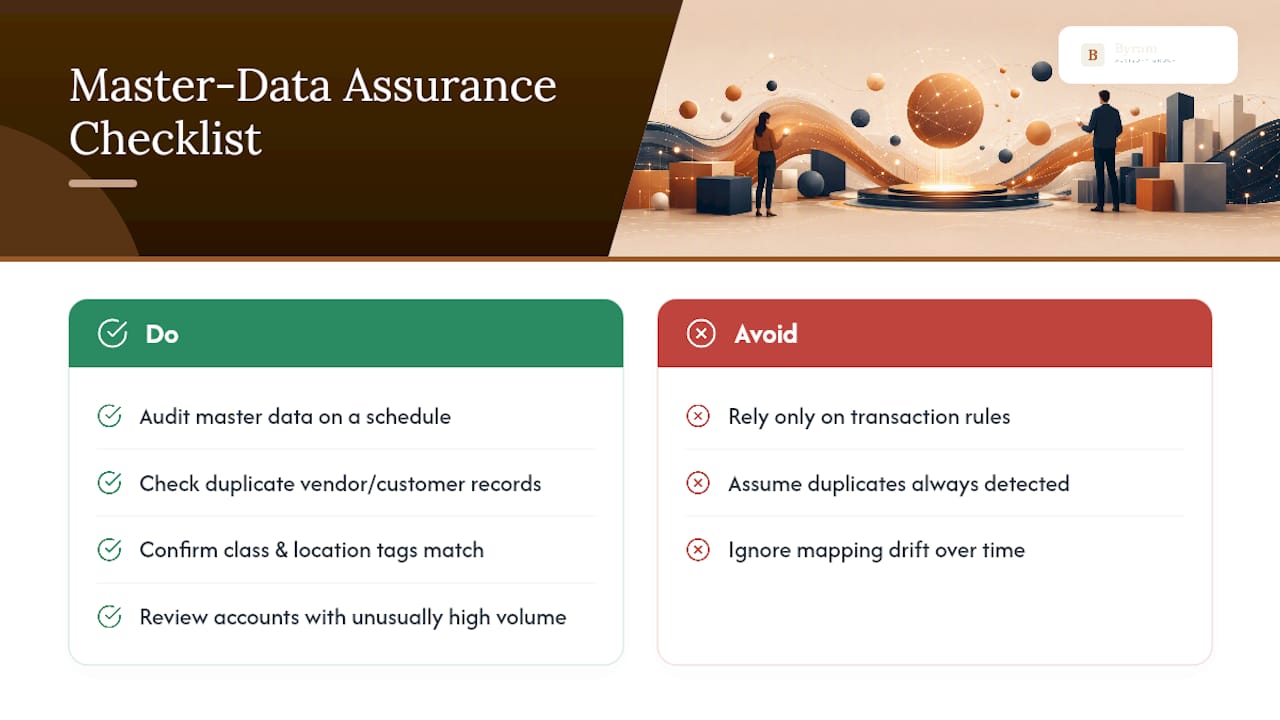
Master data is the quiet infrastructure underneath every transaction: your chart of accounts, customer and vendor lists, class and location tags, and the mapping rules that decide where a transaction lands. When master data drifts, every downstream anomaly-detection rule inherits the drift.
Classification anomalies are the most common symptom. A vendor gets set up twice under slightly different names, splitting spend history across two records and making it look like two smaller vendors instead of one significant relationship. A class gets renamed mid-year, and now your prior-period comparisons are comparing different buckets without anyone realizing it. An expense account gets used as a catch-all because nobody remembers the correct mapping, and by month six it's a black box.
Master-data assurance means auditing these structures on a schedule, not just when something looks wrong. Check for duplicate vendor or customer records, confirm class and location tags haven't drifted from their original definitions, and review any account with unusually high transaction volume relative to its historical pattern. This work is less glamorous than building detection rules, but skipping it undermines every rule you build on top of it. A duplicate-detection rule can't catch a duplicate vendor if the two records have different spellings; that's a master-data problem, not a transaction problem, and it needs its own review cycle.
What Successful Implementations Actually Look Like
The firms that get real value from anomaly detection almost always start narrower than they'd like to. A controller running close for a dozen client entities doesn't try to build detection coverage across every account category at once. They pick the two or three exception types generating the most manual rework, usually duplicate bank feed entries and unmatched deposits, and build rules for those first.
The pattern that separates a working rollout from a stalled one is the review loop. Firms that route every flagged item through a queue with a required approver and a documented resolution build a track record fast: within a few close cycles, they can point to a shrinking pile of manual adjustments and a reconciliation process that closes faster than it used to. Firms that skip the queue and let the software auto-resolve low-risk flags tend to lose visibility into what's actually being caught, and that erodes trust in the system just as fast as it built it.
The QuickBooks-specific fixes for duplicate bank-feed transactions, disconnecting redundant bank connections, preferring "match" over "add," and tightening the import date window, are a good example of a small, mechanical fix that prevents a recurring anomaly rather than just detecting it after the fact. That's the difference between a detective control and a preventive one, and the strongest implementations use both.
What the First Two Years Usually Look Like
Year one tends to bring fewer duplicate postings, faster reconciliations, and less time spent on manual cleanup before reports go out. Year two is where the harder work happens: harmonizing master data across entities, expanding detector coverage into new account categories, and improving cross-entity consolidation. The most common pitfalls are automating too fast, ignoring reviewer pushback on rules that generate noise, and building alerts without a real audit trail behind them.
— Owen
Get Started With a Guided Anomaly-Detection Pilot
Byram Advisory Group builds the anomaly-detection roadmap in this article into working systems, and clients keep the code and process documentation afterward, so the setup runs independently rather than locking you into an ongoing vendor relationship. Every automated flag still passes through written process steps and a mandatory human signoff, which is what keeps the resulting books defensible under outside review.

If you want the checklist version of everything above before committing to anything, download the free Field Guide to AI for Accounting Firms. For firms ready to move faster, The Sprint is a $2,000 tactical engagement built to pilot anomaly detection on your highest-volume exceptions within weeks, not quarters. Teams that need staff training and change management alongside the tooling should look at The Bootcamp, a cohort-based program for firms rolling this out across multiple client accounts at once. If you'd rather start with a diagnostic, request a Close teardown through the Byram Advisory Group site to see exactly where your current close process is generating avoidable rework.
Sources
- Automating the record-to-report & financial close process — SAPinsider (2025)
- Standards for Internal Control in the Federal Government (Green Book) — GAO
- Journal entry testing using Excel — Journal of Accountancy (2021-11-01)
- Fix issues at the end of a reconciliation in QuickBooks Online — QuickBooks Support
FAQ
What Is Transaction Anomaly Detection in Accounting?
It's the practice of automatically flagging bookkeeping errors, like duplicate transactions, misdated journal entries, and reconciliation mismatches, inside systems like QuickBooks. It focuses on data integrity within your own books rather than payment or credit-card fraud.
How Is This Different From Fraud Detection?
Fraud detection uses machine learning to flag suspicious payment activity for banks and processors, while bookkeeping anomaly detection flags internal ledger errors like duplicate postings or misclassified accounts. The two solve different problems for different audiences.
What Should I Automate First?
Start with reconciliations and recurring journal entries, since SAPinsider's 2025 survey found 56% of finance teams rank reconciliation management as a top automation target. These areas generate the highest volume of repetitive, rules-friendly exceptions.
How Do I Know if My Detection Rules Are Working?
Track your false positive rate, unresolved alert aging, and reviewer acceptance rate over several close cycles. If reviewers are consistently agreeing with flagged items and the backlog isn't growing, the rules are earning their place.
How Does Byram Advisory Group Help With This?
Byram Advisory Group's Peregrine platform connects to QuickBooks to automate reconciliation and journal-entry checks while keeping human signoff on every ledger change. Pricing for services like The Bootcamp and The build is available directly on the Byram Advisory Group site, and The Sprint is listed at $2,000 for a tactical pilot engagement.